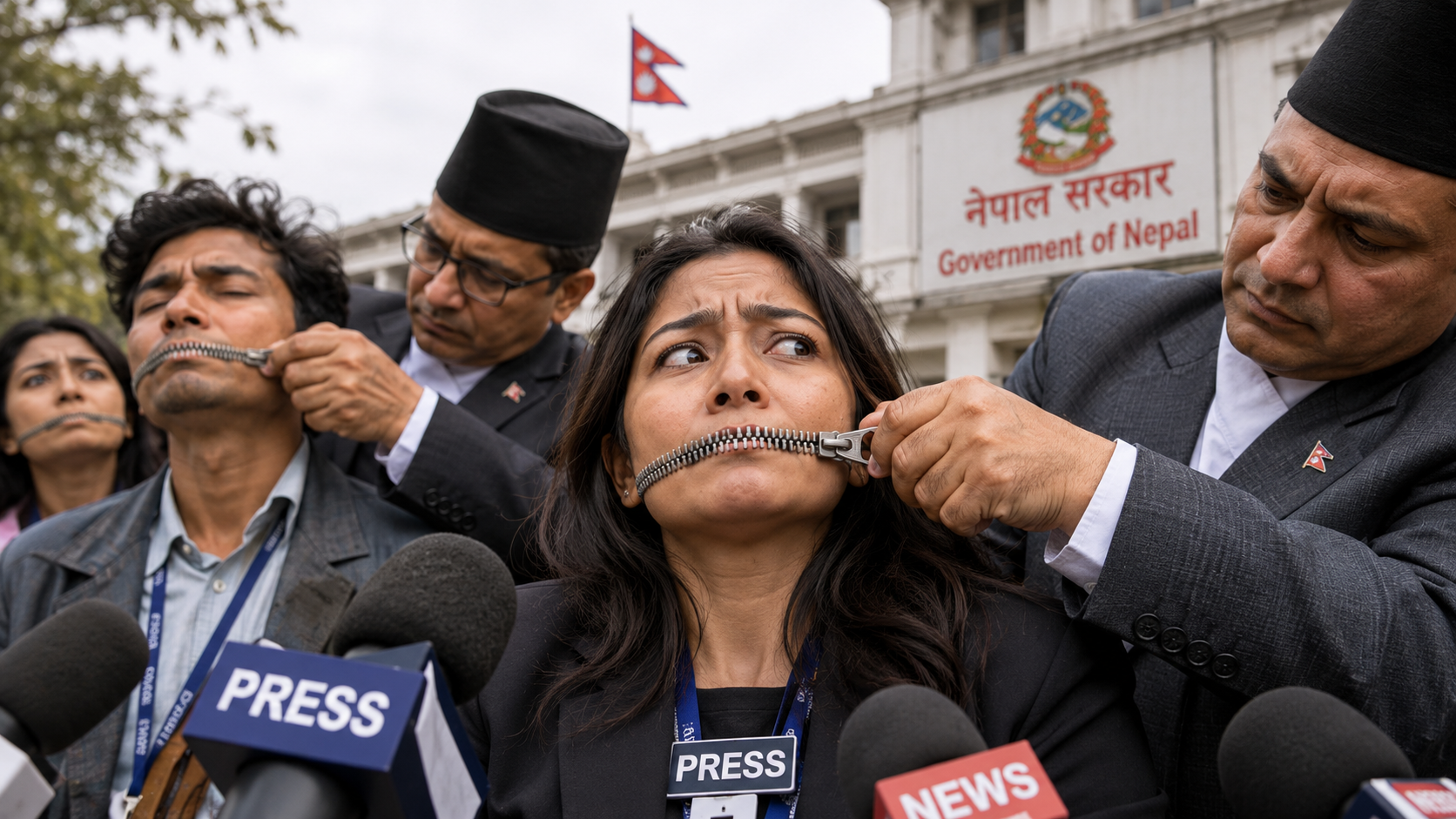
Representative Image AI
Amrit Kharel
Kathmandu, November 6 — The Nepal government’s decision to amend the Press Council Act through an ordinance has sparked serious concerns over the future of press freedom, freedom of expression and independent journalism in the country.
Critics argue that, in the name of regulating the rapidly changing media landscape and maintaining journalistic accountability, the government is introducing provisions that could expand state influence over newsrooms, journalists and digital media platforms.
The proposed changes to the Press Council Act, 2048, raise a fundamental question: Is the government attempting to make journalism more responsible, or creating a mechanism through which independent voices can be pressured, intimidated and silenced?
The Cabinet recommended the ordinance to President Ram Chandra Paudel on November 3.
Why the ordinance is considered regressive
One of the most concerning aspects of the ordinance is its expansion of the Press Council’s jurisdiction to social media accounts operated by registered media organisations, including Facebook, YouTube, X and TikTok. It also brings individuals identifying as media professionals, content creators and influencers under the journalistic code of conduct when they engage in journalistic activities.
While extending ethical standards to digital journalism may be necessary, the question is whether the regulatory authority has been given sufficient safeguards to prevent arbitrary intervention.
1. Expanding regulatory power over digital journalism
The ordinance gives the Press Council authority to monitor digital platforms and investigate content published by media organisations. In an environment where independent digital journalism has become an important alternative to traditional media, such broad regulatory authority could create uncertainty about what journalists and media organisations are allowed to publish.
The lack of clearly defined boundaries could encourage self-censorship, particularly among journalists reporting on corruption, government failures, political controversies and abuse of authority.
2. Suo motu investigations can create an atmosphere of fear
The ordinance allows the Press Council to initiate investigations on its own, even without receiving a formal complaint.
Although such authority may help address serious ethical violations, it also creates the possibility of selective investigations. If the regulatory body is not sufficiently independent, critical reporting could attract scrutiny simply because it challenges powerful political or institutional interests.
The danger is not limited to punishment. The possibility of being investigated, repeatedly summoned or forced to defend legitimate reporting can itself become a form of pressure.
3. Mandatory apologies and corrections could undermine editorial independence
The ordinance empowers the Press Council to order media organisations to publish apologies, clarifications or corrections at a specific location and within a prescribed timeframe.
The council can also determine the placement and format of such publications.
Corrections are an essential part of responsible journalism. However, when a regulatory authority has extensive discretion over how a media outlet must present its response, the distinction between correcting factual errors and controlling editorial decisions becomes crucial.
A regulator should not become an editorial authority deciding how a newsroom must communicate with its readers.
4. The threat of self-censorship
Perhaps the most damaging consequence of excessive media regulation is not the punishment of journalists but the silence it creates.
When journalists fear investigations, complaints and regulatory action, they may begin avoiding sensitive stories. Editors may hesitate to publish investigative reports. Media houses may choose not to expose powerful individuals or institutions.
This is how freedom of expression can be restricted without an outright ban on newspapers, television channels or online portals.
5. Journalism cannot be separated from the public’s right to question power
A free press is not merely an institution that publishes information. It is a democratic watchdog that investigates those in power, questions government decisions and gives citizens access to information.
The government has a legitimate responsibility to address misinformation, fabricated news and unethical journalism. But these objectives must not become a justification for expanding state control over independent reporting.
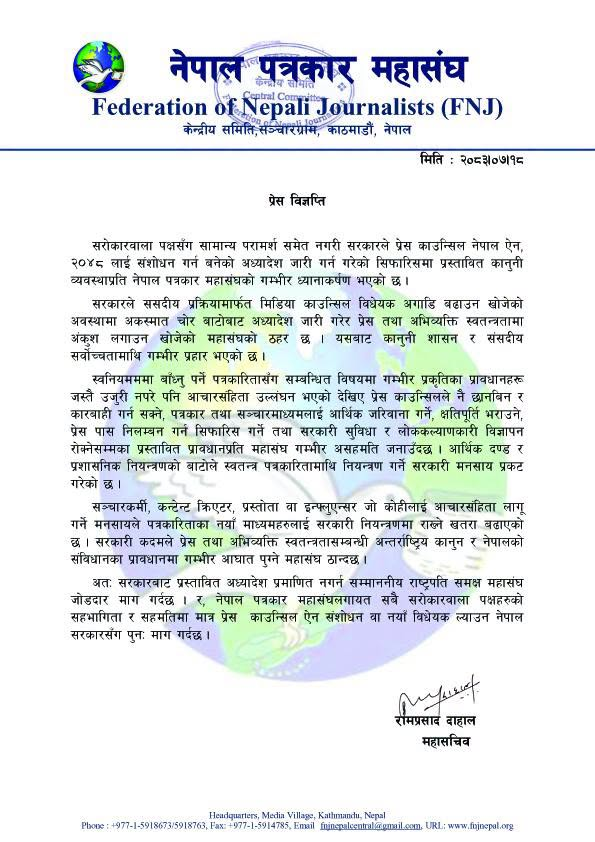
The Federation of Nepali Journalists has also raised concerns about the government’s approach to media regulation, lack of consultation and provisions that could undermine constitutional press freedom.
A dangerous precedent for democracy
The timing and manner of introducing the ordinance have also raised questions about democratic consultation. A major legal change affecting the media should not be pushed through without meaningful discussion with journalists, media organisations, press freedom advocates and other stakeholders.
The Federation of Nepali Journalists has questioned the government’s haste in introducing the ordinance and has called for stronger guarantees of press freedom.
It is also important to acknowledge that the ordinance reportedly exempts personal social media opinions, commentary, criticism of current affairs, satire, art and entertainment from the journalistic code of conduct. However, these exemptions do not eliminate concerns about the expanded regulatory powers over media organisations and journalistic activities.
The government must understand that regulating journalism and controlling journalism are two fundamentally different things.
Freedom of expression must not become a privilege granted by the state
Nepal’s democratic transformation was built on decades of struggle against authoritarianism, censorship and restrictions on civil liberties. The freedom that journalists and citizens enjoy today was not granted as a favour by any government; it was secured through people’s movements and democratic struggles.
Any law that creates an atmosphere in which journalists must think twice before questioning the government deserves serious scrutiny.
The Press Council should function as an independent institution protecting professional ethics, media accountability and the public’s right to information—not as an instrument that could be used to discipline critical voices.
The government must ensure that the ordinance contains clear legal definitions, proportional measures, independent oversight, due process and effective protection against political interference.
A government that welcomes criticism strengthens democracy. A government that fears criticism weakens it.
The proposed changes must therefore be subjected to wider public debate and rigorous constitutional scrutiny. Nepal cannot afford a regulatory framework that, under the banner of responsible journalism, gradually squeezes the throat of freedom of expression.
Ultimately, the real test of democracy is not how comfortably a government governs without criticism, but how freely its citizens and journalists can question those who govern them.