महाकवि देवकोटाको ११८औँ जन्मजयन्ती

Ram Kumar Rai
Kathmandu, November 8 |
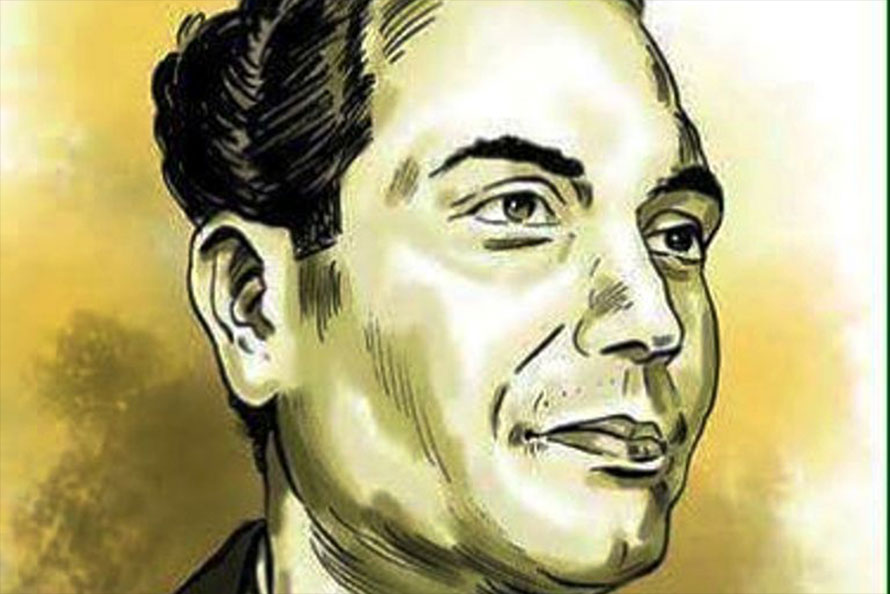
In the firmament of Nepali literature, Mahakavi Laxmi Prasad Devkota is a beacon of light whose brilliance earned Nepali language and literature global recognition. Born on the auspicious day of Laxmi Puja—the dark moon night of Kartik (V.S. 1966) in Dillibazar, Kathmandu—he was the third son of father Tilamadhav Devkota and mother Amararajyalaxmi Devi. Consequently, Nepali-speaking communities across the country and around the globe are celebrating the 118th birth anniversary of Mahakavi Devkota with immense reverence and enthusiasm.
Though born on a sacred night dedicated to the worship of Laxmi, the goddess of wealth, and enduring physical poverty throughout his life, Devkota was blessed with the infinite grace of Saraswati, the goddess of knowledge and arts.
Acknowledging his invaluable contribution to Nepali literature, Natya Samrat Balakrishna Sama honored his extraordinary genius by famously remarking that Devkota was born three times through Muna Madan, the epic Shakuntala, and the poem Paagal (The Lunatic).
Today’s occasion transcends Devkota’s physical absence, reminding us of his timeless creations and the golden path he carved in Nepali Vangmaya (literature).
Laxmi Prasad Devkota was not merely a poet; he was a multidimensional and epoch-making genius of Nepali literature. He was well-versed in almost every literary genre, including poetry, long poems (Khandakavya), epics, essays, dramas, and novels.
He was a pioneer of the romantic movement. Breaking away from traditional classical rigidities and orthodox rules in Nepali poetry, Devkota inaugurated the romantic-progressive stream. The personification of nature, expression of human sensitivities, and individual liberty remain the core features of his poetic rebellion.
Devkota was a champion of humanism. The foundational element of his literature is humanism. Defying the caste system, class discrimination, and superstitions, he established the supremacy of humanity. His famous line—“Manis thulo dille hunchha jatle hudaina” (A person is great by heart, not by caste)—sent out a resounding call for social transformation in Nepali society.
Devkota possessed extraordinary and supernatural writing proficiency. He proved his exceptional poetic genius by composing the children’s epic Shakuntala and the Tale of Frogs based on imaginative themes in just 10 days, and the profound epic Sulochana in a mere three months.
Devkota worked to bring Nepali literature to the global stage through English translations of his works and by representing Nepal at Afro-Asian writers’ conferences. As Nepal’s Minister of Education in V.S. 2014, he spearheaded historic initiatives, including the establishment of Tribhuvan University and making Nepali the medium of instruction in schools nationwide.
Devkota’s creations are vast in both quality and quantity. Among them, the Khandakavya Muna Madan is the most widely cherished work in the history of Nepali literature. Based on the folk Jhyaure meter, it vividly captures the agony of a class-divided society, the compulsion of Nepalis to migrate abroad due to poverty, and the tragic aspect of pure love. The core essence of this epic is the philosophy that the heart is greater than wealth, and humanity is superior to caste.
Similarly, Shakuntala is regarded as the first original epic in Nepali literature, blending Eastern mythological narratives with Western stylistic craftsmanship. It clearly displays the peerless depiction of nature and Devkota’s soaring intellectual imagination.
Sulochana is a social epic that captures the social environment, love, and conflicts between different castes and clans in contemporary society, offering a realistic depiction of that era.
Based on Greek mythology, the epic Prometheus represents the absolute peak of Devkota’s rebellious and revolutionary consciousness. He beautifully transformed the story of Prometheus—who fought against tyranny for humanity and freedom—into the Nepali poetic landscape.
Poems such as “Bhikhari” (The Beggar) and “Yatri” (The Traveler) from his poetry collection Bhikhari highlight his profound philosophical consciousness and humanist outlook. The core philosophy of the poem “Yatri” is that God is not found in temples, but in the service of the destitute.
Paagall (The Lunatic) is one of the finest modern poems in Nepali literature. Composed in protest after contemporary Rana-era autocratic rulers and society labeled a sensitive and rebellious poet like him as “mad,” this poem brims with high-pitched radicalism and profound satire.
Devkota was equally powerful in the essay genre. His essays feature soaring thoughts, subjectivity, and provocative prose styles. Masterpieces like Ke Nepal Sano Chha? (Is Nepal Small?) and Hi Hi Angreji (Hay! Hay! English) stand out among his finest works.
Mahakavi’s literature presents an unmatched confluence of boundless love for nature, romantic rebellion, humanism, and philosophy. He was deeply influenced by Eastern Vedanta philosophy and Western romanticism—particularly the ideas of poets like William Wordsworth, P.B. Shelley, and John Keats. Consequently, his compositions reflect an exquisite synthesis of Eastern spirituality and Western material consciousness.
Passing away on Bhadra 29, V.S. 2016 due to cancer, Mahakavi Laxmi Prasad Devkota may no longer be physically among us, but he lives on in the heart of every Nepali through his immortal and timeless creations. He remains the pride and identity of Nepali literature.
As we celebrate his 118th birth anniversary today, honoring him should go beyond mere formal programs and praise; truly paying tribute to him means translating his humanist path, consciousness for social transformation, and profound love for the Nepali language into our daily actions.
Based on the book: Bandhu, Chudamani (V.S. 2058). Devkota. Sajha Prakashan.