डोम समुदाय
Dhanusha, November 10.
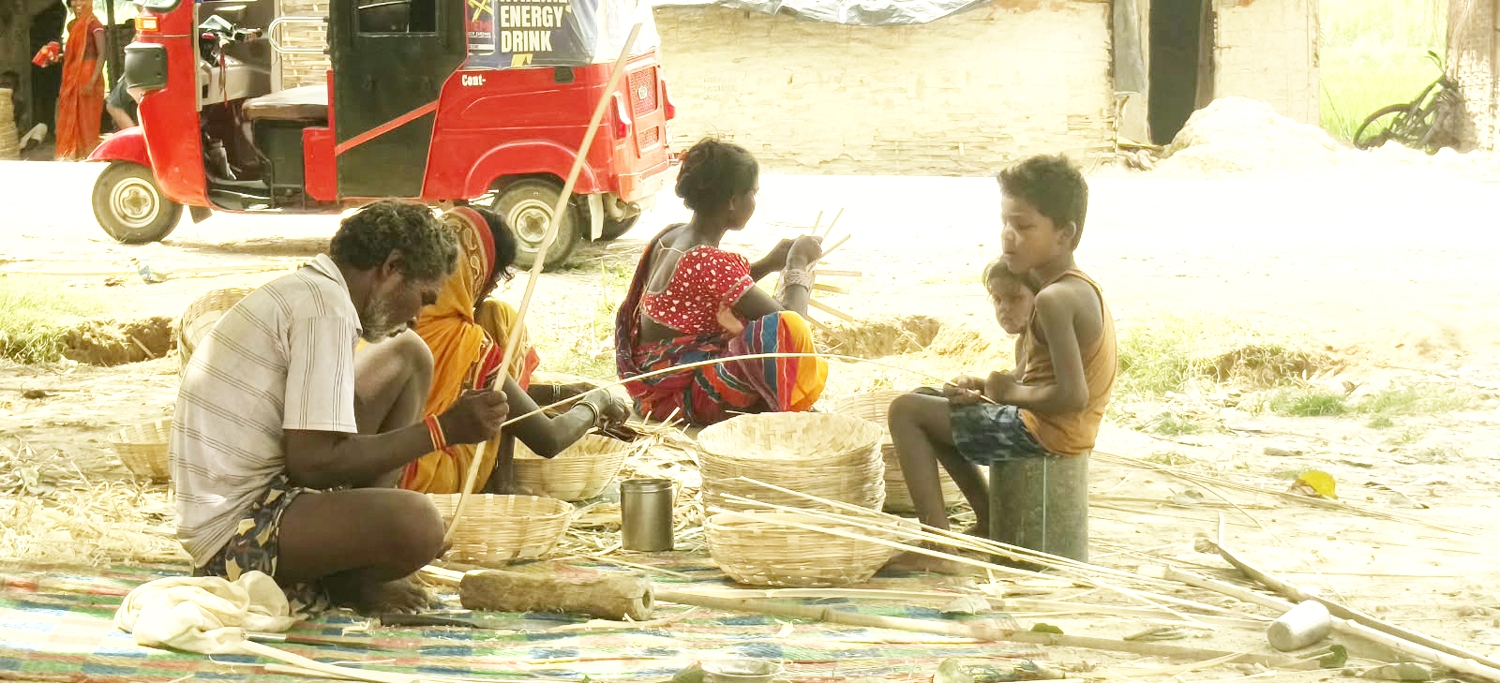
The profession of making bamboo artifacts, traditionally associated with the Dome community in the Terai-Madhesh region, is increasingly attracting people from other communities in recent times. As individuals can earn an income by utilizing their skills and labor right from home, people from various castes and communities in Kataiyagaun, Dhanauji Rural Municipality–3, Dhanusha, have become engaged in this profession.
The use of bamboo-made items such as dhakki, dalo, nanglo, and suppa has been prevalent in the villages and settlements of Terai-Madhesh since ancient times. Used from household chores to religious and cultural activities, these items are considered essential particularly during festivals and rituals such as Chhath, weddings, and bratabandha (sacred thread ceremony). Traditionally, crafting these items has been recognized as the occupation of the Dome community.
This profession has also been the primary livelihood for the Dome community, who have been weaving various items by extracting bamboo strips for generations. However, in recent times, this skill is no longer limited to any single caste or community and is expanding to others as well.
In Kataiyagaun of Dhanauji Rural Municipality–3, people from communities including मुखिया (Mukhiya), Mandal, Yadav, Chamar, Muslim, and Sah are involved in making bamboo items. According to local Nirdhan Mukhiya, about 200 people in the village are engaged in this profession. Out of the 150 households in the village, members of most families are involved in the production of bamboo items in one way or another, he stated.
“The notion that only the Dome community weaves bamboo items is incorrect. People from any community with the skill can do this work and earn an income,” Mukhiya said.
According to him, people from various communities in Kataai adopted this profession by learning the skills from one another. What initially started with only a few families gradually spread to other households. He noted that local residents’ attraction has grown because bamboo production does not require a large investment, and income can be generated from the sale of the products.
Local resident Arbind Kumar Sah, who is involved in producing bamboo items, also stated that this should not be viewed through the lens of ethnic identity. According to Sah, who has been making items like dhakki from bamboo strips for a long time, a significant number of people from communities other than the Dome community are also engaged in this profession in Kataai.
In Sah’s view, no work is small or big. Since income can be earned through skill and hard work, there is no need to associate a profession with ethnic prestige. He believes that the tendency to feel ashamed of working only increases unemployment.
“No one is going to give you two rupees just for sitting around. No matter what the work is, one should not feel ashamed. You must work to earn your living,” he said.
According to him, by making bamboo items, he earns a daily income of up to around Rs 1,000. Although the income varies depending on the volume of work, type of items, and market demand, it has helped manage household expenses, he shared.
Even though some relatives and acquaintances suggested other businesses, Sah expressed satisfaction with the income and work from this very profession. His rationale for continuing is that the work can be done from home using one’s own skills, and there is a steady demand for the products in the market.
Demand for Bamboo Items Surges with Chhath
With Chhath festival approaching, the busyness of bamboo craftspeople in Kataiyagaun has increased. With the surge in demand for essential worship items like dhakki, dalo, nanglo, and suppa, locals are finding it hard to keep up with production.
Chhath festival is celebrated with profound devotion and faith in Terai-Madhesh. Bamboo items are utilized during the worship and invocation of the Sun God and Chhathi Mata. Dhakki, dalo, and suppa are used for everything from holding prayer offerings to decorating prasad and fruits. Because bamboo items are considered traditional and pure, their demand is higher during Chhath than at other times.
Anticipating high demand during the festival, producers begin preparations well in advance. Other family members also pitch in to craft items according to market demand. Locals share that items produced during this period sell easily.
However, the occupation of Kataai residents is not limited to Chhath festival alone. Items such as dhakki, dalo, nanglo, and others required for household purposes are produced year-round. Locals state that while sales peak during specific festivals, there is market demand throughout the year, ensuring a regular source of income.
Locals do not even have to travel to distant markets to sell their products; traders come directly to the village to purchase them. This has helped producers save on market-searching and transportation costs. Because they can produce right in the village and sell through traders, many families have made this a regular source of income.
Employment and Income from Home
Making bamboo items does not require large industries, modern machinery, or a massive workforce. The work can be done right at home with simple tools, bamboo, and skill. Since family members can work at their convenience, this profession has become a reliable medium of income generation for rural residents.
At a time when employment opportunities in villages are limited, this is a promising profession that utilizes local resources to generate income. For those who want to work from home or are unable to engage in other forms of employment, bamboo production provides self-employment opportunities.
Families engaged in this profession have been producing items of various shapes and types based on their experience and skills. Attention must be paid to the size, design, and quality of items according to market demand. Locals experience that understanding customer needs makes sales smoother.
Nevertheless, to make this profession more organized and commercial, attention needs to be paid to the easy availability of bamboo, fair pricing, product quality, and market expansion. Connecting traditional skills with market needs could yield even higher earnings. If supported by local skill development, product diversification, and marketing, bamboo item production can become a vital pillar of the rural economy.
Shift in Social Outlook Along with Skill Expansion
The engagement of people from diverse communities in the same profession in Kataiyagaun also conveys a message of social transformation. As other communities adopt occupations traditionally tied to specific castes or groups, social perspectives towards labor and professions are beginning to change.
Society has long maintained a tendency to identify occupations based on caste and community, with certain jobs still viewed as belonging to specific groups. However, the residents of Kataai have challenged this mindset by prioritizing skill and labor.
According to local residents, work must be respected, and the caste or community of the worker should not matter; earning a living through hard work is what truly counts. This very mindset has made it easier for people from various communities to engage in the same profession in the village.
The profession of making bamboo items has not only provided income opportunities for the residents of Kataai but has also inspired a reconsideration of traditional social norms. The expansion of a skill passed down through generations in one community into other communities is regarded as significant for the respect of labor and the continuity of skills.
According to Dhanauji Rural Municipality Chairperson Raj Kumar Sah, the practice in Kataiyagaun sends a message that traditional professions and skills should be viewed beyond ethnic boundaries.
“No profession is small or big; the skill, hard work, and honest effort put into it are what truly matter—an example of which has been presented by the residents here,” he stated.
Chairperson Sah added that the efforts of locals earning a livelihood by weaving bamboo strips have successfully combined the utilization of local resources, self-employment, and social harmony.
— RSS