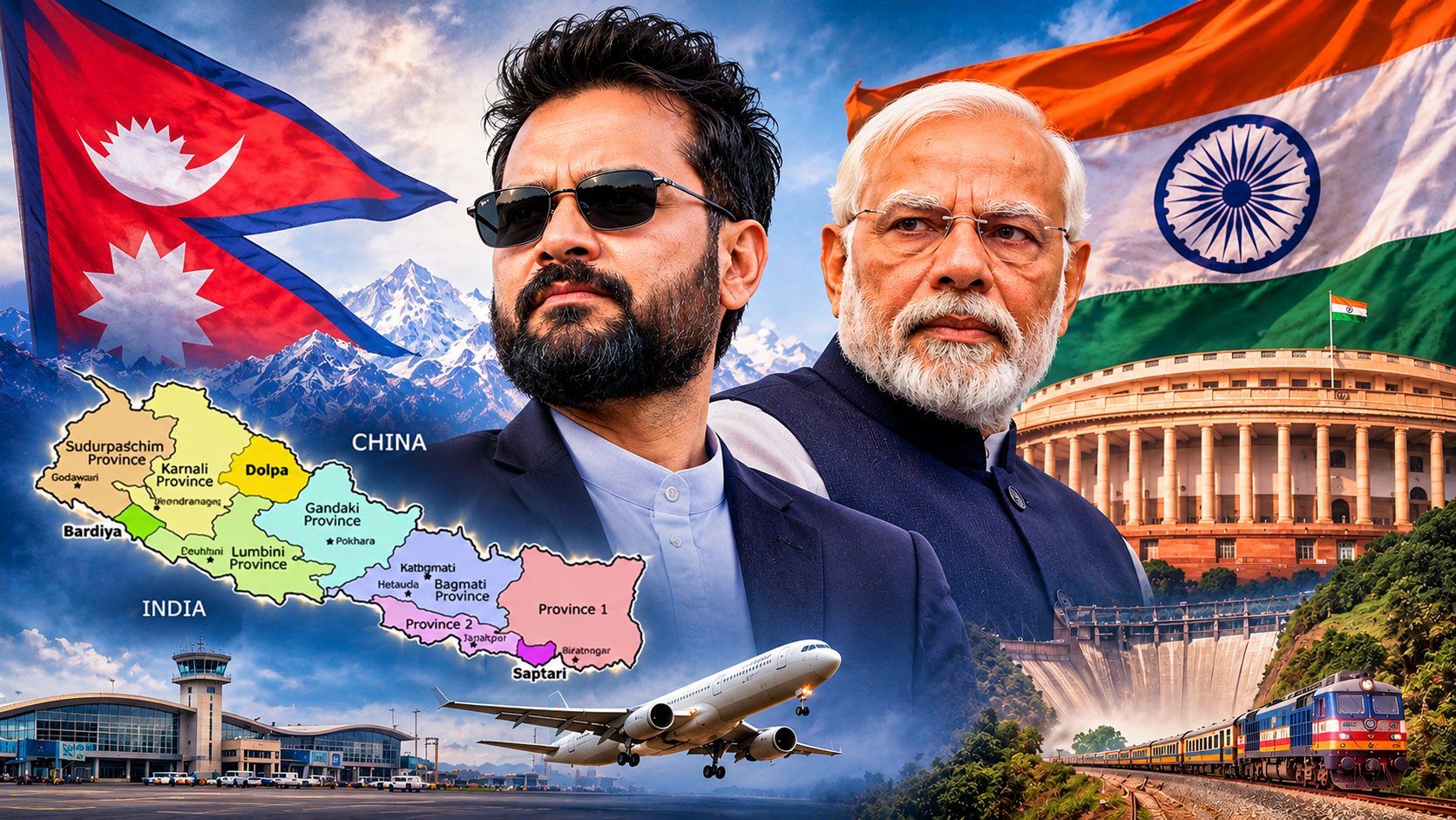
From the disputed territories of Lipulekh, Kalapani and Limpiyadhura to restricted air routes, Chinese-funded airports and unequal treaties, Prime Minister Balendra Shah’s first official visit to New Delhi will test whether his nationalist rhetoric can translate into real diplomatic results.
Amrit Kharel

A symbolic map on an office wall may attract public attention. Defending a country’s territorial claims in a diplomatic negotiation requires preparation, historical evidence, political consistency and strategic skill. Now Shah must move beyond symbolism.
Will the man who displayed the Greater Nepal map look Modi in the eye and firmly raise the question of Lipulekh, Kalapani and Limpiyadhura?
Will he defend the same national interests he once invoked while serving as Kathmandu’s mayor?
KATHMANDU, November 18: Prime Minister Balendra Shah is preparing for his first official visit to India since taking office. At the invitation of Indian Prime Minister Narendra Modi, Shah is scheduled to travel to India on November 22 for a two-day visit. It is being presented as an opportunity to strengthen bilateral relations, expand connectivity, promote tourism and accelerate development cooperation.
But beneath the familiar language of friendship and cooperation lies a much bigger question, will Balen Shah use this visit to defend Nepal’s national interests, or will he follow the diplomatic script that successive Nepali prime ministers have followed in New Delhi?
This is no ordinary neighbourhood visit. It is a test of political credibility, diplomatic courage and national commitment.
For decades, Nepal has entered negotiations with India carrying a long list of unresolved concerns—border disputes, unequal treaties, restrictions on air routes, water-sharing disagreements and economic dependence. Governments have changed, prime ministers have come and gone, but many of these issues remain unresolved.
Shah now has an opportunity to break that pattern. Whether he has the political will to do so is another matter.
According to Foreign Ministry spokesperson Lok Bahadur Poudel Chhetri, preparations for the visit are underway. The official agenda is expected to include connectivity, development assistance, tourism, people-to-people relations, railway and road expansion, and energy infrastructure.
These are important issues. But they are not the whole story.
The real test will be whether Nepal’s most politically visible nationalist leader can raise the difficult questions that previous governments have often approached with caution.
Will he clearly defend Nepal’s constitutional map and historical claim? Will he demand a time-bound process to resolve the dispute? Or will he allow the issue to disappear behind the usual language of dialogue, friendship and mutual understanding?
Nepal does not need confrontation with India. It needs a serious negotiation between two sovereign states. Friendship cannot mean silence, and diplomacy cannot mean surrender.
Lipulekh, Kalapani and Limpiyadhura: What Will Balen Tell Modi?
The territorial dispute over Lipulekh, Kalapani and Limpiyadhura remains one of the most sensitive issues between Nepal and India.
Nepal maintains that these territories belong to it on the basis of historical records and the Sugauli Treaty of 1816. In 2020, Nepal amended its Constitution to incorporate the territories into its official political map. India rejected Nepal’s position and continues to maintain its own claim.
The dispute intensified in 2019 when India published a new political map that included the disputed territories. It resurfaced again with India’s decision to facilitate the Kailash Mansarovar pilgrimage route through Lipulekh.
For Nepal, this is not simply a disagreement over a few square kilometres of land. It is a question of territorial integrity and the credibility of the state.
Shah has already attracted controversy over his remarks in Parliament, in which he reportedly said that Nepal had also encroached upon Indian territory in some places, just as India had encroached upon Nepali land. He said he had learned of such cases after becoming prime minister.
The remarks triggered criticism and raised questions about the government’s understanding of the border dispute. Critics argued that local disputes over land use, shifting river courses and the placement of boundary pillars should not be casually equated with the state-level territorial claims involving Lipulekh, Kalapani and Limpiyadhura.
The concern was straightforward. Was the prime minister weakening Nepal’s established position by presenting the issue as a case of mutual encroachment?
Shah also indicated that diplomatic efforts were underway, including communication with India, China and the United Kingdom. He referred to India’s response to Nepal’s diplomatic note and the possibility of a mechanism involving historians, survey experts and border specialists.
That may be a reasonable diplomatic route. But the fundamental question remains, what exactly will Shah tell Modi?
Will he clearly defend Nepal’s constitutional map and historical claim? Will he demand a time-bound process to resolve the dispute? Or will he allow the issue to disappear behind the usual language of dialogue, friendship and mutual understanding?
Nepal does not need confrontation with India. It needs a serious negotiation between two sovereign states. Friendship cannot mean silence, and diplomacy cannot mean surrender.
India Wants Nepal’s Airspace. Why Is Nepal Still Waiting for Its Own Air Routes?
Perhaps nowhere is the imbalance in Nepal-India relations more visible than in aviation.
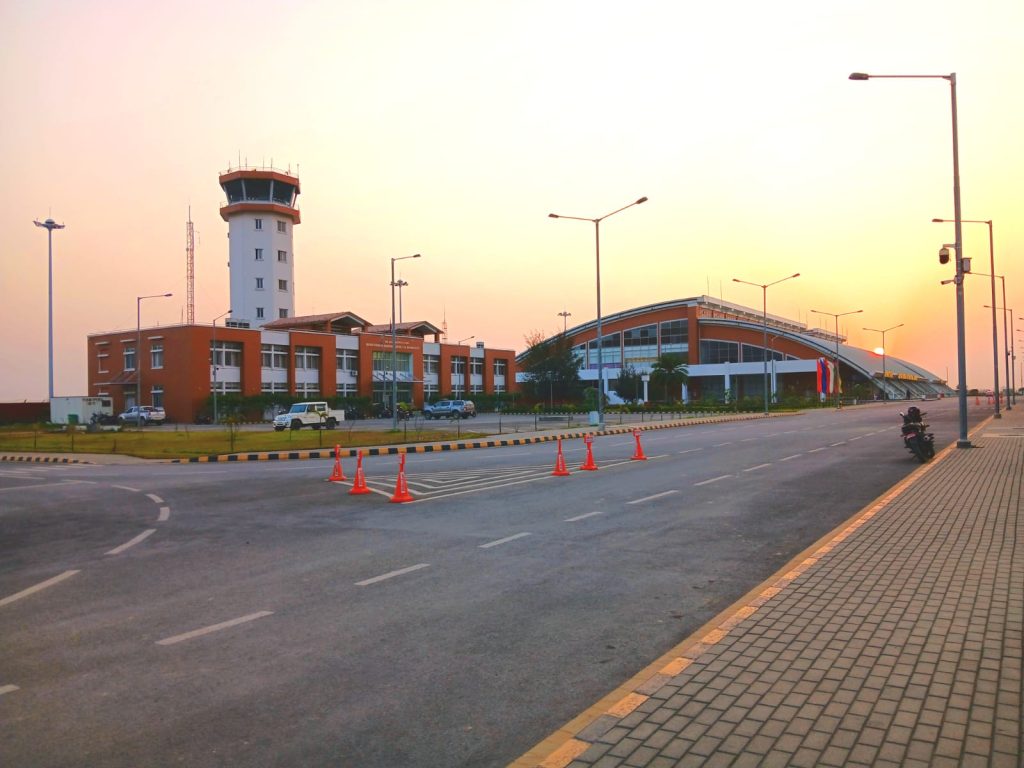
Nepal has long sought additional air-entry routes from India to make its two international airports at Bhairahawa and Pokhara commercially viable. Yet the necessary cross-border arrangements have remained a major obstacle to their full potential.
The Gautam Buddha International Airport in Bhairahawa and Pokhara International Airport were built with the expectation that they would open new gateways for international tourism, trade and travel. Instead, both have struggled to attract the level of international traffic originally anticipated.
Aircraft approaching Bhairahawa from the west face routing constraints and often have to take longer approaches through the Simara entry point. Pokhara also needs more practical air connectivity for international flights from western and other regional destinations.
Longer routes mean higher fuel costs, greater operating expenses and reduced commercial attractiveness. An international airport without convenient international air access is little more than an expensive infrastructure project waiting for its purpose to be fulfilled.
Now comes an interesting development.
India has reportedly sought permission to use Nepali airspace for international flights operating from Bagdogra airport in West Bengal. It has also raised proposals relating to the use of Nepali airspace and air traffic management in connection with the proposed airport at Raxaul.
Nepal has indicated a positive response to the Bagdogra proposal, while seeking more time to study the technical aspects of the Raxaul proposal.
This presents Kathmandu with an important diplomatic opportunity.
If India wants to use Nepal’s airspace to improve connectivity for its airports, why should Nepal’s own requests for better air access remain unanswered?
Why should air connectivity be treated as a mutual benefit when India needs it, but as a difficult security or technical question when Nepal asks for it?
Nepal should not reject India’s proposals simply for the sake of political posturing. But neither should it give away valuable airspace arrangements without securing meaningful reciprocal benefits.
The government should seek clear commitments on air-entry routes for Bhairahawa and Pokhara, together with technical agreements and an implementation timetable.
There is also a larger sovereignty issue. Reports about India’s proposal concerning air traffic management in Nepali airspace, particularly in relation to Raxaul, deserve careful scrutiny. Airspace management is not merely a technical matter. It involves national jurisdiction, security and sovereign control.
Shah must ensure that any agreement protects Nepal’s authority over its own airspace.
This is precisely where diplomacy should deliver results rather than photographs.
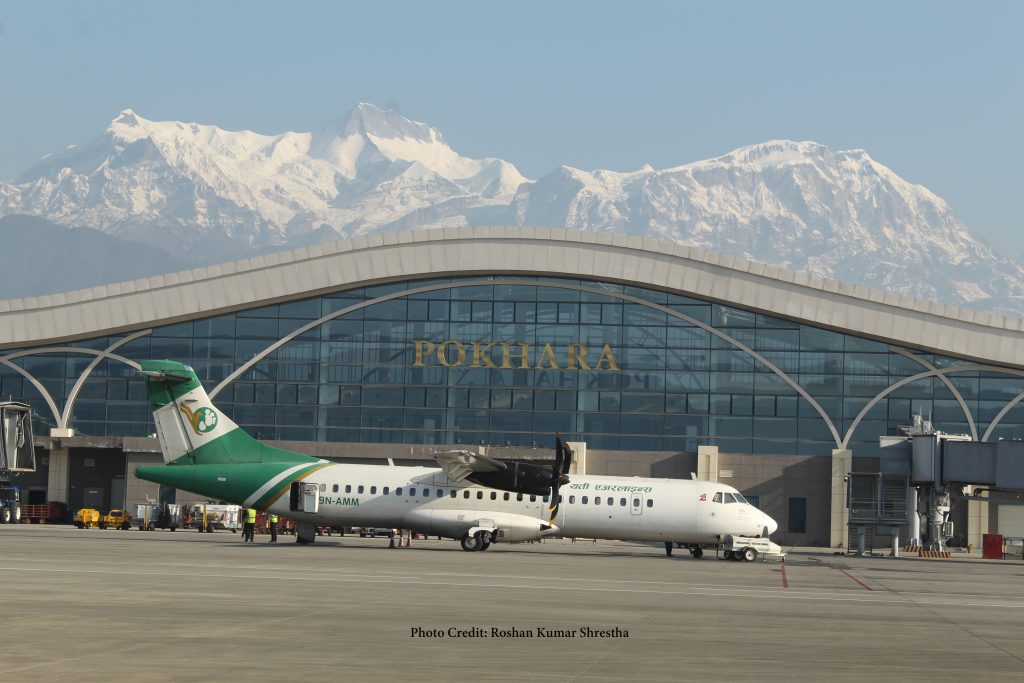
Pokhara Airport: Is Nepal’s Development Being Caught in the India-China Rivalry?
Pokhara International Airport raises an even more complicated question: how much of Nepal’s development is being affected by the strategic rivalry between India and China?
The airport was built with Chinese loan assistance. It is a major infrastructure investment intended to strengthen Nepal’s tourism industry and connect Pokhara with international destinations.
Yet the airport has faced serious difficulties in securing the international air connectivity needed to operate at its intended capacity.
India has raised security and technical concerns over aspects of regional air connectivity. At the same time, questions have repeatedly been raised in Nepal about whether India’s strategic unease over Chinese-funded infrastructure is influencing its approach to the airport.
Shah must ask a simple question in New Delhi, what practical steps will India take to ensure that Nepal’s international airports can function as genuine international gateways? If he cannot secure progress on this issue, his visit will have done little for one of Nepal’s most important tourism investments.
The involvement of a Chinese construction company in the Gautam Buddha International Airport has also contributed to the broader debate.
There have been reports of difficulties surrounding proposed international services, including the proposed Pokhara-Lucknow connection by Buddha Air.
It would be inaccurate to claim that every restriction or delay is necessarily the result of Chinese involvement. Security and aviation regulations are legitimate concerns for every country. But it would be equally unreasonable to ignore the geopolitical context.
Nepal is a sovereign country. It has the right to borrow from China, India or any other development partner, provided the terms serve its national interests.
India has every right to raise genuine security concerns. But such concerns must be addressed through transparent technical discussions, not through arrangements that leave Nepal’s expensive infrastructure commercially stranded.
Shah must ask a simple question in New Delhi, what practical steps will India take to ensure that Nepal’s international airports can function as genuine international gateways?
If he cannot secure progress on this issue, his visit will have done little for one of Nepal’s most important tourism investments.
From the 1950 Treaty to Mahakali: When Will Nepal Revisit the Unequal Agreements?
The territorial dispute and air connectivity are only part of a much larger problem. Nepal’s relationship with India is shaped by a series of treaties and agreements whose fairness and implementation have been questioned for generations.
The 1950 Treaty of Peace and Friendship remains one of the most debated documents in Nepal’s foreign relations. Many Nepali political leaders, diplomats and scholars have argued that some of its provisions are unequal and no longer reflect the realities of a modern, sovereign Nepal.
The treaty has long been criticised for the imbalance it creates in security, economic and strategic relations between the two countries. Nepal has repeatedly called for its revision. Yet meaningful progress has remained elusive.
Will he raise the revision of the 1950 treaty? Will he demand progress on Pancheshwar? Will he question the unequal distribution of benefits from Nepal’s water resources?
Or will these issues once again be pushed aside in favour of new memorandums, ceremonial announcements and promises of future cooperation?
The same questions surround the Kosi, Gandak and Mahakali agreements.
Nepal is rich in water resources, but its people have repeatedly questioned whether the country receives a fair share of the benefits generated from its rivers. Issues of irrigation, flood control, electricity generation, water utilisation and the distribution of economic gains remain politically sensitive.
The Mahakali Treaty was once presented as a landmark opportunity. The Pancheshwar Multipurpose Project was expected to transform bilateral water cooperation and generate substantial economic benefits for both countries. Decades later, the project remains far from delivering the promises that accompanied its approval.
This raises an uncomfortable question: how many more generations of Nepalis must wait for agreements that were once celebrated as historic breakthroughs?
Shah has an opportunity to place the review of these arrangements back on the diplomatic agenda. He need not demand the cancellation of every past agreement. But he must insist on fairness, transparency and implementation.
Will he raise the revision of the 1950 treaty? Will he demand progress on Pancheshwar? Will he question the unequal distribution of benefits from Nepal’s water resources?
Or will these issues once again be pushed aside in favour of new memorandums, ceremonial announcements and promises of future cooperation?
A country cannot build a balanced relationship on agreements that one side continues to regard as unfair.
The ‘Greater Nepal’ Map: Will the Nationalist Mayor Stand His Ground as Prime Minister?
Perhaps the most interesting dimension of Shah’s India visit is his own political history.
When he was mayor of Kathmandu, Shah made a strong symbolic statement in 2023 after India’s new Parliament building displayed a map labelled ‘Akhand Bharat’—an undivided India that included territories claimed by Nepal and other neighbouring countries.
In response, Shah placed a map of ‘Greater Nepal’ in his office. The map included territories that were under Nepal’s control before the Sugauli Treaty of 1816 but are now within Indian territory.
For many, the gesture represented national pride and resistance to what they saw as an expansionist historical narrative. Others questioned the diplomatic wisdom of displaying a map that went beyond Nepal’s officially recognised present-day territorial boundaries.
Shah also cancelled a planned visit to China in 2023 after Beijing published a map that did not fully reflect Nepal’s revised political map.
These episodes helped build his image as a leader willing to take a hard line on questions of national sovereignty, regardless of whether the country involved was India or China.
But being mayor and being prime minister are two very different responsibilities.
A symbolic map on an office wall may attract public attention. Defending a country’s territorial claims in a diplomatic negotiation requires preparation, historical evidence, political consistency and strategic skill.
Now Shah must move beyond symbolism.
Will the man who displayed the Greater Nepal map look Modi in the eye and firmly raise the question of Lipulekh, Kalapani and Limpiyadhura?
Will he defend the same national interests he once invoked while serving as Kathmandu’s mayor?
Or will the language of political power and diplomatic convenience replace the language of nationalism?
The people of Nepal are entitled to ask these questions. Nationalism is not measured by social media posts, maps on office walls or fiery speeches. It is measured by the ability to protect the country’s territory, airspace, natural resources and economic interests when the stakes are real.
This visit will reveal whether Shah’s nationalism is a political identity or a governing principle.
A joint statement can be drafted in a few hours. A border dispute can remain unresolved for generations. A memorandum can be signed in minutes. An international airport can remain underused for years.
The difference between diplomatic theatre and diplomatic achievement is what happens after the cameras are switched off.
For Shah, this visit is also a test of his own political credibility. He built much of his public image on challenging established political conventions and speaking forcefully about national sovereignty. His Greater Nepal gesture and his decision to cancel the China visit over Nepal’s map demonstrated that he was willing to take politically uncomfortable positions.
Now he occupies the highest executive office in the country. He can no longer rely on symbolic gestures or social media statements. He must translate his political convictions into state policy.
Beyond the Disputes: Railways, Roads, Energy and Development Cooperation
The formal agenda of the visit is also substantial and should not be overlooked.
The two governments are expected to discuss expanding railway connectivity, including the proposed launch of the Janakpur-Ayodhya rail service, extending the Jayanagar-Janakpur railway to Bardibas, exploring the Raxaul-Kathmandu railway project and developing other cross-border rail links.
Road and bridge construction, integrated check posts, electricity transmission lines and energy infrastructure are also expected to feature prominently.
The discussions may cover India’s assistance in post-disaster reconstruction, a review of ongoing Indian-supported projects in Nepal, the completion of delayed projects and the inauguration or handover of completed infrastructure, including the Nepal Police Academy.
The two sides are also expected to discuss new development projects, tourism promotion, stronger people-to-people relations and more efficient cross-border payment systems.
These are worthwhile areas of cooperation. Nepal needs better transport links, more reliable energy infrastructure, stronger trade connectivity and greater access to regional markets.
But connectivity must work both ways. Development cooperation must deliver measurable benefits to Nepal. And agreements should be assessed not by the number of projects announced but by how many are actually completed and how much value they create for Nepali citizens.
The challenge is to turn diplomatic goodwill into practical results.
Vikram Misri’s Sunglasses Diplomacy: A Small Incident, a Bigger Political Message?
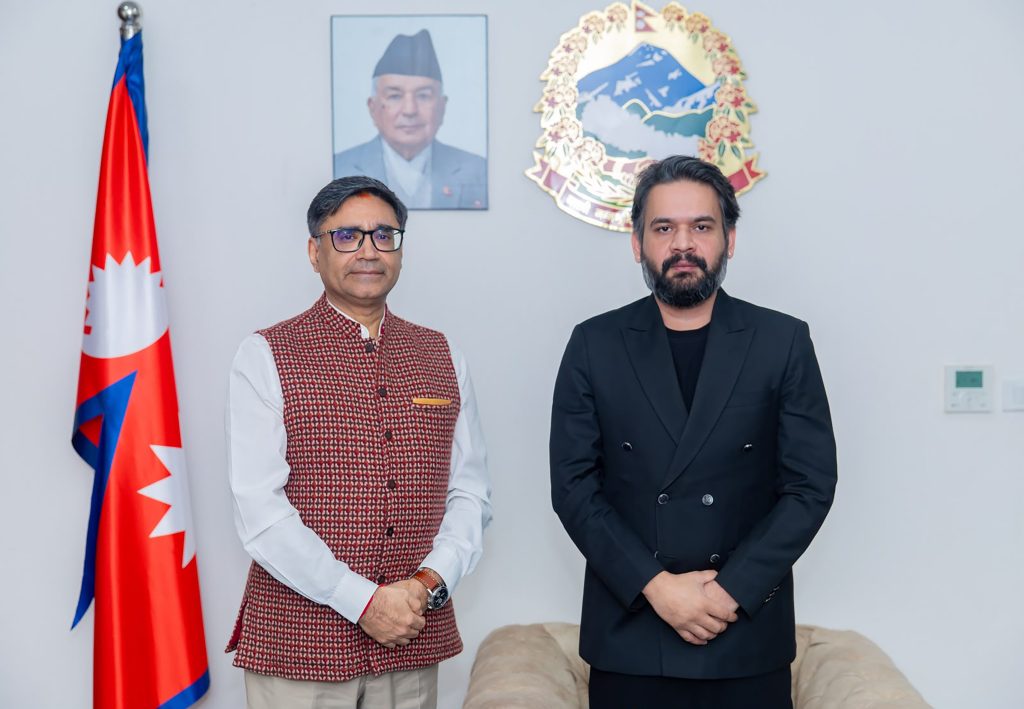
There was an interesting moment during Indian Foreign Secretary Vikram Misri’s visit to Kathmandu on November 4 and 5, ahead of Shah’s India trip.
Misri arrived at Tribhuvan International Airport wearing dark sunglasses. The image attracted attention because Shah himself is often seen wearing dark glasses in public appearances.
During the formal meeting and photographs with the Indian foreign secretary, however, Shah appeared without his familiar sunglasses.
It may have been nothing more than ordinary diplomatic protocol. But in Nepal’s political culture, even small gestures can become subjects of public interpretation.
The episode also raises a broader question about the power dynamics of diplomacy. Who sets the tone when representatives of a much larger neighbour arrive in Kathmandu? Does Nepal approach the negotiating table as an equal sovereign partner, or does it still feel compelled to adjust its posture to accommodate India’s sensitivities?
Now that Misri has completed his preparatory visit, attention shifts to Shah’s meeting with Modi.
The political curiosity is almost irresistible: having taken off his sunglasses in Kathmandu, what kind of political vision will Shah carry to New Delhi? Will he return with a clearer view of Nepal’s national interests, or will the realities of power politics blur the promises he made at home?
The exchange of ambassadors and the diplomatic preparations on both sides suggest that the visit is being taken seriously. Nepal and India have appointed ambassadors to fill vacant positions, and their respective diplomatic missions are working on the preparations.
Shah assumed office on March 26 and made his first foreign trip to attend the 81st session of the United Nations General Assembly on September 22. His India visit will be his first official trip to a neighbouring country as prime minister.
That makes the visit politically significant.
The real test of Balen’s nationalism begins in Delhi. And the verdict will be delivered not by his speeches, but by the results he brings home.
The Real Question: Will Balen Return With Results or Just Photographs?
Nepal and India share a relationship that cannot be reduced to territorial disputes or diplomatic disagreements. Their geographical proximity, open border, trade, employment links, cultural ties, energy cooperation and people-to-people relations make each country important to the other.
Nepal does not benefit from hostility with India. Nor does it benefit from a relationship in which difficult issues are continually postponed because one side is more powerful than the other.
A mature relationship requires mutual respect. It requires the larger neighbour to recognise the legitimate concerns of the smaller one. It also requires Nepal’s leadership to negotiate with clarity, preparation and consistency rather than relying on emotional nationalism.
Shah should therefore use this visit to seek concrete progress on at least four fronts.
First, he must push for a time-bound diplomatic process to resolve the Lipulekh, Kalapani and Limpiyadhura dispute, firmly defending Nepal’s official territorial position.
Second, he must secure meaningful progress on additional air-entry routes for Bhairahawa and Pokhara International Airports, rather than allowing these major investments to remain commercially underutilised.
Third, any Indian proposal to use Nepali airspace, including the arrangements concerning Bagdogra and Raxaul, must be evaluated on the basis of reciprocity, technical feasibility and Nepal’s sovereign control.
Fourth, he must reopen the discussion on the 1950 treaty and the implementation of water-sharing agreements, particularly the long-delayed Mahakali and Pancheshwar commitments.
These are not unreasonable demands. They are the legitimate concerns of a sovereign country seeking a balanced relationship with its largest neighbour.
India’s interest in using Nepal’s airspace could provide Kathmandu with an opportunity to advance its own long-standing demands. Such an opportunity should not be wasted in the name of diplomatic courtesy.
The government should also resist the temptation to measure the success of the visit by the number of agreements signed, development projects announced or photographs taken with Indian leaders.
A joint statement can be drafted in a few hours. A border dispute can remain unresolved for generations. A memorandum can be signed in minutes. An international airport can remain underused for years.
The difference between diplomatic theatre and diplomatic achievement is what happens after the cameras are switched off.
For Shah, this visit is also a test of his own political credibility. He built much of his public image on challenging established political conventions and speaking forcefully about national sovereignty. His Greater Nepal gesture and his decision to cancel the China visit over Nepal’s map demonstrated that he was willing to take politically uncomfortable positions.
Now he occupies the highest executive office in the country. He can no longer rely on symbolic gestures or social media statements. He must translate his political convictions into state policy.
The question is not whether Shah should confront Modi. It is whether he can negotiate with Modi without compromising Nepal’s legitimate interests.
Nor should success be judged by whether he returns with a confrontational message. A skilled prime minister can maintain cordial relations while firmly defending national interests. Indeed, that is precisely what good diplomacy requires.
Nepal needs an equal partnership, not a relationship governed by the convenience of the stronger neighbour.
The mayor who once displayed the map of Greater Nepal now has the responsibility of defending the actual Nepal.
When Shah returns from New Delhi, the country will want to know what he secured on the negotiating table—not how warmly he was received, how many handshakes he exchanged or how impressive the official photographs looked.
Will he return with a credible roadmap for resolving the border dispute, meaningful progress on air connectivity and a commitment to revisit long-standing agreements?
Or will he return with another collection of assurances that Nepali governments have heard for decades?
His visit will not simply reveal the state of Nepal-India relations. It may reveal the distance between Balen Shah the nationalist politician and Balendra Shah the prime minister.
The real test of Balen’s nationalism begins in Delhi. And the verdict will be delivered not by his speeches, but by the results he brings home.