Kanchanpur, Nov 19 (Mangsir 3):
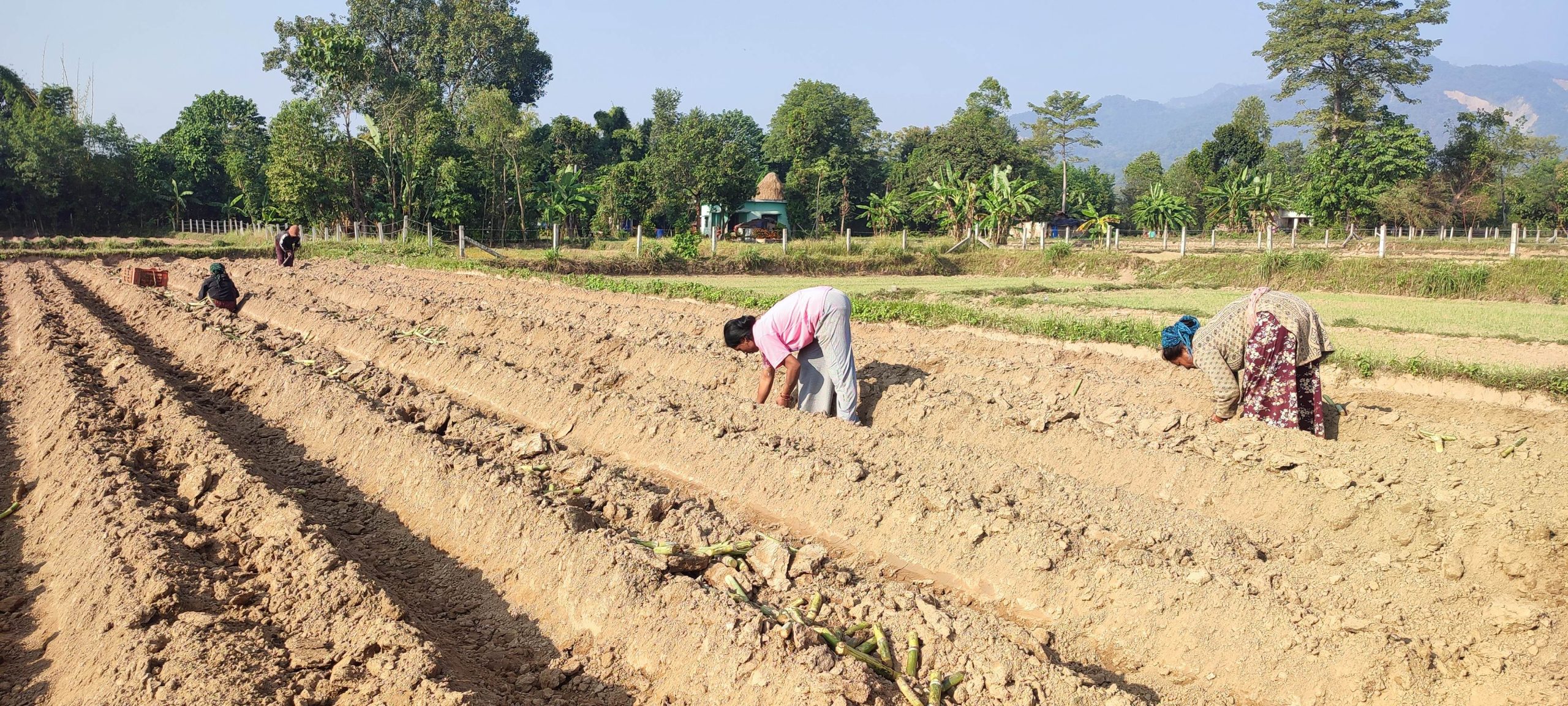
Farmers in Kanchanpur, who have traditionally been cultivating food crops such as paddy and wheat, are increasingly drawn toward sugarcane farming.
Farmers have turned to sugarcane cultivation as it generates double the income compared to other crops. Dhansingh Thagunna of Bhimdatt Municipality-7 in Kanchanpur stated that sugarcane farming appears to yield double the income. “Since sugarcane farming offers better returns than traditional farming, three of us pooled together to lease land. We are moving forward commercially,” he said, adding, “Sugarcane farming provides good returns with less labor and investment.”
He noted that he took up sugarcane farming because there is no market problem once the crop is produced and good returns can be obtained all at once. Having started cultivation on two bighas of land, he said he is now leasing 12 bighas to grow sugarcane. “In the first season, after deducting all expenses, the income equals around NPR 100,000 per bigha,” Thagunna said, adding, “Once sugarcane is planted, production can be harvested for three consecutive seasons.”
According to him, after planting sugarcane in the first year, harvests can also be taken in the second and third seasons from the shoots sprouting from the roots, eliminating the hassle of replanting every year. He said this helps reduce farming costs while increasing income.
The harvested sugarcane is sold to Mahakali Sugar Mill located in Belauri. He stated that the mill supports sugarcane farmers by providing seeds and pesticides. “From paddy and wheat, after deducting all expenses, one bigha yields at most up to NPR 40,000,” Thagunna said, adding, “In sugarcane farming, if there is a good harvest on one bigha, up to NPR 300,000 can be earned after deducting all expenses.” He noted that he is farming on 12 bighas of leased land at an annual rate of NPR 2,000 per kattha.
Local farmer Tara Mahara has been engaged in commercial sugarcane farming for three years. “We got into this because sugarcane farming gives double the profit compared to traditional food crops,” he said, adding, “Sugarcane on two bighas of land is ready for sale, and we are currently planting seeds on ten bighas.”
He stated that 20 to 25 people get seasonal employment. According to data from the Agriculture Knowledge Center Kanchanpur, sugarcane is being cultivated across 5,660 hectares in the district. Annually, 345,260 metric tons of sugarcane is produced from that area, with district productivity standing at 61 metric tons per hectare.
RSS