


Amrit Kharel
The government has demonstrated a willingness to challenge entrenched practices, confront corruption and demand accountability from public officials. But six months into its tenure, questions are mounting over institutional respect, economic delivery, disaster response and whether a strong political mandate is translating into tangible improvements in people’s lives.
Six months ago, Balendra Shah assumed the office of Prime Minister with an unusually powerful political mandate and an equally extraordinary burden of public expectations. His government emerged from a political transformation in the wake of Gen Z movement driven by demands for accountability, an end to corruption, better governance and a decisive departure from the practices of traditional political leadership.
The expectations were not merely electoral promises. They represented a broader public demand for a government that would work differently, spend public money responsibly, hold officials accountable and deliver services without the familiar delays and bureaucratic obstacles.
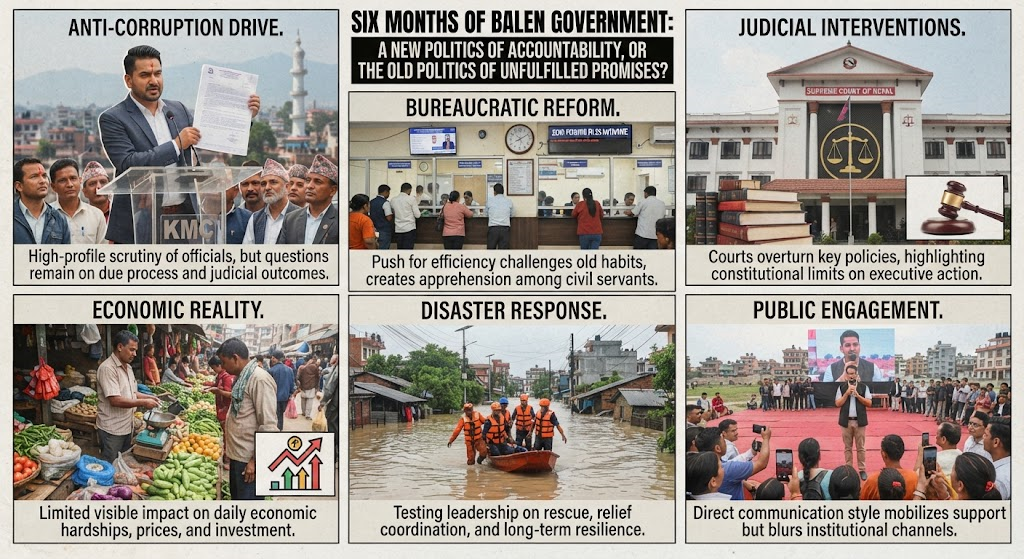
Six months into the administration, the Balen government presents a mixed picture. It has demonstrated political determination, initiated administrative restructuring and taken several high-profile steps against alleged corruption and institutional inefficiency. At the same time, its approach has generated concerns about due process, consultation, institutional independence and the gap between ambitious announcements and measurable results.
The central question is no longer whether the government wants to change the system. It is whether its methods and achievements are producing a more accountable, efficient and trustworthy state.
A government that began with a clear message
One of the administration’s defining features has been its willingness to challenge established administrative practices. Immediately after assuming office on March 27, the government introduced a 100-point governance reform agenda, placing administrative efficiency, corruption control, public service delivery and legal reform at the centre of its programme.
The government subsequently reduced the number of ministries, introduced a zero-pending-files initiative, initiated organisational reviews of public bodies and introduced performance-based agreements with senior administrative officials. These measures indicate an effort to move away from a government culture focused primarily on procedures and announcements towards one that emphasises deadlines and measurable responsibilities.
The message to the bureaucracy has also been unmistakable. Public officials are expected to work in the interest of citizens, not merely political leaders, and administrative positions are not to be treated as instruments of personal privilege.
This emphasis on accountability has resonated with citizens frustrated by slow public services, administrative negligence and allegations of corruption.
The government’s decision to establish a commission to investigate the assets of politicians and public officials, including individuals who have held public office since 2008, further reinforced its anti-corruption commitment. The initiative was presented as an evidence-based investigation rather than a political exercise.
The government has also challenged established practices surrounding public appointments and administrative privileges. Its efforts to restructure institutions and scrutinise public expenditure reflect a willingness to question arrangements that previous governments often left untouched.
These are meaningful signals. In a political environment where reform agendas have frequently lost momentum after government formation, the administration’s insistence on accountability deserves recognition.
But political determination is only the beginning of governance. The real test is whether these initiatives establish durable institutions rather than depend on the authority and personal intervention of the prime minister.
The anti-corruption drive: A promise under judicial scrutiny
The government’s most visible political strength has been its willingness to pursue investigations involving powerful political figures and public officials.
The investigation into the assets of former and serving officeholders, alongside high-profile arrests and corruption-related inquiries, has demonstrated that the administration is prepared to confront politically sensitive matters.
However, the distinction between initiating an investigation and establishing wrongdoing remains essential. Several prominent detainees have subsequently been released by courts, raising questions about the quality of evidence, investigative preparation and the legal foundations of some government actions.
This does not automatically invalidate the government’s anti-corruption agenda. Judicial release is not necessarily equivalent to a finding that an investigation was baseless. Nevertheless, a government that promises rule-based accountability must ensure that every investigation meets the same legal standards it expects others to follow.
The public wants corruption investigated, not merely suspects arrested. Sustainable accountability requires credible evidence, impartial investigation, effective prosecution and judicial outcomes.
The government will therefore need to demonstrate that its anti-corruption campaign is institutionally grounded rather than dependent on high-profile enforcement actions.
The bureaucracy: Accountability or an atmosphere of apprehension?
The administration’s relationship with the civil service has become one of its most consequential challenges.
Its demand for faster performance and greater public accountability addresses a longstanding problem in Nepal’s administration. Delayed files, weak coordination, procedural obstruction and limited responsibility for poor service delivery have frequently frustrated citizens.
Yet the government’s methods have generated considerable unease among civil servants.
Reports have described growing uncertainty over administrative careers, concerns about political advisers bypassing established channels and apprehension surrounding proposed retirement provisions and organisational restructuring. The arrest of former secretary Krishna Hari Pushkar over a message sent to the prime minister also intensified debate about the relationship between administrative accountability and freedom of expression.
The government’s underlying objective of making officials answerable to citizens is legitimate as a governance priority. But accountability cannot be achieved by creating an environment in which officials fear making decisions or offering professional advice.
An effective civil service needs both discipline and institutional confidence. Officials should face consequences for misconduct, negligence and corruption, but they must also be protected when they act lawfully and provide independent professional advice.
The challenge for Balen is to transform the bureaucracy without weakening its institutional capacity.
When reform meets the Constitution
The government’s reform agenda has repeatedly encountered judicial scrutiny.
The Supreme Court overturned the government’s policy restricting public advertisements to state-owned media, finding the arrangement unconstitutional and discriminatory. The court also intervened in government decisions concerning public appointments, student organisations and the treatment of informal settlers.
These developments expose a fundamental tension in the administration’s approach.
The government has a strong mandate to reform public institutions. But a parliamentary majority does not remove constitutional limits or eliminate the need for consultation and lawful procedures.
For example, the proposal to replace politically affiliated student organisations with alternative representative structures addresses a longstanding debate about political activity on university campuses. Yet attempting to implement such a major change through executive action rather than an adequately deliberated legislative process invited legal challenges.
Similarly, the attempt to channel government advertising exclusively through state-owned media raised concerns about fairness and media pluralism.
The Supreme Court’s interventions should not simply be interpreted as obstruction of reform. They are also part of the constitutional system through which executive decisions are tested.
The administration’s future credibility will depend partly on whether it learns to design reforms that can withstand legal scrutiny instead of repeatedly defending decisions after they have been challenged.
Disaster response: A defining test of leadership
The devastating floods have added another dimension to the government’s performance review.
The scale of the disaster has placed extraordinary pressure on the administration, particularly in rescue operations, relief distribution, reconstruction and rehabilitation.
The government has faced the challenge of responding to a major humanitarian emergency while continuing its broader reform agenda. International reporting has highlighted the extensive destruction and the difficulties of responding across affected areas.
The administration’s diplomatic efforts to secure international assistance and advocate grant-based recovery financing have also drawn attention to Nepal’s vulnerability to climate-related disasters.
Nevertheless, the continuing concerns over search and recovery, relief delivery and reconstruction have exposed the importance of coordination between federal, provincial and local authorities.
Disaster management is not measured by announcements or meetings alone. It is measured by whether affected families receive timely assistance, missing people are accounted for, damaged infrastructure is restored and communities are protected against future risks.
The government’s performance in these areas will remain a significant part of its public assessment.
A political style that challenges convention but raises questions
Balen’s political style is another defining feature of the administration.
The government has challenged traditional practices involving ceremonial inaugurations, political privileges and elaborate public displays of authority. Its preference for direct communication and a more restrained public image has helped distinguish it from previous administrations.
The prime minister’s address to the United Nations General Assembly, including his call for grant-based support for disaster recovery, also demonstrated an effort to present Nepal’s concerns on the international stage.
However, the government’s communication style has also generated controversy.
The extensive use of social media for policy announcements and political communication has raised questions about whether official decisions are being communicated through established institutional channels. The announcement of policy reversals before formal Cabinet approval has further contributed to concerns about procedure and transparency.
Direct communication can make government more accessible, but it cannot substitute for institutional decision-making.
The prime minister’s personal popularity may help mobilise public support for reform. Yet the long-term strength of a government depends on institutions that continue functioning effectively regardless of who occupies the highest office.
The economy: Where public expectations meet everyday reality
Perhaps the most important weakness of the government’s first six months is the limited visibility of improvements in people’s everyday economic circumstances.
The administration entered office with expectations of more efficient public services, stronger investment confidence, employment opportunities and effective market monitoring.
Yet reports and economic assessments published around the six-month mark continue to identify concerns over rising prices, employment, investment confidence and difficulties in accessing public services.
The government’s administrative restructuring may reduce unnecessary expenditure and improve coordination over time. But these measures do not automatically translate into economic growth or better household incomes.
Businesses need predictable policies, consistent regulation and confidence that investment decisions will not be disrupted by abrupt government interventions.
Likewise, ordinary citizens judge governance through practical experiences. The price of essential goods, access to public services, employment opportunities and the time required to complete routine administrative work.
The government has made digital governance a priority, but technological initiatives must be judged by whether they actually simplify citizens’ interactions with the state.
A digital service that remains difficult to access or fails to resolve an administrative problem is not meaningful reform merely because it has been launched online.
The administration needs to move beyond the language of efficiency and demonstrate measurable improvements in service delivery and economic opportunity.
The NEPSE test: Reform optimism has yet to reach investors
The stock market provides another mixed indicator of the government’s first six months. When Balendra Shah became prime minister on March 27, the NEPSE index was around 2,950 points. By September 30, it had fallen to 2,598.89, a decline of roughly 351 points, or nearly 12 percent. The market’s performance has therefore remained a source of concern despite government and regulatory initiatives aimed at strengthening the capital market.
The decline should not, however, be attributed entirely to the government, since NEPSE is influenced by interest rates, liquidity, corporate earnings, investor expectations and broader economic conditions. Still, the market is an important barometer of confidence, and its performance suggests that the political change and promised reforms have not yet translated into sustained optimism among investors. For a government that came to power promising economic dynamism and policy stability, reviving confidence in the capital market remains one of its unfinished challenges.
The unfinished promise of institutional reform
The government’s first six months have also highlighted the difference between announcing reforms and completing them.
Administrative restructuring and performance agreements represent important initiatives, but major legislative reforms, including legislation concerning education and the civil service, remain unfinished according to assessments published around the six-month milestone.
The government must also demonstrate that its reforms are sustainable.
Reducing ministries, restructuring public bodies and introducing performance indicators may improve efficiency, but the public ultimately needs evidence of better outcomes.
How much time has been saved in public offices? Have citizens experienced shorter waiting periods? Has corruption declined in measurable terms? Are public appointments more transparent? Have government services become more accessible?
These are the questions that should guide the next stage of evaluation.
The administration’s own claims of progress should be assessed alongside independent evidence, judicial decisions and citizens’ experiences.
Six months later: The opportunity remains, but the clock is moving
The Balen government has not been short of political authority or public expectations. Its near two-thirds parliamentary mandate provides considerable room for legislative action and institutional reform.
That makes the administration’s responsibilities particularly significant.
Its strengths are visible in its determination to challenge established practices, prioritise governance reform, pursue corruption investigations and demand greater administrative accountability.
Its weaknesses are equally important as there are concerns over due process, strained relations with the bureaucracy, judicial setbacks, unfinished legislation, economic uncertainty and questions about the effectiveness of public service delivery.
These developments do not amount to a definitive verdict on a government that has completed only six months of a five-year term. Nor should the scale of the challenges be used to excuse shortcomings in implementation.
The administration still has substantial time to correct its course, strengthen consultation, improve coordination and turn its reform agenda into measurable outcomes.
The most important transition it must now make is from a government that demonstrates its willingness to act to one that consistently demonstrates the results of its actions.
Ultimately, the success of the Balen government will not be determined by how many officials it confronts, how many institutions it restructures or how forcefully it announces reforms.
It will be determined by whether citizens experience a state that is more transparent, less corrupt, more efficient, economically responsive and respectful of constitutional rights.
Six months have established the government’s reformist intent. The remaining years must establish its institutional legacy.
Author is an expert in international law and he is practising lawyer in the Supreme Court of Nepal.