A review of Veena Joshi (Rajbhandari)’s Newar Samudayaka Paramparagat Mukundonach (Traditional Mask Dance of Newar Community), winner of the Madan Puraskar 2082
Amrit Kharel

Behind each mask in this book there is a face, a guru, a family that has danced for generations, and an old woman in a hall who kept her promise to a schoolroom in Malangwa.
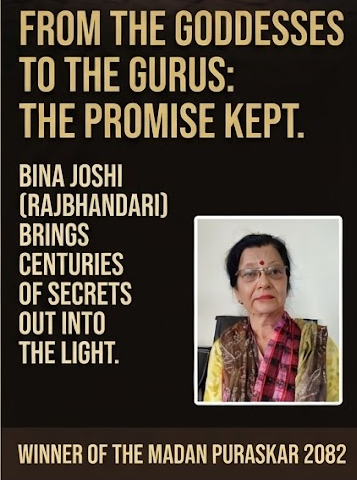
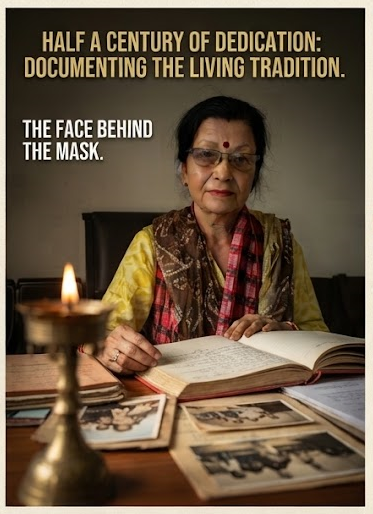
Some seventy years ago, in a school in Malangwa, Sarlahi, a town with no electricity and no road to the rest of Nepal, a young girl noticed that her school honoured dance by the students. She was highly motivated by this incident and made up her mind to pursue higher education in dance and give her life to it. This September that girl, now eighty-two, learned that the country’s most prestigious literary prize was hers.
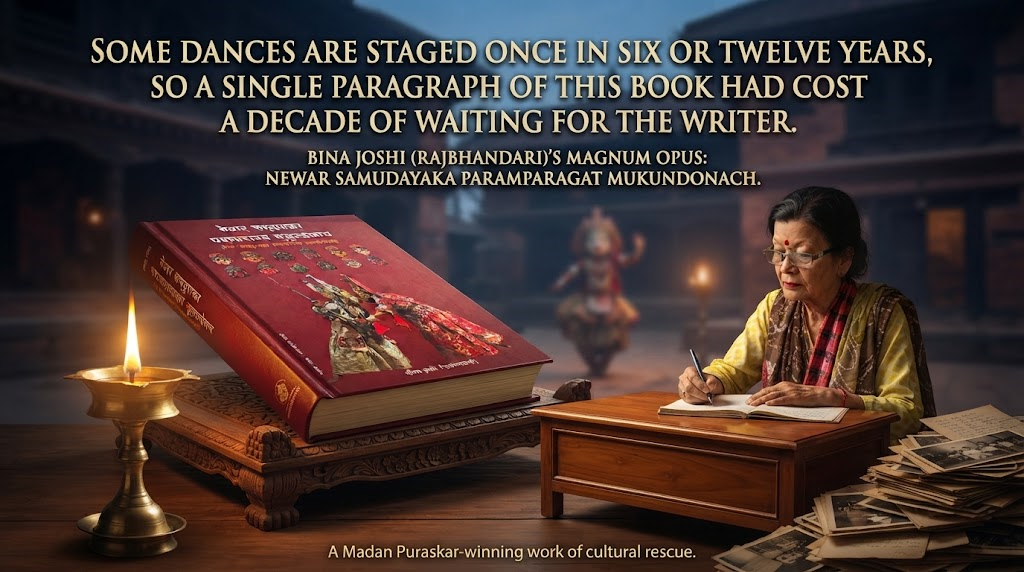
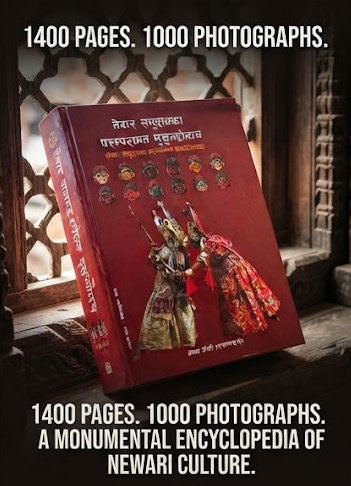
The book that earned it is, first of all, is an act of her endurance. It runs to roughly 1,400 pages in seventeen sections, with about a thousand photographs. The author wrote it herself and published it herself, and by her own account paid for it from savings set aside from household expenses. It was released on Jestha 3, 2083, unveiled by her mother, who is a hundred years old, and fifteen traditional gurus conversant to tantric form of dance in a ceremony organized at the Mahendra Police Club in Kathmandu.
From 298 submissions, the Madan Puraskar Guthi chose this book for collecting and documenting Newar mask-dance traditions that are still alive in community practice.

Seventeen chapels under one roof
The structure of the book is expansive and comprehensive. Five opening sections prepare the ground. The first sets the stage which covers the history of dance, the Valley, the Newar performers, and what the Shah-era capital added.
The second turns the year into a score, arranging festivals and jatras by lunar tithi and solar month.
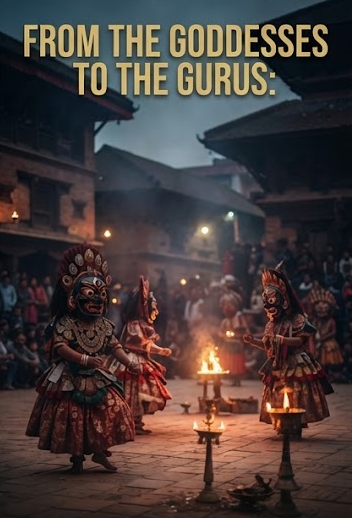
The third introduces the cast which covers the Nasa:dya, the Ashtamatrika and Bhairav troupe, the rites of sacrifice and feast/bhoj, and the making of the mask itself.
The fourth section measures the dances against the Natyashastra and the Abhinaya Darpana. The fifth turns to carya, the Vajrayana ritual song and dance.
Twelve sections then follow dance by dance one by one including Kartik naach, the Gathu Pyakhan of the Malakars, the Devi naach of Kilagal, Sankhu, Sanga, Panauti and Banepa, the Mahakali naach of Bhaktapur and Thimi, Nilbarahi of Bode, the Bhairav naach, Shwetkali, Harisiddhi, Sikali Pyakhan (Rudrayani), Halchok’s Akashbhairav, Lakhey, and finally Bhaktapur’s Makah Pyakhan alongside the Hanuman dances of Baglung, Beni and Kusma. That last section carries the book beyond the Valley. The dances taken by the Newar communities along with them outside the valley during their migration inspired by their distance trading activities are well covered in the book.
Each section closes with its own conclusion and reference list, and a general conclusion and appendix follow.
The book also give an account of the history of Nepal Mandal Valley. Bhaktapur was divided into tol by tol into upper, middle and lower, long lists of ward names, manuscripts dated in Nepal Sambat, verses in Newari. This is a documentary mind at work, one that prefers the list to the flourish. These all collection has presented the volume as an encyclopedia of Newari culture.
How it was made
The foreword is itself the noteworthy part of the book. The author watched almost every dance she describes in person. She names only Kirtipur’s Devi naach and the Dakshinkali naach as exceptions. At the Gathu Pyakhan in Kathmandu and Kirtipur she sat in one place for seventeen or eighteen hours.
Some dances are staged once in six or twelve years, so a single paragraph of this book had cost a decade of waiting for the writer. The tantric core of these dances is guarded by initiated gurus, and she came to it as an outsider to that circle and as a woman. The writer mentions in her preface that different gurus saw her persistence and confidence and chose to speak, because she was able to convince them that knowledge that is not documented goes to the pyre with the guru.
When she moved new house, notes were lost and had to be rewritten. Typing and editing took years, partly because she wanted a person she could trust with knowledge that others might copy the matter.
Three voices in the front matter
Hariram Joshi’s essay in the preface, Mukundonachko Brihat Shalyakriya (“The Great Surgery of Mukundo Naach”), opens the book. It is less a summary than a learned overture. He traces dance from the Rigvedic nritu and Shiva Nataraja through the Skanda Purana’s twilight dance of Shiva, the Pashupati inscription of Samvat 157 that names Shiva Nrityeshwar, Lichchhavi inscriptions of music and dance associations, the devadasi tradition, and Kalhana’s Rajatarangini.
He lingers on a Patan legend in which Shiva teaches music to Bhimsen, and he is careful to call it folk narrative (lokakhyan) while noting that the paired images at Mangal Bazaar support it. He then turns to the author as a disciple and “karmayogi”, and says that to call her work a great gift to the nation would be no exaggeration (atyukti nahola).
He ends with the Sanskrit maxim kirtir yasya sa jivati: he lives whose fame lives. Joshi is himself a Madan laureate (2058 BS, for Abhinav Sanskriti Kosh), so his blessing carries weight.
Yajnamanpati Vajracharya writes the preface from inside the tradition. He values the carya section most, because the practice had long been confined to the Vajracharya community and it is notable that an outsider has now documented it. He singles out the rare Payenta (panchatal) material, the khale raga bols, and the comparative section on Kathmandu and Patan. His image is memorable: a lamp lit for centuries inside a pitcher (ghaito), which this book carries out into the open.
Bhairab Bahadur Thapa, a dance scholar, calls it a bhimkay (“colossal”) book and insists it is also a historical document and an important record of Newar tradition, the work of five decades of research.
The question of myth
Some readers might object that the book admits too much legend and too little proof. The objection deserves a direct answer, and the author’s own preface supplies much of it.
She says plainly what she did. On the origin of the dances she heard that the goddesses themselves wrote down the rules, that ancestors learned by watching the goddesses dance, and that ancestors learned by binding the goddesses through tantric practice. She recorded the folk testimony she found, and then, because folk memory could not supply authority, she went looking for inscriptions, chronicles and technical evidence.
She also admits the obstacles and limitations in her research work. The historical chronicles contradict, different kings are credited, and written records are destroyed by earthquakes roughly once a century. Her use of evidence is uneven but not naive. She says the Mahakali naach was refined from an older Devi dance and reworked in the reign of Surendra Bikram Shah, and she notes that Lalitpur’s Kartik naach has a dated origin under Siddhinarasimha while other places lack any record. She argues that the dances predate the Malla era, citing the permission-seeking custom tied to the earlier Thakuri dynasty and the dancing ganas on seventh- and eighth-century Umamaheshwar sculptures.
Here the critics have a point. A dancing figure in stone proves a dance culture. It does not by itself prove an unbroken line of masked performance across centuries. The chain from Neolithic peoples through the Nag to the Newars, which she adopts while acknowledging that historians differ, is a plausible composite and no more. The tantric origin stories can be recorded but not tested.
But such objection will misjudge the genre. This is first an ethnography and then only an archive, which is exactly what the Madan Puraskar Guthi has honoured. In such a work a legend is data about how a community understands itself, and the claim that goddesses taught the dance tells us what the performers believe.
The author calls her method seeing history “through the eyes of dance”, and she concedes that the book is not complete: research, she says, is diving into an ocean. Her weaker moments come when macro-history carries more weight than the evidence can bear. A future edition could help the reader by marking, in each section, what rests on inscription or text, what on dated manuscript, and what on oral tradition alone.
Other reservations
The book is enormous, and at the price of Rs. 7,000 it is out of reach of many of the undergraduate students of culture and dance and also the general cultural enthusiast readers who would most benefit. The self-contained structure, each section with its own introduction, conclusion and references helps the dip-in reader but will cost the cover-to-cover reader with some repetition of matters.
From the contents pages, no index of names and terms has been developed, which a work of this size badly needs. A bilingual glossary, an English summary and a digital archive of the photographs and recordings would multiply its reach.
Why a lover of culture must read it
First, because it is rescue work. Some of these dances come round once in twelve years, and much of the knowledge sits with elderly gurus. Once it is written down it can no longer be lost with them.
Second, because it reads the whole Newar year as performance, when each dance falls, who dances it, and why. Third, because it makes visible the social machinery behind the masks, the guthis, the caste and occupational roles, and the rituals of mask-making and offering.
Fourth, because it lets us see how ritual dance holds together technique, theology and community memory. Whatever one thinks of its theories of origin, the record she has made is of a kind that cannot be remade.
Fifth, because it is the life’s work of a woman who stayed in the field for half a century and earned the trust of gurus who guard their secrets. Yet in our society, scant literatures of research works are published by the women writers in comparison to the male writers.
Verdict
Hariram Joshi’s title proposes a surgery, and every surgeon needs a scalpel. Here the blade is sharpest where the author is closest to the dancers, on their masks, steps, calendars and guthis, and bluntest where she reaches back for the earliest origins and history. That is a limit, and an honest one. It does not diminish the achievement. Writer is indeed not a historian but a cultural expert. Behind each mask in this book there is a face, a guru, a family that has danced for generations, and an old woman in a hall who kept her promise to a schoolroom in Malangwa.
Reviewer’s rating: 4.7 out of 5