Amrit Kharel

A frightened judge is a movable judge. Parliament can remove a judge for misconduct, and a judge who fears that power has two honest answers. Keep your record clean in the open, or resign. Taking shelter with a stranger who offers to hold off the House is a third answer, and it is the one the public will not forgive. The offer was itself the pressure.
There is an old test for a judge that needs no statute. Ask whether he would be comfortable if the room he sat in last week were shown on television. By that test the Supreme Court has had a poor week, and it wrote most of the script itself.
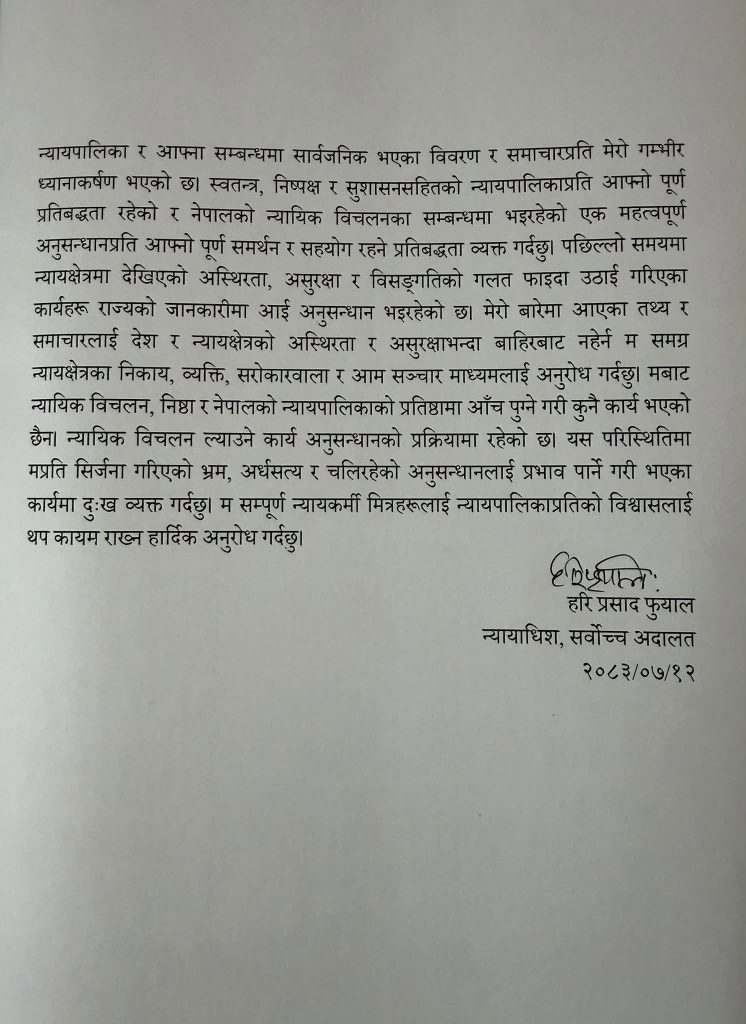
Four statements came out on Kartik 12 (October 29). Justice Hari Prasad Phuyal spoke to journalists and then issued a written note in the evening through his facebook account.
Chief Justice Manoj Kumar Sharma issued a denial with the seal of Supreme Court.
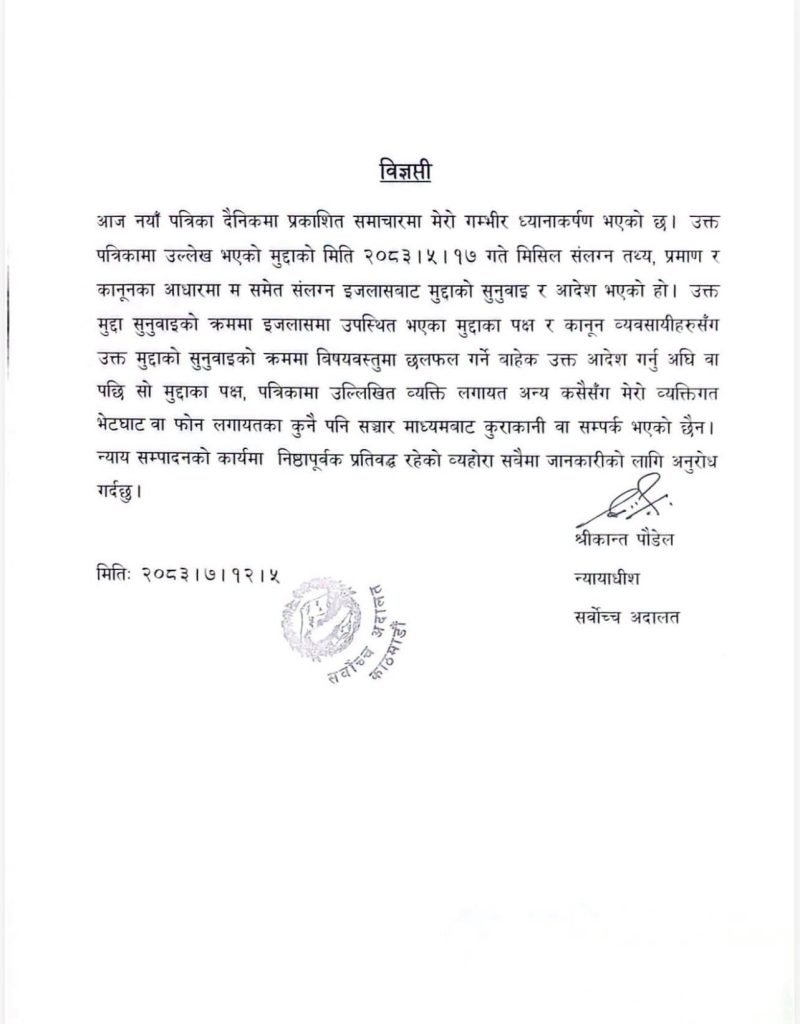
Justice Shreekanta Poudel issued another with court’s seal.
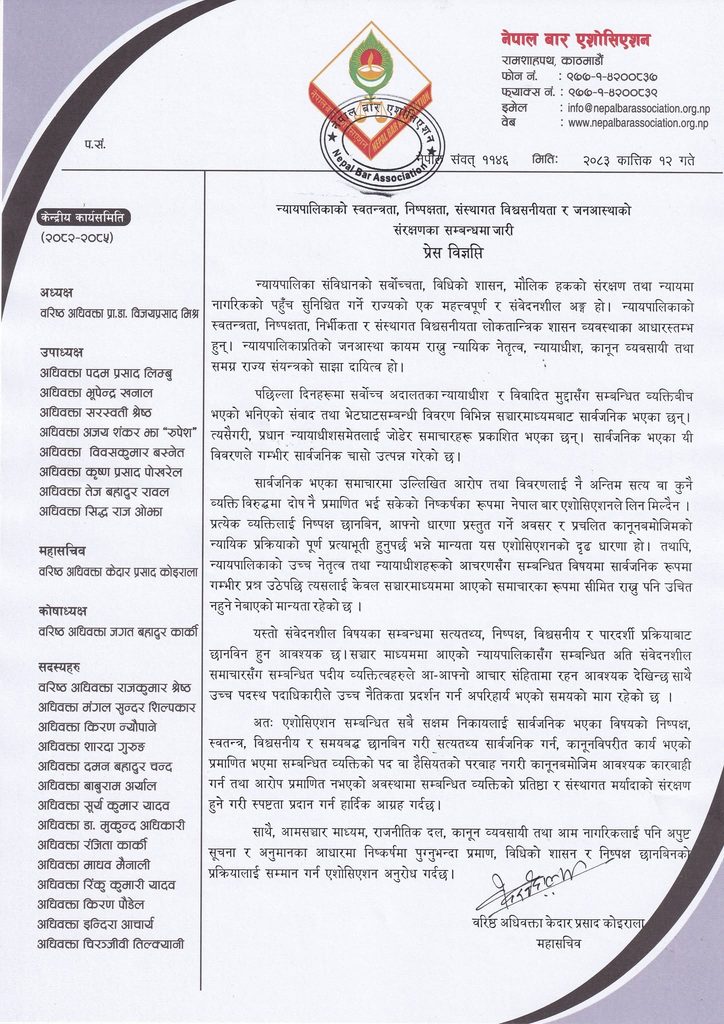
The Nepal Bar Association asked for an independent inquiry. I have read all four slowly, twice, with the patience of a man marking exam papers, and I want to say what a columnist may say and a news report may not.
First the fair part. The allegations about ‘middleman’ Inam Sapkota are unproven and are being investigated.
Nobody has shown that any judge took a single rupee. The Chief Justice and Justice Poudel deny any contact. But I do not need a bribe to be troubled. The judges have told us enough about themselves, and what they have told us is worse than what the newspapers guessed.
The question for a judge was never whether a man turned out to be a fraud. The question is why a judge was in the room.
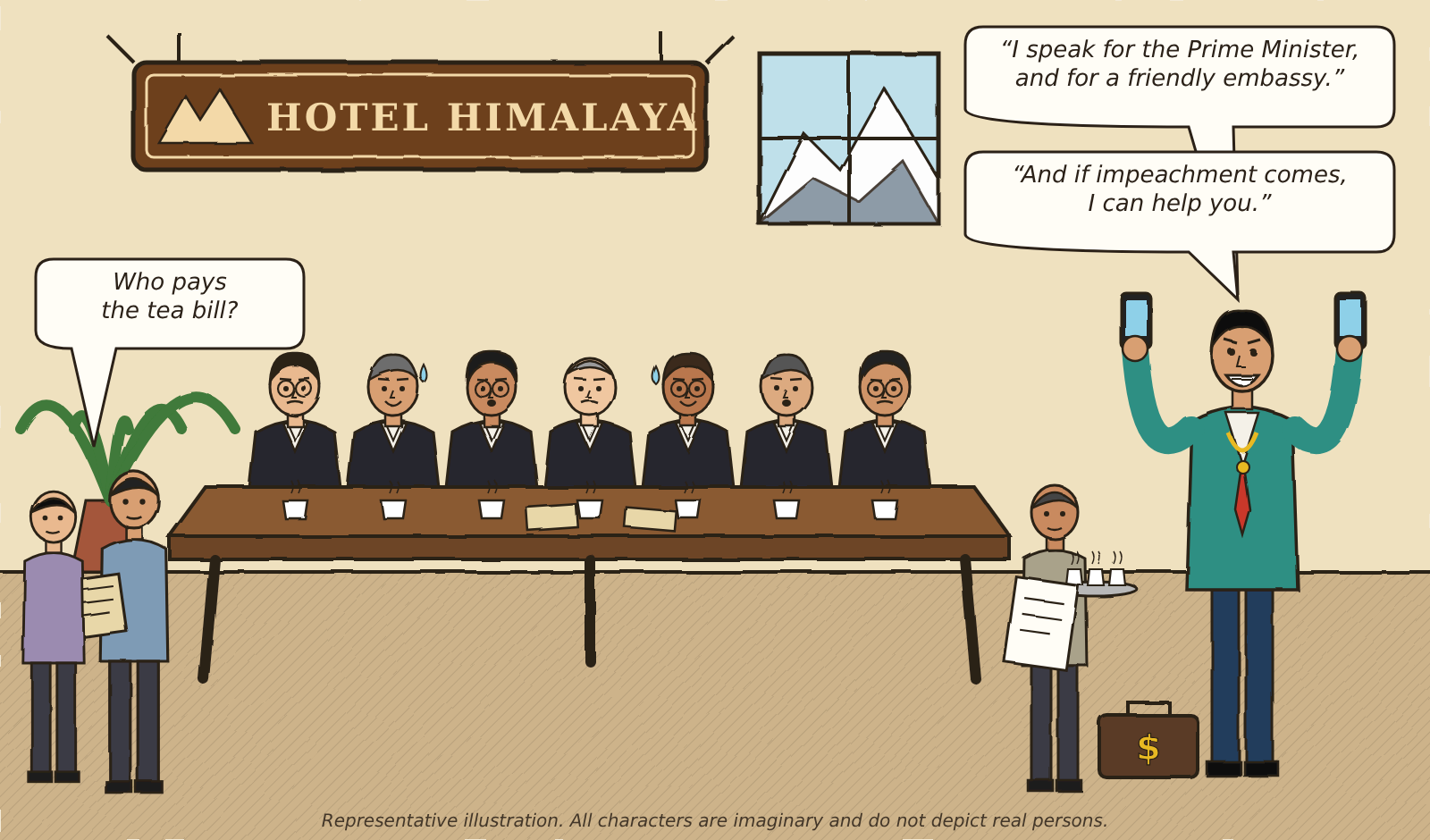
Why would a Supreme Court judge go to Hotel Himalaya to sit with a man who calls himself the Prime Minister’s person and an embassy’s person? If the judge believed the man, the meeting is a problem. If he doubted him, the meeting is also a problem. I cannot find a version in which the visit is fine. A judge does not need a rule for this.
The Judge Who Went Where He Was Called
Start with Justice Phuyal, because he said the most. He admits that he and colleagues met a man who told them he spoke for the Prime Minister and for a friendly embassy. He says he was the third judge the man approached. He says the man promised to help judges if impeachment came. He says a friend at the embassy told him no one of that name worked there. And still the meetings went on, and the last of them was held at Hotel Himalaya.
Stop at that embassy check. That was the moment the whole story could have ended. A judge who learns that the embassy has never heard of the man shuts the door, writes to the Chief Justice that very day and calls the investigators. Instead the account carries on for weeks.
The man starts raising cases. He asks judges to pass a word to a colleague in a habeas matter. He speaks loudly about the Prime Minister’s displeasure. The hotel bill is put in someone else’s name. The judge himself asks whether the man takes his money in American dollars. Who asks that question of a person he trusts? A judge who asks it already suspects the answer, and still sits down for the next cup.
I keep returning to a plain question. Why would a Supreme Court judge go to Hotel Himalaya to sit with a man who calls himself the Prime Minister’s person and an embassy’s person? If the judge believed the man, the meeting is a problem. If he doubted him, the meeting is also a problem. I cannot find a version in which the visit is fine. A judge does not need a rule for this. He needs the instinct that tells him which rooms to stay out of.
Those of us who regularly litigate at Supreme Court and write about the courts keep a simple habit. The moment a person is recommended for the bench we stop all contact except open academic talk. Friends and colleagues of yesterday are suddenly judges, and the dignity of the office comes first. If outsiders and professional lawyers can keep that distance, how can judges themselves not keep it? This is basic minimum ethics for a post we call honourable. A judge’s dignity is kept by the judge, and nobody else can hold it for him.
Here is the line that stayed with me. Justice Phuyal says it might have been better not to meet the man, but that the man claimed to carry the Prime Minister’s message and that he believed so at the time.
Read it again. The regret is not that judges sat with a messenger of the executive. The regret is that the messenger was false. Had he been real, the same meetings would have felt right.
So I will ask what nobody has asked. People who went wherever they were called, and whenever they were called, because someone said he spoke for the Prime Minister, what would they have done if the Prime Minister himself had called? What if he had sent a real envoy, with the same talk of impeachment, and given them work? I think we all know the answer. They would have gone, and they would have done it.
I suspect the anger we now hear is not about the meetings at all. It is about being lied to. They are cross that a dishonest man deceived them, not that they went. That is the wrong thing to be cross about.
Judicial Independence and Ethics of Judgeship
The independence of a court is not damaged only by frauds. It is damaged far more by the real thing. A real minister, a real embassy or a real party leader who calls a judge to a hotel and says, “Help us,” or faces impeachment must be told no, and the approach must be reported in writing the same day to the Chief Justice and the investigators. A judge who treats the Prime Minister’s displeasure as something to be managed has already conceded that judges serve at the Prime Minister’s pleasure. That concession does not need a bribe to hurt the court.
Justice Phuyal also says he and others felt insecure, afraid of impeachment. I believe him, and it is the most damaging sentence in his briefing. A frightened judge is a movable judge. Parliament can remove a judge for misconduct, and a judge who fears that power has two honest answers. Keep your record clean in the open, or resign. Taking shelter with a stranger who offers to hold off the House is a third answer, and it is the one the public will not forgive. The offer was itself the pressure.
At the press briefing Justice Phuyal called it judicial corruption. In his written note, the same matter becomes judicial deviation. A softer word on paper than in speech. He says he is sorry for the confusion the news created, and I ask what a judge is apologising for. A newspaper did not write about his conduct. He says he is not disturbed in financial, moral or conduct matters, but he does not tell us which charge he is denying. A denial of an unnamed charge costs nothing. His note says nothing he did harmed the reputation of the judiciary, while his own briefing describes the meetings. Harm to reputation is not judged by the judge. It is judged by the reasonable observer, and that observer is not impressed.
He also tells us that on the morning of the briefing he rang the police to ask whether the matter was in their file. A witness telephoning investigators about the contents of their file is not a small thing, however politely done. In the same breath he asks that his words should not affect the inquiry. Then he speaks to the press at length, and reads out what he saw in the case files of the habeas matters. A judge who recites files to reporters while investigations run does what a judge should not.
And look at whom the judges told. By his own account, the secretariat of the police chief, a senior level of the Prime Minister’s office, a retired army general, and finally the Chief of Army Staff. Judges afraid of pressure from the executive carried their fear to the executive and the army. Where was the Chief Justice in this account, and the Judicial Council, and a written complaint to the proper authority? He does not say. A judiciary that reports its own pressure upward to the powers it should be independent of has handed them a story about itself.
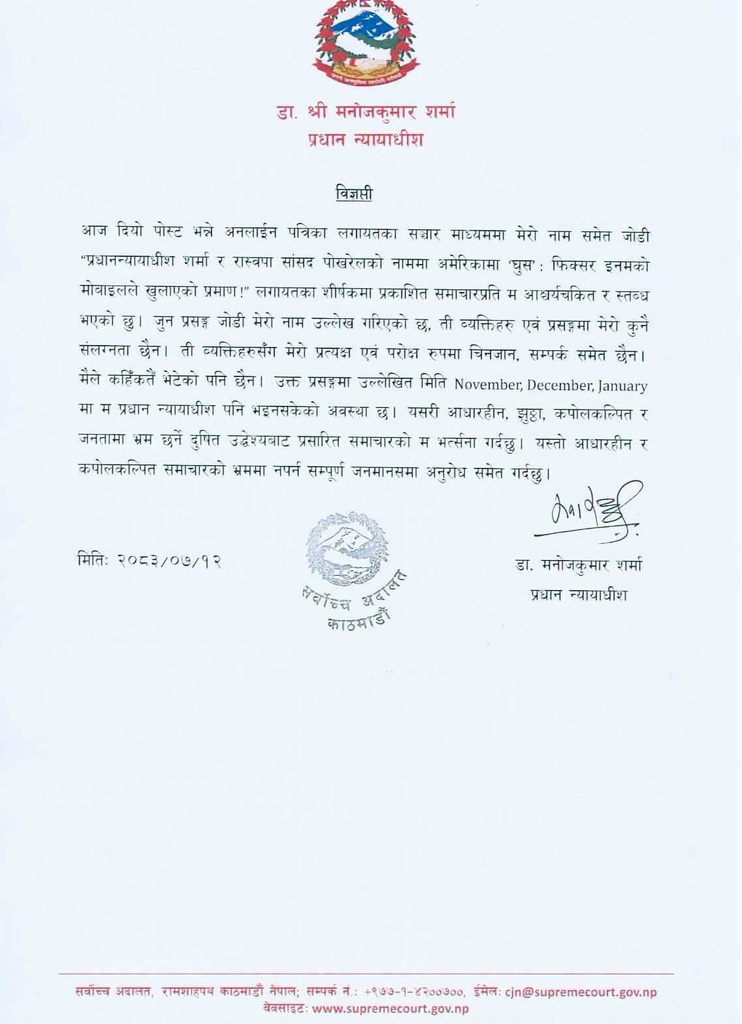
The Chief Justice says he is shocked, has never met those named, has no acquaintance with them, and was not yet Chief Justice in the months the report names. But Justice Phuyal says the suspicious man claimed he had made the Chief Justice and urged judges to help him. If a stranger was walking around using the Chief Justice’s name, the Chief Justice is the victim of that abuse and should demand an inquiry. His note only condemns a newspaper. The head of the court has not offered anyone a look at his phone, and a person who is certain should be the first to offer.
Justice Poudel says that apart from the hearing itself he had no meeting, call or contact with anyone. Anyone? No judge can say that, because judges speak to people all day. And the note speaks of one case. It never says whether he has met Inam Sapkota anywhere else, while Justice Phuyal says the two of them sat together in the Rohit Gupta habeas matter that the man tried to influence. The denial is too wide to be believed and too loose to be tested. One plain sentence would settle it.
No fair and quick forum exists where a judge can be heard, so he goes to the cameras. He becomes a litigant in his own cause, and every sentence he speaks becomes evidence. And public trust moves from reasoned judgments to press releases. A judge speaks through his orders. A judge who needs a notice to repair his name has already lost something a notice cannot return.
Who authorizes judges to use the Supreme Court seal in their personal matters?
The Chief Justice’s note comes under the national emblem, with the round seal of the Supreme Court at Kathmandu, and with the court’s address, telephone, email and website printed along the foot. Justice Poudel’s note carries the court seal too. Yet the sentences inside are personal. I am surprised. I have never met them. My own meeting or call. A private denial dressed in the colours of the state.
The emblem and the seal belong to the nation and to the court, not to any judge’s reputation. If the charge is against a person, he should answer on his own paper or through his lawyer. If the charge is against the court, the court should answer as a court, through the Full Court or the registrar, in the third person, saying what the institution will do. A first-person denial under the seal is neither. It makes one judge’s word look like a finding of the institution, the same institution that will soon be asked to look into the matter. I would like the registrar to say who approved this use, who drafted the notices, and who paid for the stationery. Justice Phuyal’s note, to his credit, carries no seal in the copy I saw.
And what does it mean when a judge must defend himself in the press? It means three things have already gone wrong. No fair and quick forum exists where a judge can be heard, so he goes to the cameras. He becomes a litigant in his own cause, and every sentence he speaks becomes evidence. And public trust moves from reasoned judgments to press releases. A judge speaks through his orders. A judge who needs a notice to repair his name has already lost something a notice cannot return.
Parliament has the last word. A motion of impeachment can be moved by one fourth of the members of the House of Representatives, on grounds of conduct and not the merits of a judgment. A sensible path is for a committee to ask the police, the Home Ministry, the Prime Minister’s office and the army to brief it in writing, to take a written account from each named judge, and then for the House to decide in the open whether the facts could amount to misbehaviour. The dispute around Chief Justice Cholendra Shumsher Rana taught us that procedure must be settled first, so that it looks neither like revenge nor like rescue.
Nepal Bar Association: Too vague in its position
The Bar’s release is sensible on balance and weak in detail. It says allegations are not final truth and every person deserves a fair hearing, then asks competent bodies to hold a credible, open and time bound inquiry. Which bodies? It names none.
In our country competent bodies is an invitation for each body to point at another. The police may say it is for Parliament, Parliament may say the Judicial Council, and the Council is chaired by the very office in question. The release also does not ask the named judges to step away from related cases, which is the most practical request of all. And it was dated the same day as the briefing, so it does not answer what a sitting judge has now admitted.
This release can be a disguised call for a commission that skips Parliament. Removal of a Supreme Court judge belongs to the House, and an inquiry without power or an owner ends in a drawer, as many have before. So the design matters more than the demand.
What should be the next course of action?
I would like to prescribe to run two inquiries, not one. The first looks at Inam Sapkota and at whoever paid, took or promised money, a criminal matter that is already moving. The second looks only at what judges did, a matter of conduct. Mixing them lets each protect the other. Secure the evidence at once, including the fixer’s phone, the Hotel Himalaya records, the court’s visitor logs, the call records and the written reports Justice Phuyal says he sent, with their dates. Every judge who met the man should file an open account of each meeting.
The Judicial Council has a real role over judges of the lower courts and Supreme Court as well, and Justice Phuyal himself asks that the man’s contacts with judges and staff of the Supreme Court. That part is squarely within its reach. But it cannot sit over its own chair, so the Chief Justice and any named judge must stay out of its handling of this matter during investiagtion from Judicial Council. The Constitutional Council does not investigate. Yet it can publish the non confidential record of how appointments were considered, ask the Prime Minister’s office to say in writing whether this man had any role or authority, and adopt a rule that anyone it considers must declare contacts with go betweens. The Prime Minister and the Chief Justice sit on that Council, so they too should stand aside from questions about themselves.
A judge who keeps his dignity gets a quiet retirement. One who does not finds that a retired life is a long and heavy time. The dignity of a judge is kept by the judge. Everything else, the inquiry, the Bar, the Council, the House, can only discover whether he kept it.
Parliament has the last word. A motion of impeachment can be moved by one fourth of the members of the House of Representatives, on grounds of conduct and not the merits of a judgment. A sensible path is for a committee to ask the police, the Home Ministry, the Prime Minister’s office and the army to brief it in writing, to take a written account from each named judge, and then for the House to decide in the open whether the facts could amount to misbehaviour. The dispute around Chief Justice Cholendra Shumsher Rana taught us that procedure must be settled first, so that it looks neither like revenge nor like rescue.
While all this runs, judges named in credible reports should step off related cases. If the Chief Justice’s denial is true, the fastest way to end the matter is to open his own phone and records.
Judges like to say that the rules are clear, so let me quote them back. The Bangalore Principles of Judicial Conduct, written by senior judges themselves and welcomed by the United Nations, rest on six values, independence, impartiality, integrity, propriety, equality, and competence with diligence. They ask a judge to be free of improper influence from any quarter, to avoid the appearance of impropriety in everything he does, to accept restrictions that an ordinary citizen would find hard, and to step aside where a reasonable observer would doubt his fairness. Notice the test. It is the picture formed in the mind of a fair and informed citizen, not the judge’s own sense of innocence. By that test, the question before us is not whether any judge took a bribe. It is whether any citizen can now believe these judges were free.
A judge must also be able to hear a threat, or an offer of shelter, and not feel his chair move. This is why we call such a person a Nyayamurti. The Sanskrit Mahakavi poet Bhartrihari describes the steadfast in the Nitishatakam, in a verse that is printed on the back of the Nepal Kanoon Patrika as well.
निन्दन्तु नीतिनिपुणा यदि वा स्तुवन्तु लक्ष्मीः समाविशतु गच्छतु वा यथेष्टम् ।
अद्यैव वा मरणमस्तु युगान्तरे वा न्याय्यात्पथः प्रविचलन्ति पदं न धीराः ॥
Let the clever blame or praise, let wealth come or go as it pleases, let death arrive today or ages from now, the steady do not move one step from the path of justice. Praise, blame, money and fear of death are the four things the poet says cannot move a judge. Fear of impeachment is a fifth. A person who can be moved by any of them is not yet a judge in this old sense, and a judge who is willing to die before he bends should hardly be afraid of a visitor with a loud voice.
Looking at the state of our judges today, I think even Bhartrihari would feel embarrassed. A judge who keeps his dignity gets a quiet retirement. One who does not finds that a retired life is a long and heavy time. The dignity of a judge is kept by the judge. Everything else, the inquiry, the Bar, the Council, the House, can only discover whether he kept it.
Author is a practicsing lawyer at Supreme Court of Nepal. He is an expert of International and Commercial Law. He is engaged in professorship of law.