फूलखेती
Bhadrapur (Jhapa), November 1 (Kartik 15)
Three farmers from Duiringe, Buddhashanti Rural Municipality-3, have turned to commercial flower cultivation with the target of generating a turnover ranging from NPR 1 million to 1.2 million, on land that previously yielded only about NPR 50,000 annually from paddy cultivation.
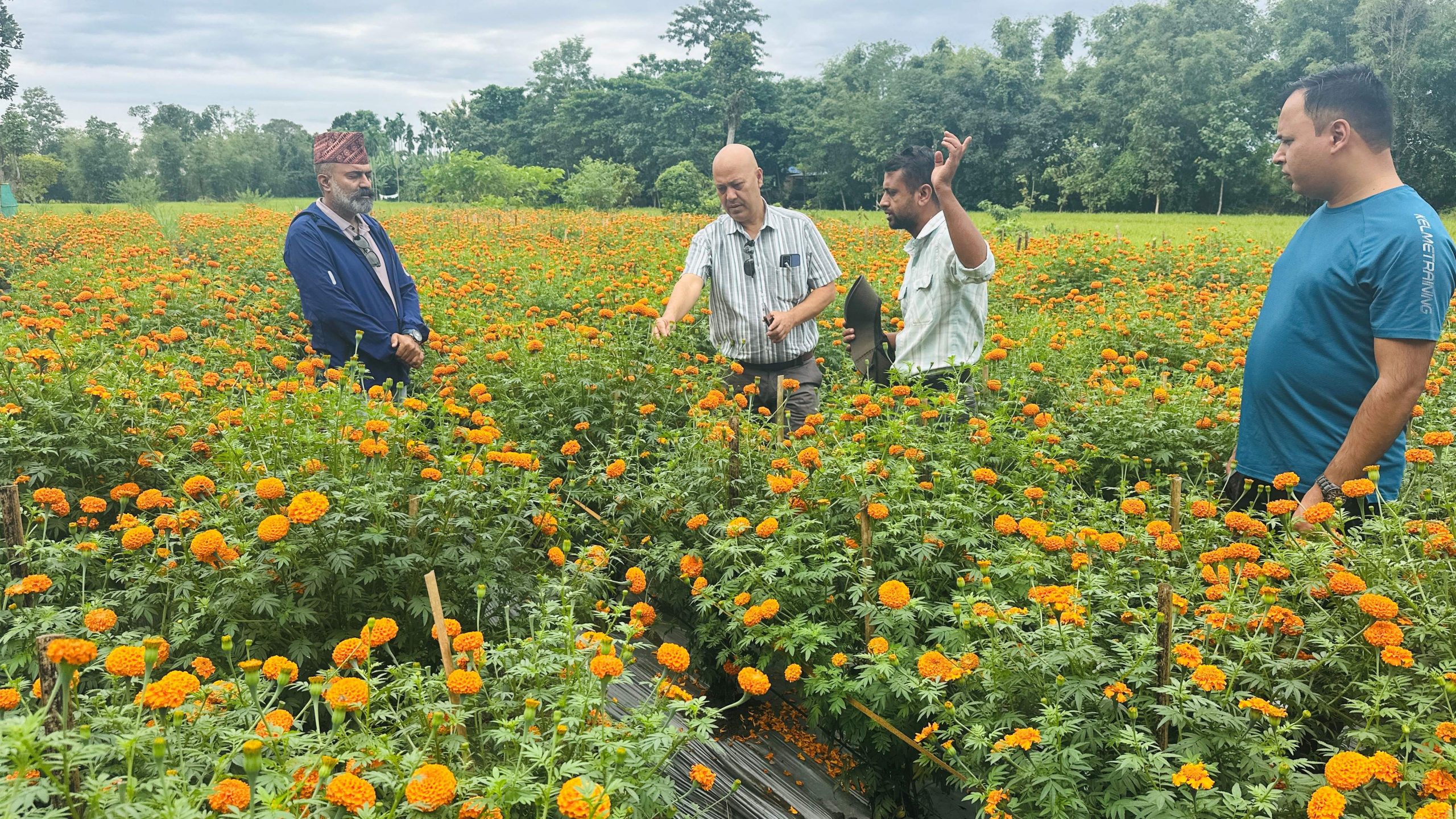
Binod Rijal, Gunaraj Nyaupane, and Birbal Baniya have collectively cultivated marigold flowers across 10 kattha of land.
Formed under the name of the ‘Krishi Compass’ group, their initiative serves as a promising alternative for farmers seeking transitions away from traditional farming.
The group planted over 7,000 marigold saplings on the land. Having invested NPR 550,000 in the venture, they expect to yield approximately 10,000 flower garlands.
They estimate earning at least NPR 1 million to 1.2 million from the sale of these garlands. Currently, flowers are being harvested, woven into garlands, and stored in cold storage units.
According to group member Gunaraj Nyaupane, paddy farming on the same land yielded around 30 muri of grain, which commands a current market value of only about NPR 50,000.
Realizing that flower farming yields manifold returns compared to paddy, they opted for an alternative crop.
“If we had planted paddy on this very land, the total yield would have been around 30 muri, worth only about NPR 50,000.
The income generated from five to seven years of paddy farming can now be reaped in just a single year through flower farming,” said Nyaupane.
He noted that the market prospects for flowers are quite favorable. With a single garland priced between NPR 100 and 150, he is confident that selling the produce will yield the anticipated returns.
Encouraged by market demand and this year’s experience, the group plans to expand cultivation next year.
Another group member, Binod Rijal, shared that preparations are underway to expand marigold farming across three bighas of land next year.
However, alongside lucrative income potentials, flower farming comes with its share of challenges. Farmers face difficulties in preserving harvested flowers for long periods and transporting them to markets.
In particular, they have expressed concerns that flower imports from India could overshadow local produce and risk their investments. Addressing this issue, a delegation of commercial flower farmers met Chief District Officer Shravan Kumar Pokhrel on Tuesday and submitted a seven-point memorandum.
The farmers demanded that domestic marigold flowers be given top priority in local markets and that unauthorized imports from India be curbed.
To understand the farmers’ demands and inspect the state of flower cultivation in the district, Chief District Officer Pokhrel visited Buddhashanti on Saturday.
He met with commercial flower farmers to gather ground-level information regarding production and market conditions.
Speaking on the occasion, he stated that if local production is sufficient to meet market demand, external flower imports can be controlled.
“Your demand that commercial flower farming undertaken collectively and domestic products receive market priority is entirely justified.
The administration also adopts policies to encourage domestic products,” Pokhrel said, adding, “Given the massive demand for flowers in Jhapa, our only concern is whether local production can fully satisfy it. If needed, flowers can also be sourced from other eastern hill districts.”
Manish Dahal, a local campaign activist for ‘Sundar Shanta Nepal’, noted that farmers’ attraction toward commercial flower cultivation in the district is growing.
According to him, commercial flower farming is expanding rapidly across large areas in Buddhashanti, including Shantinagar, Sunmai, and Gopaldanda.
Observing the rising interest and expansion trends, he expressed optimism that Jhapa could soon become self-reliant in flower production.
RSS