पैयाँ नाच
DANG, Oct 18.
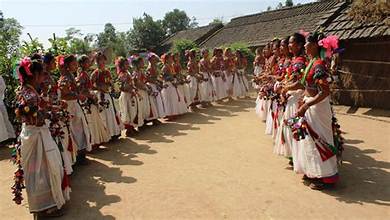
The Tharu settlements in Dang district are currently alive with the vibrant festivities of the traditional Sakhya Paiyan dance. As Dashain approaches, the tradition of collectively performing the Sakhya Paiyan dance in village communities has gained momentum, starting about two weeks prior to the festival and continuing until the conclusion of Bada Dashain.
According to local Ramprasad Chaudhary, the dance began as early as September 28 in Okhara, Ghorahi Sub-Metropolitan City-17. While some other Tharu settlements have already commenced the dance, others are preparing to do so. The Sakhya dance is a unique, indigenous tradition exclusive to the Tharu community and is known as the longest-running continuous dance form. Chaudhary explains that the dance typically begins after the Krishna Janmashtami and Atwari festivals ahead of Dashain, and continues through Tihar.
Local resident Lakshima Chaudhary noted that the start and end times of the dance now vary depending on the location. The dance features women divided into two groups, while the traditional drum (madal) players (madale) are men. The performances usually take place every evening from 6:00–7:00 PM to 10:00–11:00 PM in the courtyard of the Barghar (village headman or mahatwa).
According to Tharu community leader Buddhi Chaudhary, prior to the commencement of the Sakhya Paiyan dance, the lead and supporting madale must invoke specific deities and play the drums in a distinct rhythm known as “Jhwang Marna” or “Trasan Marna,” after which the dance officially begins. All participating youth, women, and community members dance to the rhythm of the madal. The Paiyan dance can be performed in dozens of different styles. Accompanied by the rhythmic clashing of cymbals (mujura) to the beat of the madal, the dancers perform through expressive physical gestures and precise footwork.
While the Paiyan dance is interspersed throughout the performance, the main songs feature the two groups alternating in singing and dancing to the beat of the madal, Chaudhary added. However, community leaders point out that people are increasingly omitting these traditional rituals nowadays. The younger generation’s declining participation in performing dances tied to Tharu identity highlights an urgent need for intergenerational cultural transmission.
RSS/Unified Nepal