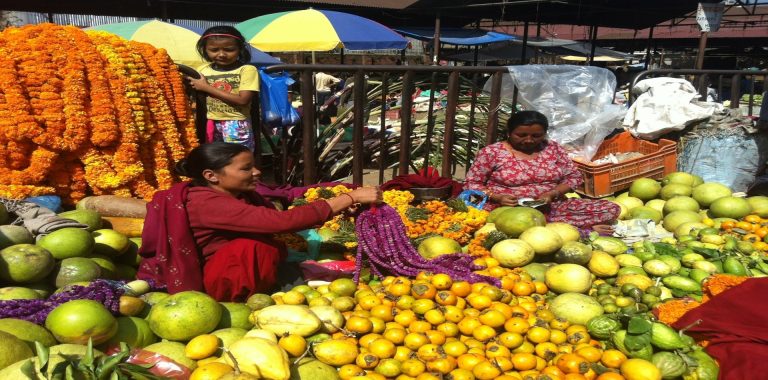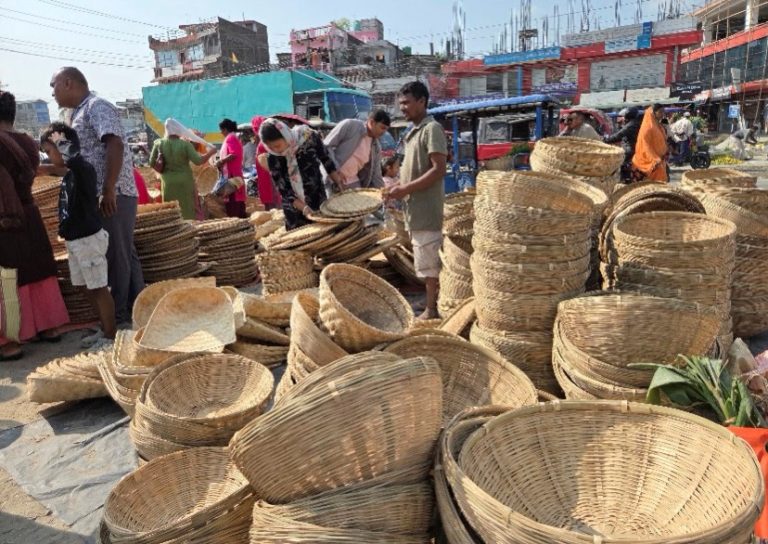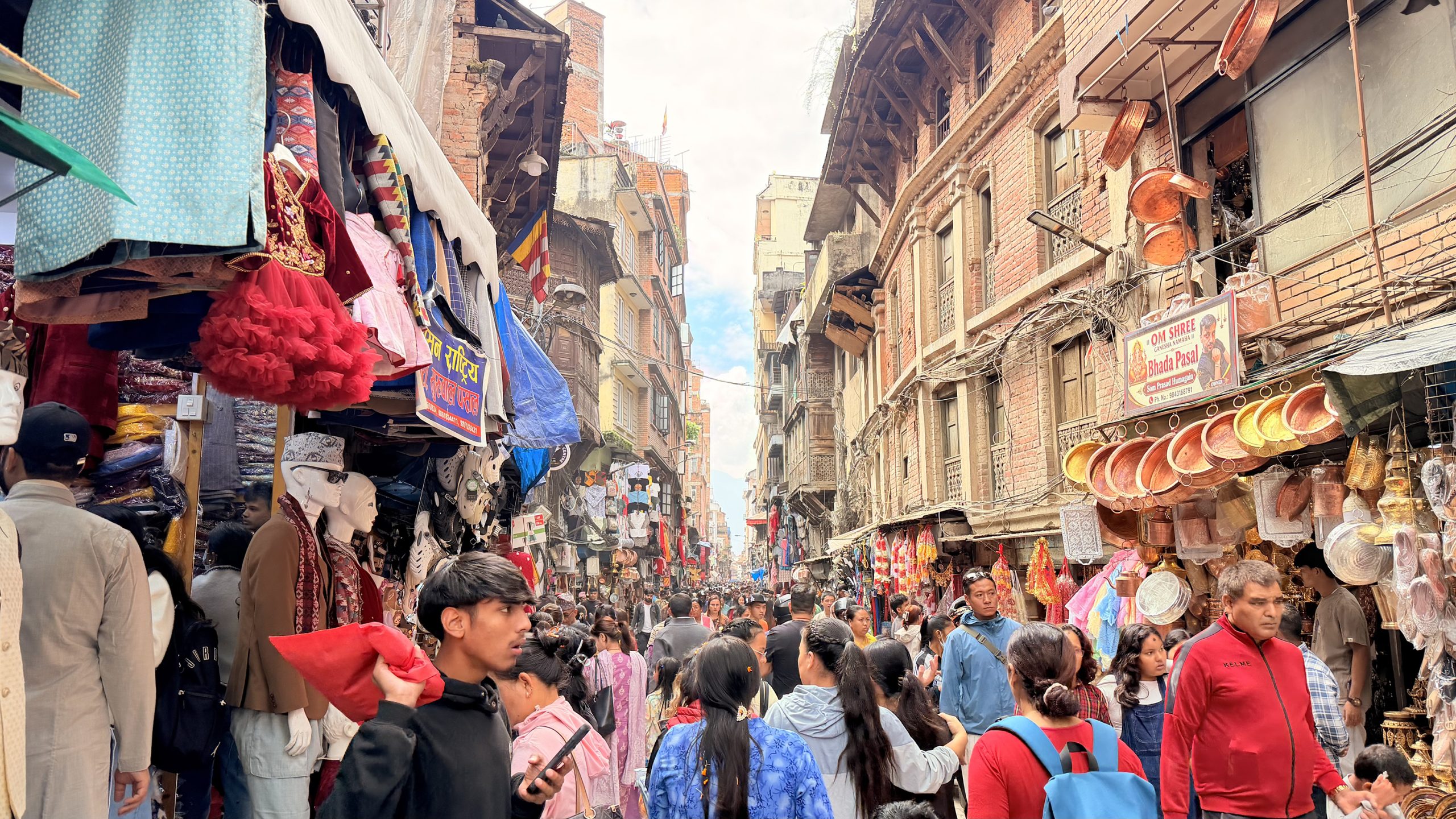
दसैँको किनमेलका लागि असन र न्यूरोड क्षेत्रमा भीडभाड काठमाडौँ, २५ असोज : बडादसैँ सुरु भएसँगै काठमाडौँको न्यूरोड तथा असन क्षेत्रमा किनमेल गर्नेहरूको भीडभाड । दसैँका लागि कपडा तथा आवश्यक सामग्री खरिद गर्न बजारमा सर्वसाधारणको चहलपहल बढेको हो । तस्बिर: लोकेश धामी/रासस
By Amrit Kharel and Ram Kumar Rai
Food, cooking oil, sugar and spices have become more expensive over six months; mutton prices have risen by Rs. 200–300 per kilogram; LPG prices have fluctuated, while border closures with China have pushed up transportation costs for clothing and other goods.
Kathmandu, October 13. Dashain has arrived, but for many Nepali families, the festive season has brought financial anxiety before joy.
Whether preparing a shopping list for rice, lentils, cooking oil, sugar and spices or heading to the market to buy new clothes, fruits and meat for their children, ordinary consumers face the same problem: household expenses are rising sharply compared with their incomes, with little relief in sight.
A comparison of market prices since the House of Representatives election held on February 21 and the current Dashain shopping season shows that inflation is not limited to one or two products.
Prices have increased across a wide range of essentials, from staple foods and cooking oil to sugar, spices and meat. Floods and landslides have disrupted roads and trade routes connecting Nepal with China, adding pressure to transportation and supply chains. People returning to their hometowns for the festival must also manage rising travel expenses alongside other festive costs.
Price lists published by the Nepal Retailers Association, government statistics and recent market reports suggest that Dashain inflation is not merely a matter of consumer complaints but a genuine economic problem linked to prices and supply disruptions.
Before and After the Election: Why Are Household Expenses Rising?
In February 2026, shortly before the election, consumers complained about rising prices of rice and cooking oil. The Department of Commerce, Supplies and Consumer Protection subsequently instructed traders to adjust prices.
According to news reports citing the Nepal Retailers Association’s price list, the price of Trishuli Pokhareli rice rose from Rs. 75 to Rs. 90 per kilogram.
The reported price of roasted mustard oil increased from Rs. 270 to Rs. 350 per litre, soybean oil from Rs. 115 to Rs. 220, and sunflower oil from Rs. 140 to Rs. 240 per litre.
Price pressures have continued as Dashain approaches.
According to market rates published by the grocery traders’ association in early October, the prices of some food items increased by Rs. 5 to Rs. 30 per kilogram within just six weeks.
In some markets, rice prices have risen from Rs. 90–100 to as much as Rs. 120 per kilogram.
The price of raw peanuts increased from Rs. 260 per kilogram in August to Rs. 290, while Murali maize rose from Rs. 125 to Rs. 140 per kilogram.
Sugar prices have also offered consumers little relief. According to consumer complaints, sugar that cost around Rs. 95 per kilogram until April was selling for Rs. 110 in September, with prices reaching Rs. 150–170 in some locations. Concerns have also been raised about supply shortages and allegations that some traders have created artificial scarcity.
LPG: Official Prices Also Rose After the Election
Liquefied petroleum gas (LPG) is another essential household commodity. According to Nepal Oil Corporation’s price records, a standard 14.2-kilogram LPG cylinder cost Rs. 1,910 on March 26, 2026.
The price rose to Rs. 2,010 on April 15 and Rs. 2,160 on May 31. On June 30, the corporation reduced the price to Rs. 2,060, the latest official rate available in the cited records.
Compared with the March 26 price, an LPG cylinder is therefore Rs. 150 more expensive. However, prices rose and fell during the intervening period. It would consequently be more accurate to say that LPG prices fluctuated but remained above their initial level than to suggest that they increased continuously.
An official price, however, does not necessarily guarantee that consumers can obtain cylinders easily. When supply disruptions and availability problems are reported, regulators need to monitor distribution as closely as prices.
Local traders have reportedly cited transportation difficulties and shortages to charge even higher prices in some cases. Consumers who cannot obtain gas may find themselves with little bargaining power.
Mutton Prices Rise by Rs. 200–300 per Kilogram
Price increases are particularly evident in the meat market ahead of Dashain.
Mutton, which sold for Rs. 1,300–1,400 per kilogram during last year’s Dashain, is now priced at Rs. 1,600–1,700.
This represents an increase of approximately Rs. 200–400 per kilogram compared with last year.
Floods and landslides have added further complications to the transportation of goats and sheep.
Traders say flooding in the Bhotekoshi area, road blockages and disruptions at the Rasuwagadhi border crossing with China have made it difficult to transport livestock and Himalayan goats through traditional routes. Disruptions along the Narayanghat–Mugling road, in Gajuri and along the Kaligandaki Corridor have also affected transportation.
Goat consumption in the Kathmandu Valley during this year’s Dashain is estimated to reach only 38,000–40,000 animals, compared with approximately 45,000–50,000 last year.
At Kalanki market, live goats have reportedly been trading at Rs. 850–900 per kilogram, up from around Rs. 750 last year.
Yet an important question remains: if meat prices are rising because of supply constraints and transportation costs, why is there such a large gap between the prices farmers receive and the prices consumers pay?
Consumer rights activist Jyoti Baniya has also identified multiple layers of intermediaries, weak market monitoring and a lack of effective government intervention as factors contributing to price increases. Officials from the Department of Livestock Services have likewise expressed concern that retail prices have risen disproportionately.
Fruit and Vegetable Prices Also Affected by Supply Disruptions
Buying fruit for religious rituals, family gatherings and visiting guests is a customary part of Dashain. However, road blockages have made it more difficult to transport produce from farming areas to Kathmandu, increasing pressure on market prices.
Vegetable supplies at Kathmandu’s Kalimati market reportedly fell from an average of 657 tonnes to 242 tonnes as a result of disruptions along the Prithvi Highway.
Under normal circumstances, the market receives approximately 700–800 tonnes of vegetables daily. The sharp reduction in supply has contributed to substantial price pressure.
According to Kalimati market price information, wholesale prices for large tomatoes averaged Rs. 65 per kilogram, local carrots Rs. 110 and local cauliflower Rs. 100. These are wholesale prices; consumers pay more at retail outlets.
Fruit prices are also affected by imports, transportation costs and seasonal availability. Available market information puts Fuji apples at Rs. 300–350 per kilogram, Jumla apples at Rs. 250–350 and Nepali bananas at Rs. 150–200 per dozen.
Border Disruptions with China Put Pressure on Clothing Prices
Buying new clothes for Dashain accounts for a substantial share of household spending in Nepal. This year, however, disruptions to supplies from China have affected the market.
During visits to Kathmandu’s main shopping areas, including New Road and Asan, and conversations with clothing traders, it emerged that persistent rainfall and natural disasters had disrupted trade through three major land crossings with China: Tatopani–Khasa, Rasuwagadhi and Korala. Traders said the disruptions had made it difficult to bring new clothing into the country.
According to Department of Customs data, Nepal imported goods worth more than Rs. 76.40 billion from China during the first two months of the current fiscal year.
Traders say containers have been stranded, alternative routes have had to be used and transportation costs have increased. These difficulties are likely to affect the prices of clothing, footwear, bags and other imported goods.
Some traders have reportedly raised clothing prices by as much as 25 per cent, citing the disruption of supplies from China. The border closures have added pressure to both availability and costs.
Travellers Returning Home Face an Expensive Dashain
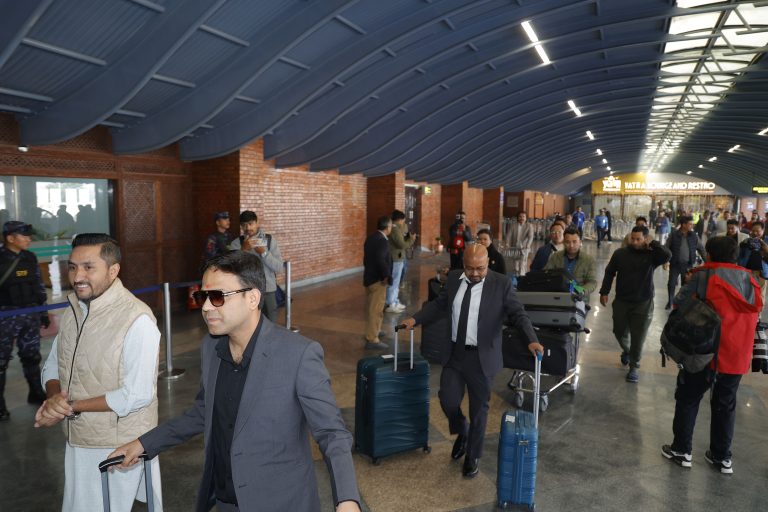
Millions of people who work or study in Kathmandu return to their hometowns during Dashain. This year, an estimated one million people are expected to leave the Kathmandu Valley by road, while another 30,000–35,000 are expected to travel by air.
The government has warned transport operators against charging more than the prescribed fares. The Department of Transport Management has said vehicles charging above the approved rates will face action.
Airfares, however, have become a particular concern for travellers heading to the far-western city of Dhangadhi.
One-way tickets from Kathmandu to Dhangadhi for Dashain have reportedly reached as high as Rs. 22,180. The usual fare is around Rs. 10,800, while the maximum fare set by the Civil Aviation Authority of Nepal is Rs. 21,600.
The reported ticket price is even higher than the airfare from Kathmandu to Delhi.
Consumer Hardship and the Effectiveness of Market Monitoring
There is no single explanation for rising prices during Dashain. International costs, Nepal’s dependence on imports, road disruptions, transportation expenses, increased seasonal demand and the role of intermediaries are all interconnected.
Nevertheless, an equally important question is whether some traders are taking advantage of natural disasters and festive demand to impose unjustified price increases.
Consumer rights activists have criticised the authorities for failing to ensure timely supplies and conduct effective market monitoring. Although the government has undertaken market inspections and operated subsidised sales outlets, upward pressure on prices remains evident.
Market monitoring should not be limited to inspecting shop receipts and imposing fines. Authorities need to examine the entire price chain, from producers and importers to wholesalers and retailers.
The government should publish evidence showing the gap between the prices farmers receive and the prices consumers pay, the actual availability of LPG, changes in import costs following border disruptions and compliance with maximum airfares.
Without transparent information, it will be difficult to distinguish genuine cost increases from excessive profit-taking.
Dashain: A Festival of Joy or a Season of Financial Anxiety?
The impact of inflation this Dashain goes far beyond the numerical differences on price lists. Families that could previously buy a certain quantity of rice and lentils with a given amount of money now receive less for the same expenditure.
Having to buy less meat, reduce the number of new clothes or postpone travelling home has become a genuine concern for low- and middle-income households.
One consumer shopping for Dashain in Kathmandu’s Asan market described the situation this way:
“We used to set aside a separate budget for Dashain. This year, when we add up the costs of food, clothes, meat and travel home, it is becoming almost impossible to manage. We have to think carefully about what to buy and what to leave out.”
Another consumer looking for clothes for children in New Baneshwor expressed similar frustration:
“I want to buy new clothes for my children during Dashain. But after checking the price in one shop, I have to visit another to see whether I can find something cheaper. We still have all our other household expenses to pay.”
Dashain is traditionally celebrated in Nepali society as a festival of family reunions, social gatherings and happiness. But when celebrating the festival requires taking loans, cutting back on daily necessities or struggling to afford a journey home, the problem extends beyond individual household finances. It raises broader questions about incomes, market regulation, supply management and access to public services.
Following the election, citizens expected more than political change. They also expected improvements they could feel in their everyday lives.
Yet the government has so far failed to provide convincing, evidence-based answers to fundamental questions: Why are prices rising? Where are unjustified profits being made? Why have supplies not been maintained smoothly? And why has the cost of travelling during the festive season risen so sharply?
The central question facing the public this Dashain is straightforward. Why are expenses continuing to rise when incomes are not increasing, and who will take responsibility for easing the burden of inflation?
Regardless of which government comes to power, why does the suffering of poor and lower-middle-income families remain unchanged?