

स्याटेलाइट
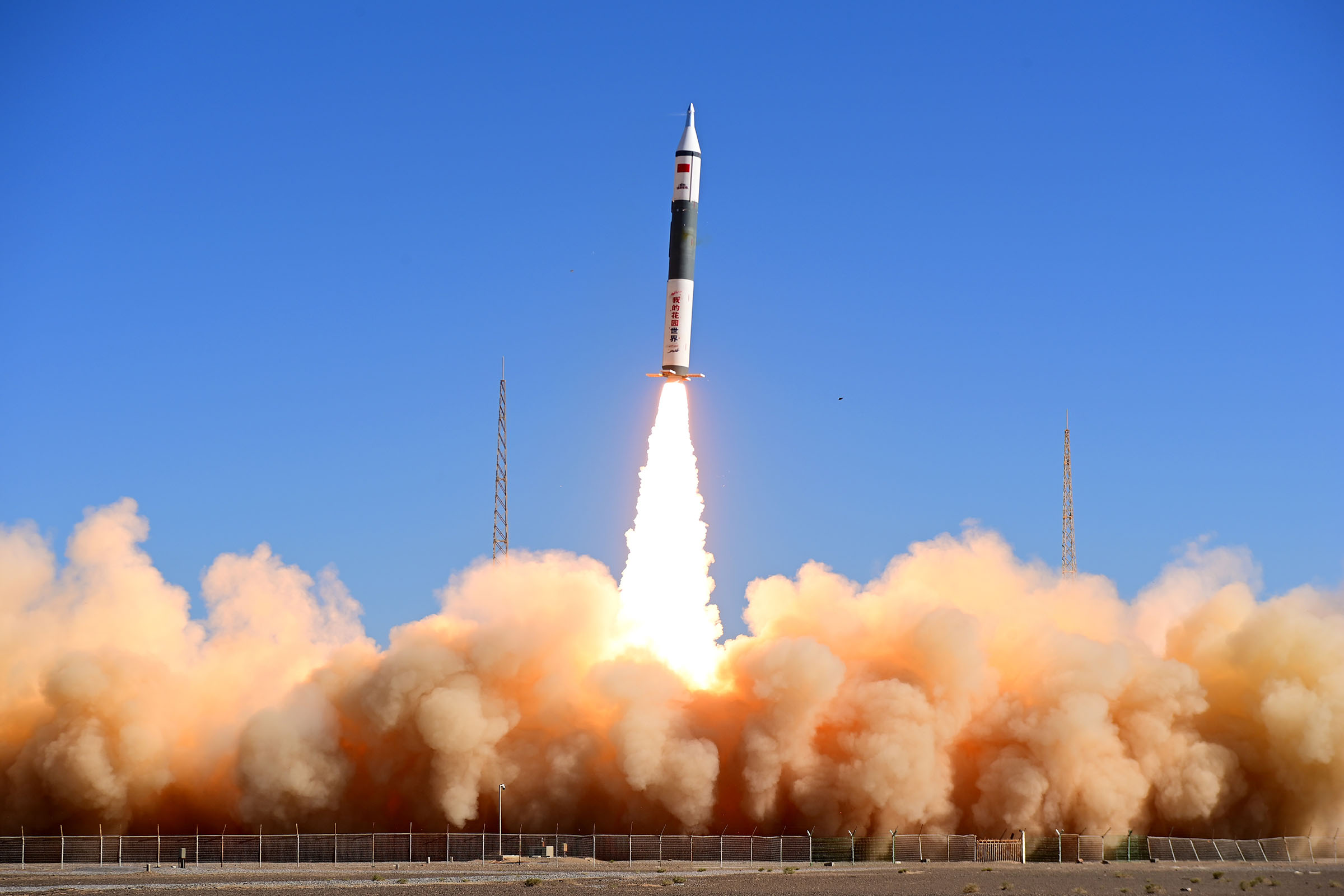
Taiyuan, September 20: China successfully launched four new satellites into space on Saturday. The satellites were launched from the Taiyuan Satellite Launch Center in Shanxi Province, northern China.
The satellites were launched using a Long March-2D carrier rocket at 6:50 PM Saturday, Beijing time. The launch center reported that all four satellites successfully entered their designated orbits following the launch.
The launched satellites are numbers 13 through 16 of the PiSat-2 series. All of these satellites utilize Synthetic Aperture Radar (SAR) technology, which plays a crucial role in capturing images of the Earth’s surface and collecting other remote-sensing data.
These satellites were developed by GalaxySpace, a private satellite manufacturing company based in Beijing. The company stated that the developed satellites are equipped with instruments capable of observing the Earth’s surface with high resolution.
According to Tuan Xiaoke, the chief designer for the satellites, the new satellites feature an intelligent processing system alongside high-resolution instruments. Because of this, the satellites will be able to process remote-sensing data collected in space in real-time.
Typically, after collecting data from Earth, satellites send it back to Earth for processing. However, due to this new technology, these satellites can process some data directly in space, which is expected to make the process of obtaining necessary information much more efficient.
Another important feature of Synthetic Aperture Radar technology is its ability to operate independently of light availability. Using this technology, information about the Earth’s surface can be gathered even at night and during cloudy conditions. This is expected to be useful for Earth observation, natural resource monitoring, disaster management, and other remote-sensing operations.
The Long March-2D carrier rocket used for the launch is a two-stage liquid-propellant carrier rocket. It has the capacity to carry a payload of up to about 1.3 metric tons into a Sun-synchronous orbit at an altitude of 700 kilometers.
With Saturday’s launch, the total flight count of China’s Long March carrier rocket series has reached 668. The Long March rocket series has been used under China’s space program to deliver various types of satellites and other space equipment into orbit.
Relevant officials stated that the high-quality data obtained from the new satellites and their ability to process data in space will aid in the future development of China’s smart space infrastructure.
In particular, the use of such satellites is expected to expand in areas such as continuous monitoring of the Earth’s surface, study of natural resources, observation of environmental changes, and providing necessary information during disasters.