फ्रान्समा प्रदर्शन
Paris, October 24:
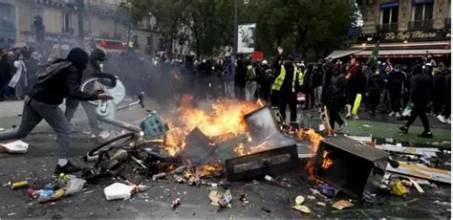
Following some of the most severe urban violence seen in years during last week’s demonstrations, France is deploying approximately 70,000 security personnel nationwide this weekend to control potential protests and clashes.
The protests, initially sparked by secondary school students expressing dissatisfaction with school environments and educational conditions, quickly expanded nationwide. The situation grew increasingly tense as public discontent over rising inflation and the cost of living became intertwined with the movement.
During a press conference in Paris, Interior Minister Laurent Nuñez announced that around 70,000 security personnel will be deployed on Saturday. He urged vigilance against potential unrest, noting that messages inciting violence and looting are actively spreading on social media.
The demonstrations have escalated as President Emmanuel Macron’s term nears its end, with just six months remaining until new elections. A recent poll places far-right leader Marine Le Pen at the forefront of the presidential race, and these recent developments are widely assessed to have further strengthened her political standing.
Meanwhile, Le Pen’s National Rally (RN) party is holding a convention this city weekend in Orléans, where thousands of supporters are expected to attend. Local authorities are concerned about potential clashes, as groups opposing the party are also preparing to gather in the same city.
On Friday, President Macron held discussions with secondary school student representatives. However, following the meeting, student representatives urged their peers to continue the movement until the government puts forward concrete proposals addressing their demands.
Prison Sentences for Offenders
The Macron government has stated that the legitimate demands of protesters must be viewed separately from the looting, arson, and vandalism that occurred last Saturday.
According to Justice Minister Gérald Darmanin, courts have sent 217 individuals to prison in connection with last Saturday’s violence, with about half of them being first-time offenders.
On Thursday, President Macron called for strict action against criminal activities, accusing ultra-left groups of attempting to overthrow the republic during the previous weekend. An ultra-left group active in western France had posted messages on its website urging supporters to evade police cordons and engage in unpredictable behavior.
Protest Bans and Tightened Security
To curb potential violence, authorities have tightened security and banned protests in several cities.
In Orléans, where 20,000 to 30,000 people are expected to take to the streets against the National Rally party, local authorities have stated that protesters will not be allowed to gather in the city center. In the southeastern city of Lyon, protesters will be barred from entering the main urban areas this weekend.
In Paris, police revoked permission for a trade union-led march along the route between the Bastille and Nation squares. Instead, police stated that the procession could take place in the afternoon along the southeastern edge of the city. However, citing security risks along the alternative route, trade unions have insisted on proceeding along the originally approved path.
Protests were also banned in the southern city of Marseille; however, on Friday, authorities decided to permit a single demonstration organized by trade unions under special circumstances, making it the sole authorized protest in the southern Bouches-du-Rhône department.
To ensure security, major museums in Paris, including the Louvre, will remain closed on Saturday, and the duration of the Art Basel art fair has been shortened.
Criticism of Crackdown on Protests
Government measures, including total bans on protests in various cities, have been criticized by human rights organizations.
Amnesty International condemned these measures as a tilt toward authoritarian practices, stating that such bans risk citizens’ rights to peaceful assembly. Questions have also been raised regarding police preparedness, intelligence gathering, and crowd control capabilities following last week’s violence.
Eva Cossé, senior Europe researcher at Human Rights Watch, stated that it is the police’s responsibility to ensure an environment for peaceful protests while protecting the public from violent incidents. She also expressed concern over reports of children being severely injured due to crowd control weapons used during recent demonstrations.
Strong Prospects for Le Pen in Elections
The violence during the protests has also impacted France’s international image, with the upcoming election seen as a decisive turning point in the country’s modern history. Compounding this, the government’s rising debt burden has heightened concerns among investors.
According to a poll conducted by Harris Interactive for M6/RTL following the violence, Marine Le Pen is projected to secure 33 to 35 percent of the vote in the first round of the presidential election. The survey suggests that far-reaching leftist leader Jean-Luc Mélenchon could become Le Pen’s challenger in the run-off, in which case Le Pen is estimated to achieve an easy victory with around 70 percent of the vote.
Amid nationwide protests, debates over security measures, and political polarization, France’s upcoming elections are expected to significantly influence the nation’s political trajectory.
— RSS/Unified Nepal