Kathmandu, November 3: The Nepal Panchang Decision Development Committee has announced the most auspicious time for celebrating Bhai Tika this year.
Committee Chairman Prof. Dr. Purushottam Bhattarai said the committee had made decisions regarding the various festivals of Tihar and announced the auspicious time for Bhai Tika.
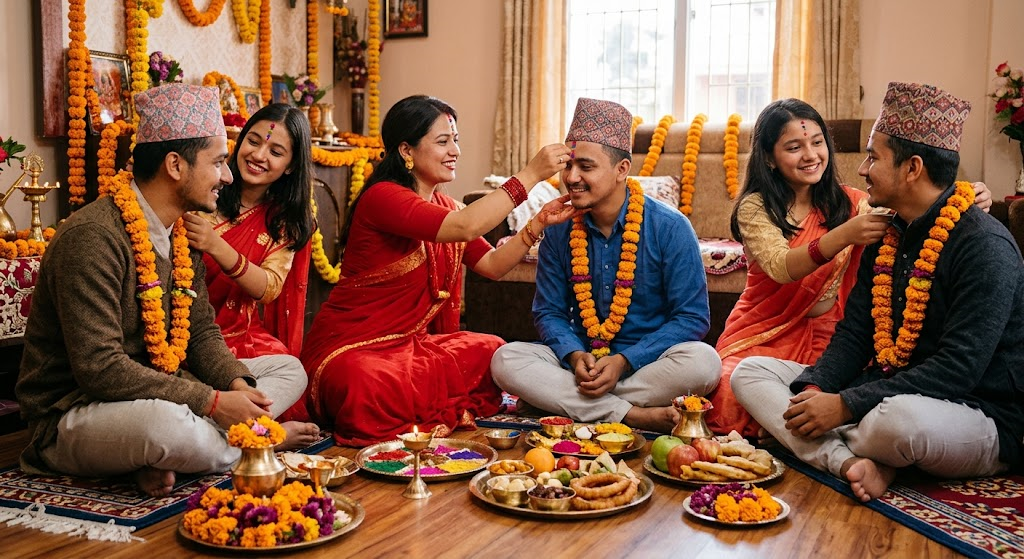
According to him, the most auspicious time for applying the Bhai Tika is 11:07 a.m. on Wednesday, November 11 (Kartik 25).
The committee stated that although there is no restriction on applying tika during the midday period, the auspicious Abhijit Muhurta has been recommended for those who wish to follow a specific auspicious time.
The general public can apply tika at any time during midday without any problem.
This year, the Yamapanchak period, which marks the beginning of Tihar, starts on Friday, Kartik 20 (November 6). Dhantrayodashi (Dhanteras) falls on that day.
Kag Tihar (Crow Festival) falls on Saturday, Kartik 21 (November 7). Dhanwantari Jayanti is also observed on the same day.
On Sunday, Kartik 22 (November 8), Kukur Tihar (Dog Festival), along with Narak Snan (ritual bathing), will be observed, followed by Laxmi Puja in the evening.
The committee stated that festival dates were determined in accordance with religious scriptures because Krishna Chaturdashi (the 14th lunar day of the dark fortnight) falls during the daytime, followed by Aunsi (the new moon day). According to religious scriptures, Laxmi Puja should be performed on the day when the new moon falls during the evening.
However, ritual bathing and charitable donations associated with Aunsi should be performed on the morning of Monday, Kartik 23 (November 9). Laxmi Puja will also be observed on this day.
According to religious scriptures, the worship of cows, oxen and one’s own self (Mha Puja) should be performed on Tuesday, Kartik 24 (November 10).
The religious text Krityavatika mentions that Mha Puja should be performed in the evening of Kartik Shukla Pratipada (the first day of the bright lunar fortnight). Since Kartik Shukla Pratipada begins on this day, Mha Puja should also be observed accordingly. Mha Puja is a traditional practice particularly followed by the Newar community.
Three of the calendars (Panchang) approved by the committee are published by Panchang makers from the Newar community. Siddhilakshmi Byanjankar, Kirtikiran Joshi and Shashidhar Joshi, all Newar Panchang makers, have also mentioned in their respective calendars that Mha Puja should be observed on Kartik 24.
The New Year of Nepal Sambat 1147 also begins on this day. According to religious scriptures, the New Year should be celebrated on the day when the sun rises during Pratipada.
In accordance with religious traditions, Bhai Puja, also known in the Newari language as Kija Puja, will be celebrated on Wednesday, Kartik 25 (November 11). According to religious scriptures, Bhai Tika should be applied during the midday period.
The committee has therefore concluded that celebrating Bhai Tika on Kartik 25 is in accordance with religious traditions.
Chairman Bhattarai said that the term Bhratri Puja, used in religious scriptures, refers to both brothers and sisters. Although the festival is commonly known as Bhai Tika, the committee stated that applying tika according to the order of seniority is consistent with religious traditions.
Tihar, also known as Yamapanchak, is celebrated every year from Kartik Krishna Trayodashi (the 13th day of the dark lunar fortnight) to Kartik Shukla Dwitiya (the second day of the bright lunar fortnight).
During this festival, Yama Deepdan, the ritual offering of oil lamps to Yama, the god of death, is performed from the evening of Kartik Krishna Trayodashi until the evening of Kartik Shukla Dwitiya.
Yama Deepdan is performed by reciting the names of family members according to the number of people in the family. According to religious beliefs, offering these lamps helps protect people from the suffering associated with Yama’s realm.
There is also a Vedic tradition of offering delicious food to crows and dogs, which are regarded as messengers of Yama, to please them. It is believed that doing so will ensure their assistance in the realm of Yama.