चोयाका सामग्री
SUNSARI, November 12.
With the approach of Chhath festival, the sale of bamboo-woven items has witnessed a notable surge. The demand for ritualistic and household goods such as koniya (bamboo sieves/baskets), dhakiya (baskets), nanglo (flat winnowing trays), and pankha (hand fans)—essential for worship during Tihar and Chhath—continues to grow steadily.
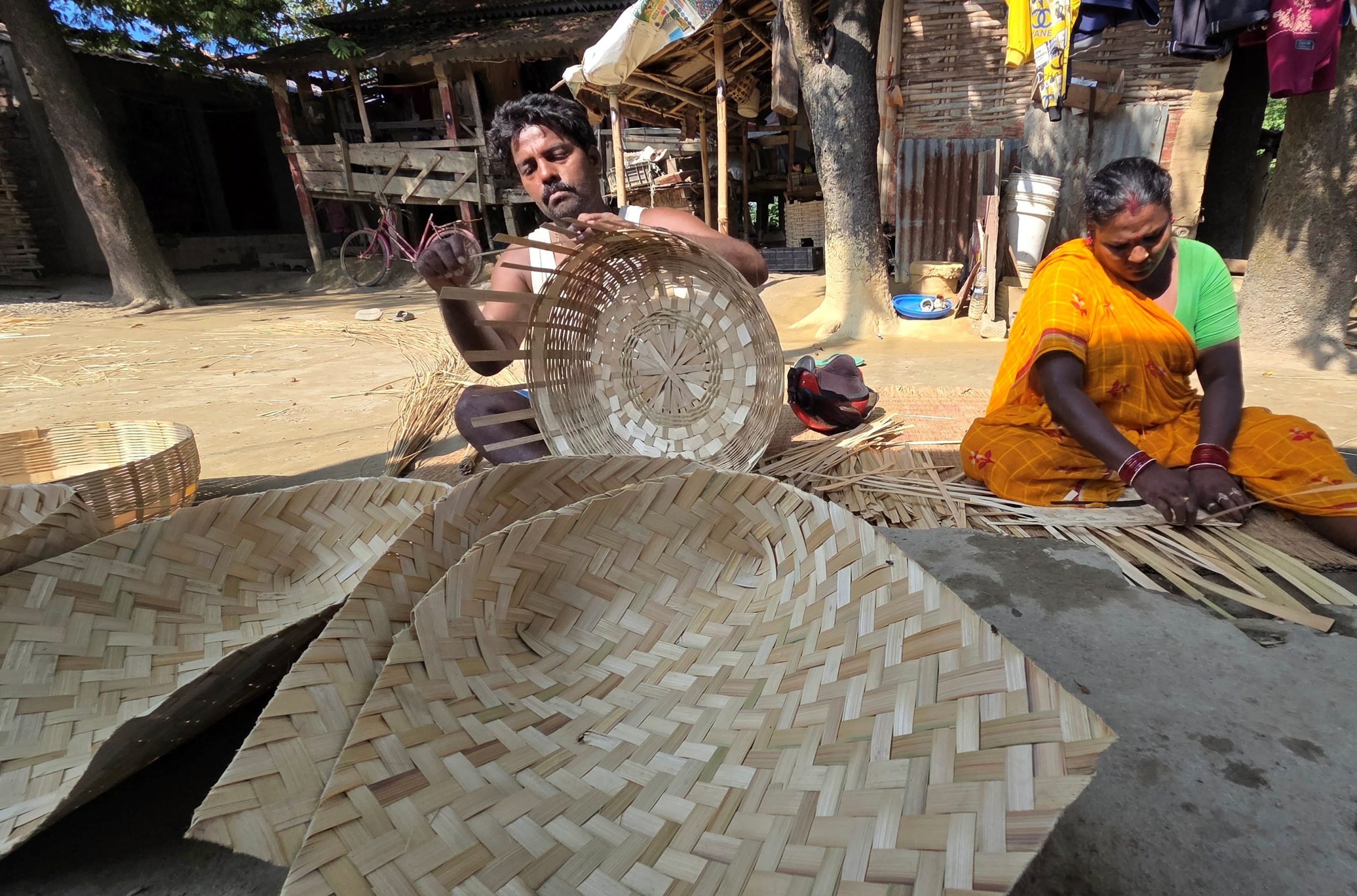
Manbharan Marik, 46, a resident of Inaruwa Municipality–4, has been supporting his family for the past 30 years by crafting various items out of bamboo strips. Continuing a hereditary skill passed down by his parents, he remains dedicated to production.
“We are carrying forward the profession once practiced by our parents,” Marik shared. “We purchase raw bamboo from the village at Rs 250 per bundle, extract the strips, and craft these items. Preparing a single standard product takes about two hours.”
Priced between Rs 50 and Rs 500, sales are primarily concentrated around affordable items due to the short-term ritualistic use of these goods. Marik regularly sells his products at the local hatiya (open-air market).
He noted that demand peaks during the wedding season, particularly within the Madhesi and Chaudhary communities where koniya and dhakiya hold significant cultural value, in addition to the heightened seasonal rush during Tihar and Chhath. While some customers buy directly from his home, he personally sells his crafts at Inaruwa’s Monday and Thursday hatiyas.
“We have no other profession and do this year-round. While we do not keep a formal ledger of our income, this trade is the sole economic backbone of our family’s livelihood,” he added.
Similarly, Basanta Rai of Sunaulo Basti in Itahari Municipality–3 makes his living weaving nanglos. Having professionalized his ancestral craft, he has been producing and selling winnowing trays for approximately two decades.
“This is our traditional occupation. If you dedicate time and work with diligence, the returns are quite rewarding,” Rai said. “Annual transactions from selling nanglos amount to about Rs 700,000 to 800,000. This income covers our household expenses, our son’s education, and other family needs.”
Rai sources raw bamboo from the Talatalaiya and Khorsaneghat regions, paying Rs 200 to 300 per bamboo stalk, which yields 10 to 12 nanglos. Producing over 100 winnowing trays a week, his output is regularly picked up directly by traders visiting his home.
His products find markets across Itahari, Dharan, Bhojpur, Biratnagar, and Pathari, with prices ranging from Rs 130 to Rs 250 per piece.
“If you can produce nanglos, finding a market is never an issue. We used to bring nanglos from Bhojpur to sell in the past, but now traders from Bhojpur come here to buy what we make,” he remarked.
With nanglos in high demand during major festivals and rituals such as Dashain, Tihar, and Chhath, sales peak during the months of Bhadra, Ashwin, and Kartik compared to the rest of the year. Over 15 households in Sunaulo Basti are professionally engaged in bamboo weaving as their primary means of livelihood.
Rai believes the profession not only provides the flexibility of working from home but also plays a vital role in preserving traditional heritage.
“Working from home and continuing our ancestral skill is far better and more profitable than working as a laborer elsewhere. It requires hard work, but the income is good,” he concluded. “With the earnings from weaving nanglos, I built a modest house and funded my children’s education.”
While customers can request custom shapes and sizes, Rai pointed out that market prices have yet to catch up with the true scale of demand.
RSS