बाजुराका अलपत्र दुई पुलको ठेक्का रद्द
BAJURA, Nov 2.
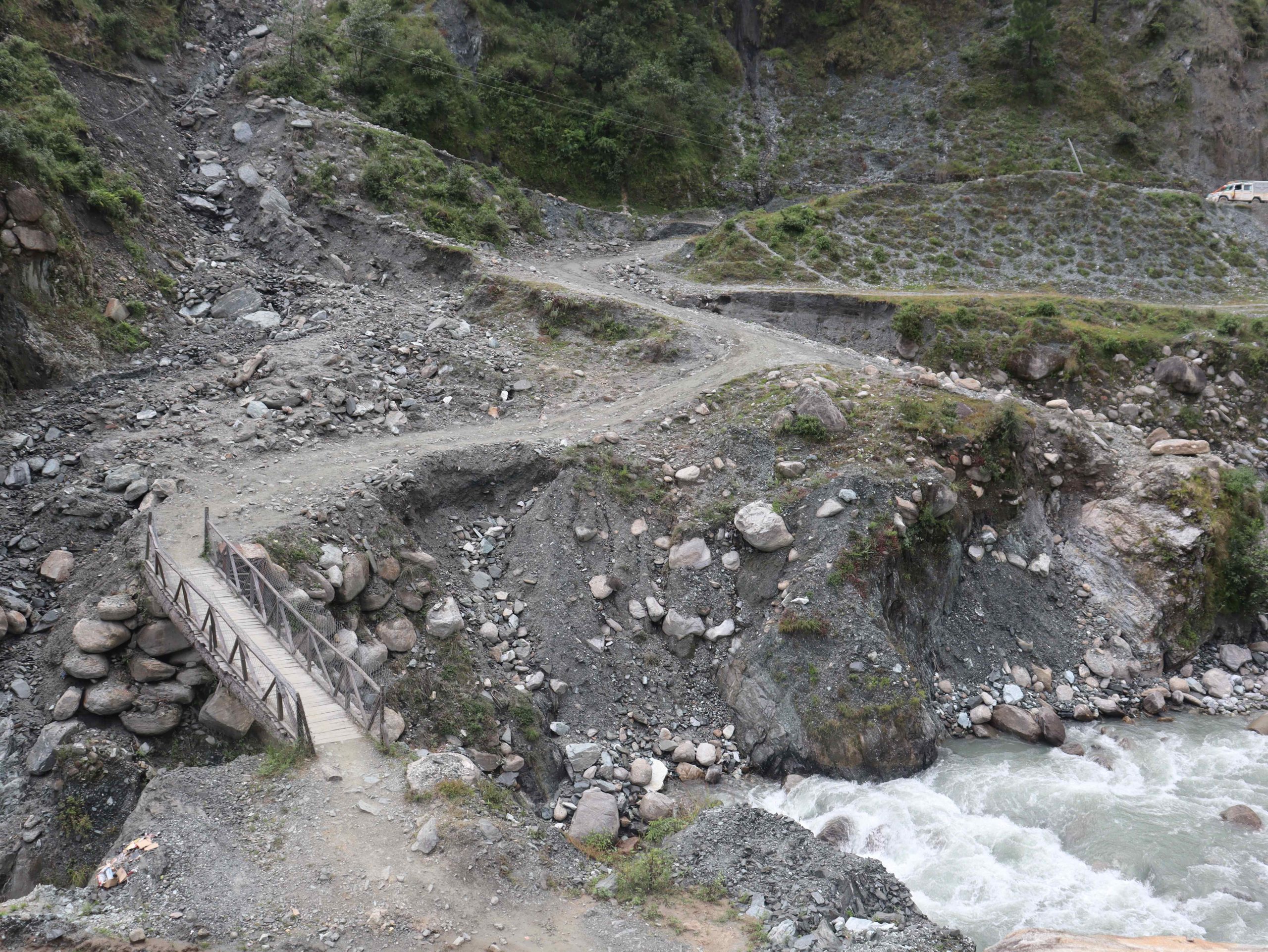
The contracts for the construction of two long-delayed bridges—the ‘Maure’ bridge over the Budhiganga River and the bridge over the Thulisanghu Stream—have been officially cancelled after the projects stalled.
Having remained unbuilt for years, the construction process for both stalled bridges has now been advanced to re-award the projects to alternative developers.
The contracts were terminated and fresh procedures initiated after the projects, initially signed about five years ago with a three-year completion deadline, failed to make meaningful progress.
The agreement to construct the Maure bridge over the Budhiganga River, connecting Budhiganga and Triveni municipalities, was signed on Magh 11, 2078 BS (January 2022).
The Mahakali Bridge Planning Office in Mahendranagar had contracted B-Coi Builders Pvt. Ltd., Kathmandu, for NPR 162,178,060, with a completion deadline of Falgun 2081 (February/March 2025).
However, when the contractor failed to initiate work even after the deadline expired, the planning office cancelled the contract and recommended blacklisting the company.
Following legal disputes, the case reached the court, which ruled in favor of the planning office in Shrawan 2083 (July/August 2026), paving the way to resume the bridge construction process, according to Ravi Shah, Information Officer for the Mahakali Bridge Project.
Triveni Municipality Mayor Karna Bahadur Thapa noted that in the absence of a bridge over the Budhiganga River, transport services across the municipality are completely cut off during the monsoon, forcing locals to navigate risky river crossings in winter.
He emphasized that the Maure bridge is not only a vital physical link between Budhiganga and Triveni but also serves as a key gateway to the Badimalika region.
The other long-stalled project is the bridge over the Thulisanghu Stream in Badimalika Municipality along the Martadi-Ghattamuna road section near the district headquarters. This stream bridge and the Budhiganga River bridge were originally contracted under a single package through the Mahakali Bridge Planning Office, Mahendranagar.
An agreement was signed on Falgun 10, 2077 BS (February 2021) with B-Coi Builders Pvt. Ltd. to construct a 30-meter-long and 11-meter-wide concrete bridge for NPR 162.1 million, targeting completion within three years (2081 BS).
Due to the absence of a bridge over the stream, residents of Gaumul, Badimalika, and Khaptad Chhededaha rural municipalities have suffered severe hardships every rainy season.
Information Officer Shah explained that despite contracting both bridge projects together, the contracts had to be scrapped due to extreme negligence by the construction company.
The process to resume construction on both stalled bridges was initiated through the Nepal Infrastructure Company under the Ministry of Physical Infrastructure Development.
The lack of bridges had entirely severed transit between the respective local units. Technical teams had previously conducted site verifications as part of preparations to restart work.
The district has long suffered from a widespread trend where development projects are contracted out, only to be left in limbo due to contractor inaction. Across rural roads, bridges, buildings, and two provincial roads in Sudurpashchim Province, work has stalled, preventing expected progress.
According to the Infrastructure Development Office in Achham, budgets allocated annually for road upgrades and blacktopping routinely go unspent and are returned due to contractor delays.
In the last fiscal year (2082/83), NPR 200 million for the Martadi-Kolti road and NPR 135 million for the road connecting Martadi via Khaptad-Gairikhad-Atichaur were returned unspent.
The Martadi-Kolti road was contracted to PS Baniya Construction Service, while the other route was awarded to KSM KBC-Tej JV of Dhangadhi, Kailali.
The failure to complete major development projects on time directly impacts the daily lives of local citizens. Residents complain that the lack of proper roads and bridges disrupts transport, hinders the delivery of agricultural produce to markets, and creates hurdles in accessing basic services like health and education.
While reasons such as contractor sluggishness, budget constraints, technical issues, and a lack of regular monitoring and effective coordination are frequently cited for project delays, local stakeholders stress that failing to hold responsible agencies and contractors accountable allows the problem to persist repeatedly.
Observers note that merely allocating budgets in the name of development is insufficient—rigorous regular monitoring of execution, enforcing accountability on contractors, and prioritizing the completion of incomplete projects are urgently required.
— RSS