देउसीभैलो
Bagmati, November 10.
With the onset of Tihar, the traditional practice of Deusi-Bhailo—once echoing to the rhythm of the Madal, Khainjadi, and flute—is increasingly witnessing the influence of modern music and technology. As traditional folk tunes, instruments, and group dancing are being replaced by modern songs and sound systems, the originality of Deusi-Bhailo is steadily fading away.
As Tihar begins, the hustle and bustle of Deusi-Bhailo has increased across the squares and settlements of Bagmati bazaar. While people of all ages, from children to the elderly, are participating and enjoying the festivities, the traditional style of Deusi-Bhailo is rarely seen in the markets.
In the past, Deusi-Bhailo was performed to traditional folk genres such as Sorathi, Maruni, Kaura, Yanimaya, Sunimaya, and Jhyaure, accompanied by the Madal, flute, and Khainjadi. These songs used to convey the joys and sorrows, social conditions, and lived experiences of rural life. Today, such traditional tunes and dances are gradually disappearing. The growing trend of dancing to recorded modern songs and playing music at high volumes has put the traditional style of Deusi-Bhailo in crisis.
Local resident Prem Shrestha noted that there has been a significant shift in the originality of Deusi-Bhailo in recent times. He stated that due to the influence of Western culture and the younger generation’s lack of adequate interest in preserving traditional arts and culture, the cultural identity of traditional Deusi-Bhailo is weakening. “Previously, stories, hardships, and social messages were conveyed through songs accompanied by the Madal, flute, and Khainjadi. Nowadays, modernity and distortions are creeping into Deusi-Bhailo,” he remarked.
Rabiprasad Sharma of Bagmati bazaar mentioned that the originality of Deusi-Bhailo is disappearing due to the development of modern technology and the tendency of imitation. He emphasized that since Tihar and Deusi-Bhailo are the cultural identity of Nepali society, their original form must be preserved. He added that westernized and modern styles are becoming dominant because the younger generation shows little interest in traditional songs, music, and dances.
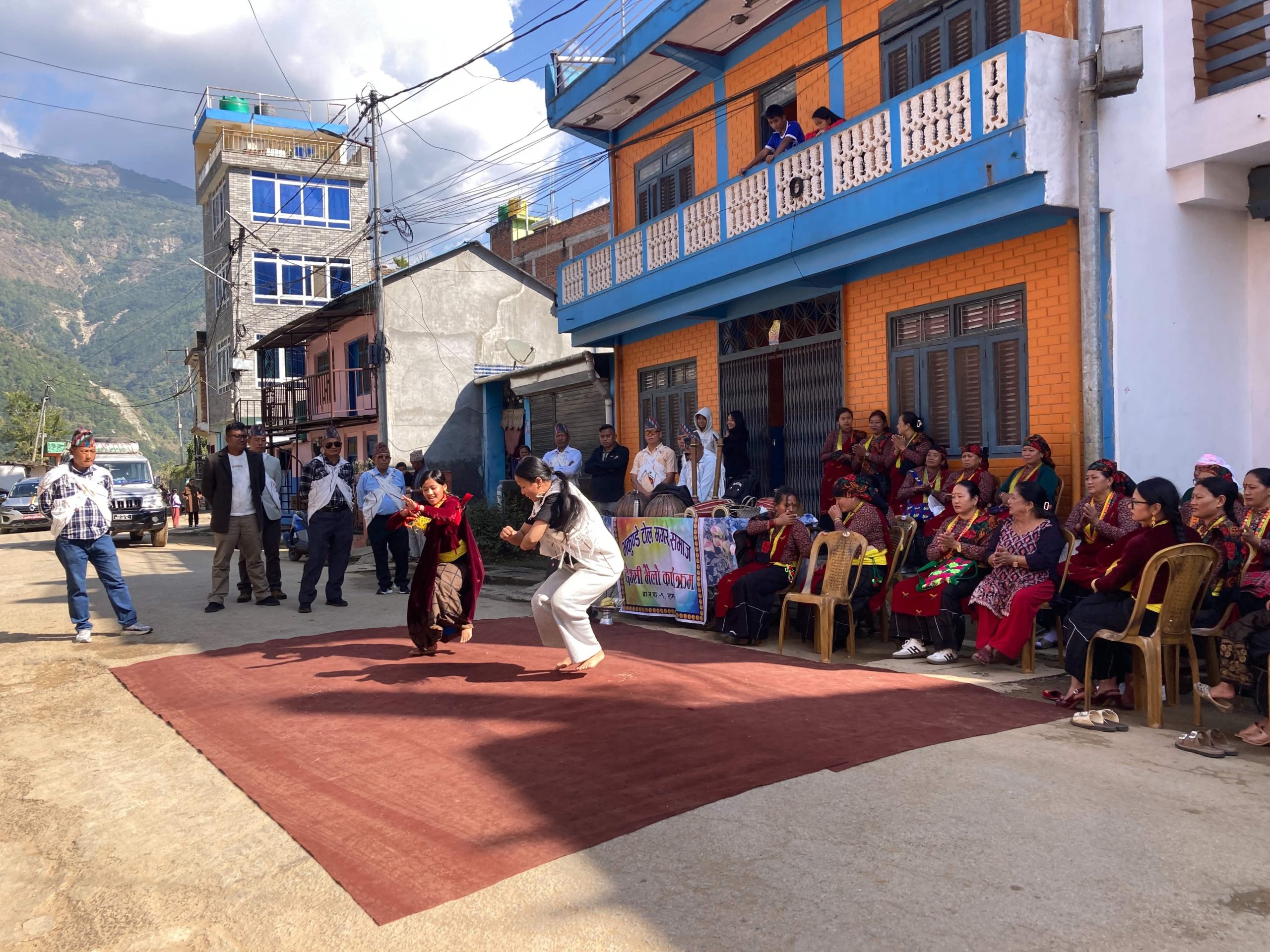
However, not all Deusi-Bhailo troupes are confined solely to modern styles. Some groups are making concerted efforts to continue old tunes and cultural practices. For instance, the Bhukunde Tole Group has been performing Deusi-Bhailo in the traditional style with the objective of learning traditional songs and dances from the older generation and passing them down to the youth.
Deusi-Bhailo is not merely a medium for entertainment and collecting donations; it is also an expression of Nepali society’s art, culture, language, and collective unity. Although a shift in its style according to the times is natural, concerns are growing that if traditional instruments, tunes, and dances fail to be preserved, the cultural identity associated with Tihar may weaken.
— RSS