पहिरोले घेरिएको पाउद्धार
MYAGDI, October 11.
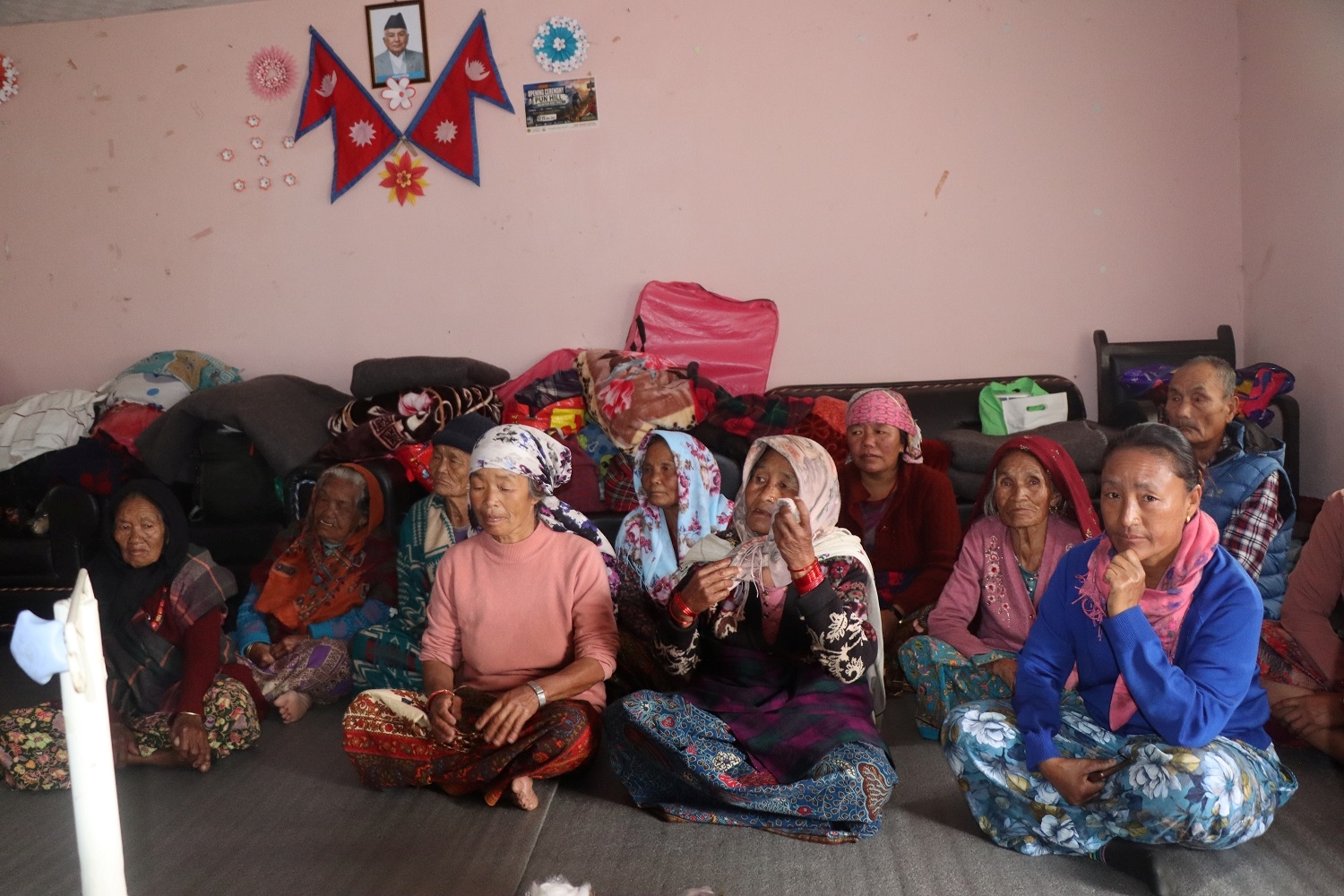
Bir Bahadur Paija (70) and his family from Paudwar, Annapurna Rural Municipality-5, Myagdi, have spent the last 15 days living in a temporary shelter set up in the premises of the Ward No. 6 office in the neighboring village of Ghar.
Following incessant rains from October 8 to 11, massive landslides surrounded the village from all sides. On the afternoon of October 11, a Nepali Army helicopter rescued Bir Bahadur’s family along with 93 others, airlifting them to safety in Ghar.
Despite finding shelter, Bir Bahadur is deeply anxious about whether he will ever be able to return to his homeland. Having toiled for decades in the village, the prospect of losing his lifelong home to the landslide has left him devastated.
“After landslides surrounded the village and we had nowhere else to go, we were rescued by helicopter and have been living in the camp. I don’t think we will ever be able to live back there again,” he said with tearful eyes. “Even if it looks okay during the winter, we are certain to face much worse hardship in the coming monsoon.”
Ongoing Uncertainty and Demands for Technical Study
Older residents like 65-year-old Jaslal Tilija and Somprasad Tilija share the same fears. They remain unconvinced that their homes are safe to inhabit given the surrounding terrain.
“Looking at the landslide with our own eyes, Paudwar does not seem fit for habitation,” said Jaslal. “We would feel much more at relief if the government quickly brought in geologists to study the area.” Paudwar consists of densely packed stone houses situated on a steep slope, incorporating three wards of the former Shikha Village Development Committee (VDC).
According to Annapurna Rural Municipality Vice-Chairperson Diba Tilija Pun, the settlement—home to over 200 households—is entirely ringed by landslides, leaving locals in deep confusion regarding the geographical risks.
Daily Struggles: By Day in the Village, by Night in the Shelter
Fearing the landslides, many displaced residents still travel back and forth to care for their livestock left behind in sheds. Ramaya Tilija walks back to the village early every morning to feed the cattle, returning to the shelter in Ghar to sleep each evening due to fear of danger.
Somprasad Tilija’s house suffered damage with one of its rooms collapsing as the landslide crept to its very edge. Finding daily life sustainable under such conditions has become impossible, prompting demands for alternative housing arrangements from the government.
Locals are urgently calling for a formal technical assessment by geologists to determine whether the settlement remains habitable. Their future relocation or rehabilitation relies completely on the findings of these expert reports.
Lifelines Severed and Comprehensive Damage
Since October 11, Paudwar has remained entirely cut off from road networks, communication lines, and electricity. Aside from local public representatives, official government teams have struggled to access the site directly.
While a walking trail via Ghar has been temporarily repaired for movement, the persistent landslide risks mean access remains unsafe. With local food stocks running out, residents remaining behind are facing mounting hardships.
A high-level inspection team—including Gandaki Provincial Assembly Member Resham Jugjali, District Coordination Committee Acting Chief Dilkumari Khatri, Chief District Officer Ganesh Gaire, and Deputy Superintendent of Police Rajan Karki—visited the temporary shelter in Ghar last week to assess the situation and listen to displaced families.
Chief District Officer Gaire assured that a team of geologists will soon be deployed to study landslide-affected areas across Annapurna Rural Municipality, after which permanent rehabilitation and reconstruction plans will move forward based on technical recommendations.
Heavy Toll Across Annapurna Rural Municipality
The disaster has severely impacted the broader region:
- Human Casualties: Six people have died across the municipality due to floods and landslides, including two individuals buried in a landslide in Giwang (former Shikha VDC Ward No. 5).
- Infrastructure Damage: 60 houses have been completely destroyed, and 129 have suffered partial damage.
- Temporary Shelters: The municipality has established three temporary shelters accommodating 255 displaced individuals (at Ghar, Shikha, and Kafaldanda’s Shiruwari), while another 156 are staying with relatives and neighbors.
For the displaced residents of Paudwar, the primary question remains whether they can safely return home or if complete relocation to a safer settlement is required. Their uncertain future now hinges entirely on upcoming geological studies and subsequent government action plans.
RSS/Unified Nepal.