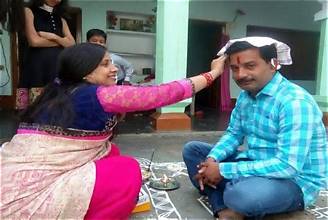
भैयादुज मनाउँदै मैथिल
Mahottari, November 11:
The Bhaiyaduj festival is being celebrated today across the Mithila region on the occasion of Kartik Shukla Dwitiya, with sisters wishing their brothers long life, happiness, and prosperity.
Bhaiyaduj, celebrated on the final day of the Tihar (Deepawali) festival, marks the conclusion of this year’s festivities. Due to fluctuations in lunar calendar dates (tithis), Deepawali, which began with Dhanteras on Kartik Krishna Trayodashi, has been observed for six days this year instead of the usual five.
Sisters in the Mithila region, including Mahottari in Madhesh Province, are busy preparing to worship their brothers today. According to Maithil tradition, sisters invite their brothers to their homes for worship on Kartik Shukla Dwitiya, the final day of Yamapanchak. In Mithila, this festival is also known as Bhaiyaduj, Bharadwitiya, and Bhratru Dwitiya.
While married sisters invite their brothers to their own homes to celebrate the festival, unmarried sisters and brothers residing in the same household observe it at their family residence.
Referred to as Tihar in the hill communities, the festival is known as Diwali or Deepawali in the Maithil language. Shobhakant Jha, a teacher of Karmakanda and an expert on Maithil folk culture at the Rajakiya Sanskrit Secondary School in Matihani, noted that although the rituals of celebration differ slightly between the hill and Maithil communities, the mythological narrative behind the festival remains the same.
According to him, the tradition is rooted in the mythological tale from Satya Yuga when Yamuna and Ganga, sisters of King Bali, applied the Saptarangi Tika (seven-colored vermilion mark) on their brothers’ foreheads, praying for their valor, well-being, and longevity.
As per Maithil tradition, sisters invite their brothers for Bhaiyaduj, and the invited brothers visit bearing new clothes, jewelry, and gifts. Sisters prepare aripan (quadrangular ritual floor designs) on the floor using pithar (a paste made from soaked raw rice flour). Inside this enclosure, brothers are seated on a wooden stool (pira) and their feet are washed with warm water placed in a traditional copper basin (kopra).
Following this, sisters apply the Saptarangi Tika to their brothers—who hold out cupped hands filled with pithar, betel leaves, and areca nuts. Upon completion of the worship rituals, sisters sing traditional folk songs praying that their brothers attain the swiftness, glory, and renown of rivers Ganga and Yamuna.
During the rituals, brothers are given dry field peas to chew—a practice known as “feeding bajri.” Maithil cultural experts explain that hard pea seeds are likened to a thunderbolt (vajra), hence called bajri. Anita Sharma, a female social leader from Jaleshwor Municipality-5, Parsa, explains that this ritual symbolizes the wish for brothers to have bodies as strong and steadfast as a thunderbolt.
Once the worship concludes, brothers place new clothes, jewelry, and monetary gifts (dakshina) in the folds of their sisters’ garments (aanchal). Sisters then serve a sumptuous feast of traditional sweets and delicacies to their brothers, bringing the festival to a close. The auspicious time (subha sait) for performing the worship is determined based on the Mithila and Vidyapati Panchangs (calendars).
Mithila features several other festivals that foster deep affection between brothers and sisters. The Rakhi festival, celebrated on the full moon of Shrawan, is also rooted in the legend of King Bali and his sisters Ganga and Yamuna.
Similarly, the Sama-Chakeva festival—observed from Kartik Shukla Purnima onwards—is based on the tale of love, affection, dedication, and sacrifice between Lord Krishna’s son Sambu and daughter Sama.
Mithila community leaders emphasize that all three of these festivals serve as powerful symbols of mutual love, familial harmony, and devotion between brothers and sisters.
— RSS