Antalya (Türkiye), Nov 10: Nepal has urged the international community to step up climate adaptation financing and make funds more accessible to help mountain regions withstand the growing threats of climate change.
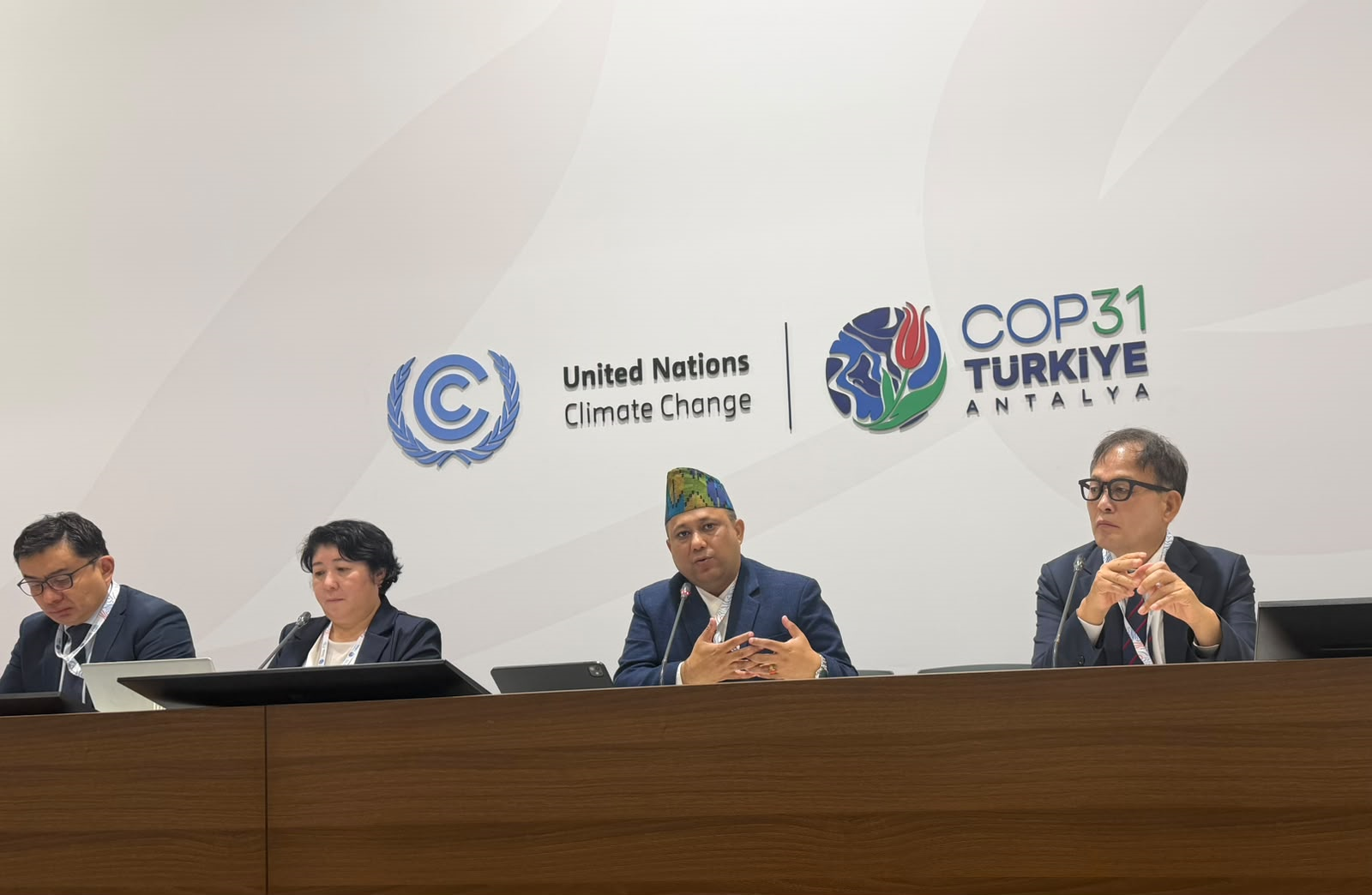
Minister for Foreign Affairs Shisir Khanal made the appeal at a high-level event titled ‘Strengthening Mountain Resilience through Adaptation Finance’, held on the sidelines of the 31st Conference of the Parties (COP31) to the United Nations Framework Convention on Climate Change, which began in Antalya, Türkiye, on Monday.
The programme was jointly hosted by a coalition of mountain countries-Nepal, Bhutan and Kyrgyzstan-in partnership with the International Centre for Integrated Mountain Development (ICIMOD) and the JOY Environment Network. Drawing attention to the devastating August 26’s Bhotekoshi flood, Minister Khanal highlighted the economic, physical and human toll of climate-induced disasters in Nepal.
He stressed that stronger regional and international cooperation was essential to protect vulnerable mountain communities from increasingly severe climate impacts. Stating that nearly one-third of the world’s population depends directly on mountain ecosystems for their livelihoods and well-being, the Minister called for mountain resilience to feature more prominently in the global climate change agenda.
Minister Khanal also pressed for increasing the volume and mobilization of predictable and easily accessible climate finance to support adaptation efforts. Reaffirming the urgency of global climate action, he urged the international community to maintain the possibility of limiting global temperature rise to 1.5 degrees Celsius. The Minister, during his address, also highlighted the importance of collective action to address the climate crisis.
Nepal inaugurates national pavilion at COP31
Antalya (Türkiye), Nov 10: Nepal has inaugurated its national pavilion at the 31st United Nations Climate Change Conference (COP31) in Antalya, Türkiye, highlighting the country’s climate priorities, biodiversity conservation efforts and community-led adaptation initiatives.
Minister for Foreign Affairs Shisir Khanal, who is leading the Nepali delegation to the conference, inaugurated the pavilion today. The pavilion showcases Nepal’s achievements in biodiversity conservation and efforts to help local communities adapt to the growing impacts of climate change, while reflecting the country’s climate ambitions on the international stage. Addressing the inauguration ceremony, Minister Khanal called for greater global attention to the mounting threats facing the fragile Himalayan ecosystem.
Khanal particularly highlighted the growing risks associated with melting glaciers and other cryosphere-related hazards, describing the August 26 Bhotekoshi disaster as a ”Himalayan tsunami”. He said countries like Nepal, despite contributing relatively little to global emissions, are bearing a disproportionate share of the consequences of climate change.
Emphasizing the need for collective action, Minister Khanal called for climate justice, easier access to financial support for loss and damage, stronger resilience in mountain regions and greater protection for downstream communities. Likewise, Minister for Health and Food Safety Nisha Mehta and member of the House of Representatives Sagar Dhakal addressed the inaugural ceremony.
Today itself, Khanal also attended the opening plenary of COP31, chaired by Türkiye’s Minister for Environment, Urbanization and Climate Change Murat Kurum. Australia’s Minister for Climate Change and Energy Chris Bowen presided over the negotiation process. On the sidelines of the global climate conference, Minister Khanal held a bilateral meeting with his Ethiopian counterpart, Gedion Timothewos.
During the meeting, Minister Khanal expressed appreciation for the solidarity and sympathy extended by the Ethiopian government and people following Nepal’s recent devastating climate-related disasters.
The two ministers exchanged views on wide range of issues including climate change, sustainable graduation from the Least Developed Country (LDC) category, trade, air connectivity, tourism and people-to-people relations. They also discussed ways to strengthen the friendly and cooperative relations between Nepal and Ethiopia.
RSS