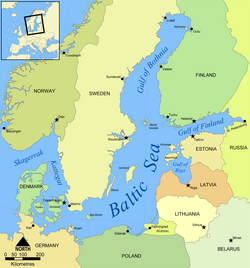
बाल्टिक सागर
Stockholm, November 10:
Eight NATO member states have launched a five-day anti-submarine military exercise in the Baltic Sea, with a senior NATO commander describing submarines as a persistent security challenge.
Led by Sweden, the exercise—running from Monday to Friday—features participation from the United Kingdom, Canada, Denmark, Finland, France, Germany, and the Netherlands. The Baltic Sea has become a primary arena for what Western nations accuse Russia of conducting as “hybrid warfare” activities.
According to NATO, the exercise involves thousands of sailors, German and Swedish submarines, warships from various nations, and aerial patrol assets. The drills comprise various phases focused on detecting and tracking submarines.
NATO has increased its naval presence in the Baltic region. Military experts note that due to the region’s shallow waters and heavy maritime traffic, it is difficult to identify acoustic signals used to detect submarines, making it easier for them to hide.
Speaking to AFP, NATO’s submarine commander, Rear Admiral John Craddock, stated that submarines remain the only technology capable of maintaining a continuous underwater presence.
“Therefore, because submarines can establish underwater dominance, the capability to detect them is essential,” he said. He added that submarine-detection skills would degrade without constant practice.
“We must practice this continuously. Unless we can make the oceans completely transparent, submarines will remain a threat,” he stated.
French Navy Rear Admiral Nicolas Molitor highlighted that security challenges have also heightened due to underwater cables and pipelines in the Baltic Sea. Speaking to AFP during the drills, he noted threats stemming from unmanned underwater vehicles and robots. He also pointed out that vessels dragging anchors across the seabed can cause damage to critical infrastructure.
— RSS/AFP