न आफन्त रहे, न घरः छैन दसैँको रौनक
KATHMANDU, October 16:
As Dashain approaches, Nirajan Poudel’s mind plays tricks on him time and again. Seeing the hustle and bustle of festival preparations in the market and the throngs of people returning home from the city, his mind nudges him: “Oh, Dashain has arrived! Now it’s time to prepare to go home.”
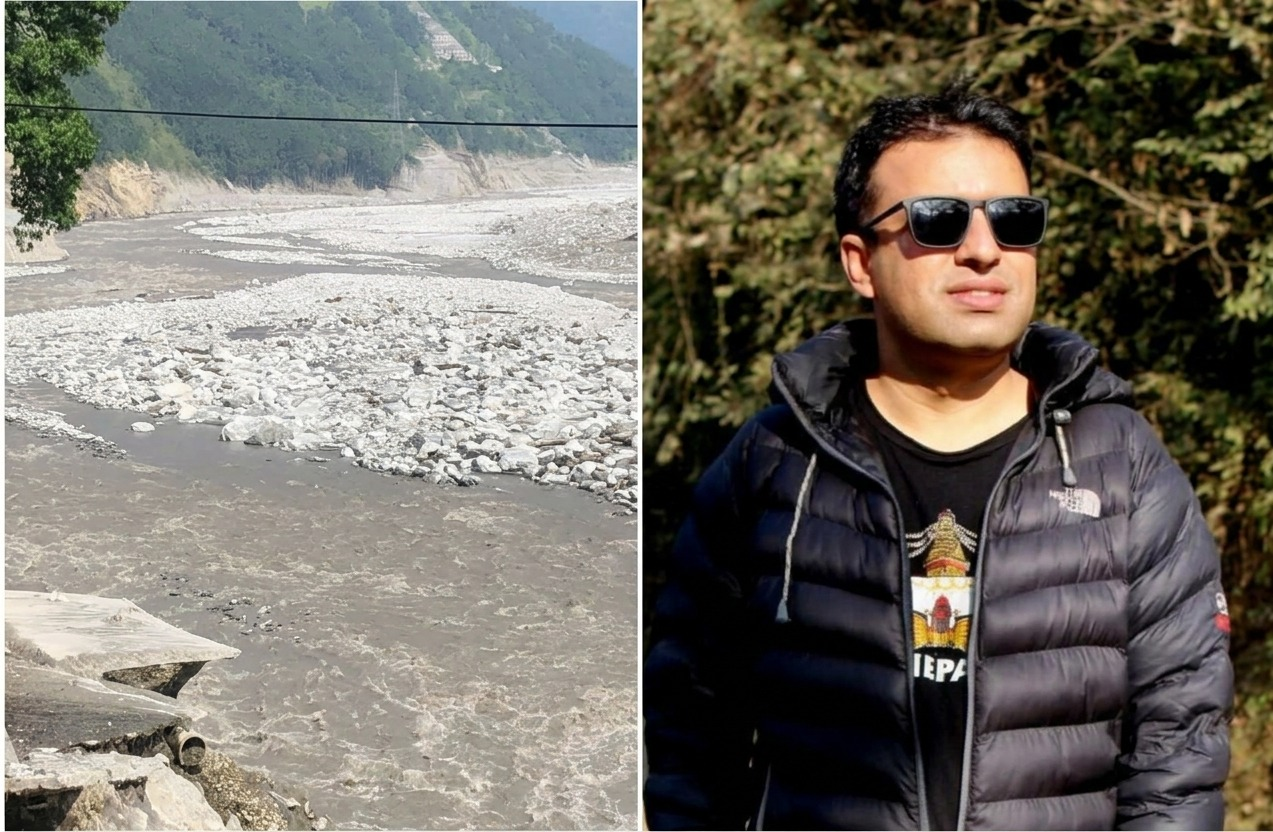
What does innocent little son Liyan know? He does not know that the house in Sole has been swept away by the Bhote Koshi flood, and that his grandfather and grandmother were also washed away by the disaster. Liyan must be thinking that once Dashain arrives, they will reach their village home, play on the swing set up by his grandfather, meet his grandmother, and have just as much fun as last year. Nirajan is at a complete loss as to how to console his son.
However, this small wave of excitement fades away almost as quickly as it arises. Along with the thought of Dashain, the unimaginable nightmare of the Bhote Koshi flood flashes in his mind, bringing the terrifying, gruesome scenes of his village right before his eyes.
The home where the joy of Dashain once blossomed and where past festivals were celebrated together with family no longer exists today. The courtyard where intimacy and a sense of belonging were shared with family and relatives has now been turned into a barren wasteland by the flood. The flood washed away not only his home but also Nirajan’s dream of returning to his village and celebrating. Therefore, this fleeting spark of joy repeatedly startles him.
Dashain has arrived, and many migrants cannot return home. Some are held back by employment, some by poverty, and others by compulsion. But Nirajan’s pain is different from all of these. He simply has no home to return to. While Dashain brings a rush to get home for others, for him, it has arrived as tears.
The irony is that during these days of Dashain, Nirajan’s mind is immersed in memories of the home he lost. While many who reached home for Dashain are opening the doors of their houses, Nirajan’s mind is opening the doors of memory, searching for past joys inside that empty home.
There is a road leading back to the village for Dashain, but there is no courtyard to step upon. There is a home in memories, but a barren riverbed right before the eyes—and inside the chest, an unhealing wound and an unfillable void. Right now, as the atmosphere of Dashain grows in the city, Nirajan is tormented by the horrifying catastrophe of August 26 (Bhadau 10). That is a day he neither wants to remember nor can ever forget.
Nirajan Poudel, a resident of Sole in Bidur Municipality, Nuwakot, lost everything on August 26. His father, Basudev Poudel, mother Goma, uncle Himalaya, aunt Uma, and sister Himani all went missing in the floods.
Today, neither those beloved family members remain, nor the property that his parents built piece by piece like a bird building its nest. There is not even a sign of where their house and farmland used to be.
“Baba, Dashain has arrived. When are we going to the village? Why haven’t Mom and Dad (grandparents) called to say ‘come quickly to play on the swing’? Why aren’t they video calling nowadays? I’ll be angry when we go home for Dashain.”
Hearing these repeated inquiries from five-year-old son Liyan, Nirajan fails to hold back his tears. To keep his son from knowing, he sometimes goes to the bathroom, sometimes to another room, to cry and wash his face with water. “Baba, when my son asks when we will go to our home in Sole to play on the swing, I simply cannot pull myself together,” Nirajan says.
“The son knows nothing. He still talks about going to the Sole home and playing on the swing during Dashain. Even when I am in another room, he asks to use his mother’s phone to show the house and the swing set up during the previous Dashain. He acts as if he is trying to make sure whether his home exists or not,” Nirajan shared.
The festive cheer of the village is now confined only to memories for Nirajan. When his mother used to coat the house with white clay and red mud, it felt as though Dashain was ready to step into the courtyard. There would be cucumbers ripening and bursting on the trellis, and pickles prepared by his mother’s own hands specifically for Dashain. Grass around the house would be left uncut to be harvested for Dashain, and the surrounding bushes would be neatly cleared. Nirajan would help his mother by gathering firewood after the Dashain holidays began, and migrants would return to the village.
“The village is joyful, Dashain is joyful,
Even if there is sorrow in the heart, Dashain brings joy of its own.”
When this Dashain song—with lyrics and music by Shiva Hamal and vocals by Bimal Pariyar and Sabita Pariyar—used to echo until last Dashain, an atmosphere of celebration would fill Nirajan’s heart as well. That very village, which looked so vibrant and cheerful during Dashain, has now turned into a desolate wasteland.
When Nirajan came to Kathmandu for studies and work, he used to long for holidays so he could go back to the village. This time, his father had plastered the house. Nirajan had planned to receive tika and jamara sitting in that newly plastered home and meet relatives and friends. Those relatives, uncle, aunt, and friends were washed away by the rushing floodwaters, never to be met again.
“Every year, my parents would call and ask, ‘When are you coming for Dashain? How many days will you stay? How much meat will you eat?'” Nirajan says. He wishes his mother would make that exact same phone call just like every other Dashain.
“Right now, it is hard for us to tell whether Dashain has arrived or if it is just any other day. When Dashain used to come before, there was a unique joy. Now, we don’t even feel the presence of a festival,” Nirajan says.
Displaced by the Earthquake, Stripped of Everything by the Flood
The 2015 earthquake had already displaced Nirajan’s family from their original home. Since the village house became unsafe to live in after the quake, some family members moved further down towards the river basin. They bought land there and built a house.
Income from agriculture became the basis for the family’s livelihood. The family gradually organized their life in the post-earthquake house. More than a decade after the house was built, plans were finally made to improve it further. Just two months ago, his father had the house plastered because he wanted it to look nice when all family members gathered for Dashain. The form of the house was changing, and the family’s dreams were coming true. But the flood of August 26 swept away all those dreams in a split second.
Shortly before the flood, Nirajan had urged his family not to stay in the village. Having witnessed floods in the Bhote Koshi the previous year as well, sensing the rising danger, he had asked his parents to come to Kathmandu. Nirajan had thought of bringing the family to Kathmandu to take care of his grandson. However, his father was teaching at a school, and since he still had three years left before retirement, his father had said they would think about it after taking a Dashain advance.
“I kept telling my parents not to stay there anymore, that it was risky and they should come to Kathmandu. But none of us ever imagined such a disaster would strike,” Nirajan recalled. He feels that if his parents had come to Kathmandu, they might have lost their property, but they wouldn’t have lost their lives.
A journalist by profession, Nirajan was at his office on August 26. Working at Ratopati, when he first received news of the flood, he initially thought it would be just a routine rise in water levels. Since rivers frequently swelled and caused minor floods before, he thought this time would be similar. But shortly after, news arrived that the flood had entered the village. Arjun Poudel, living in Kathmandu, called to inform him that the flood had reached Sole. As the gravity of the disaster became clear through direct visuals and news reports, Nirajan began calling his family members. He called his mother first; there was no connection. He called his father; it wouldn’t go through. Calls to his uncle and sister also failed to connect.
Even though the calls didn’t go through, Nirajan believed in his heart that his family members had reached a safe place. In past floods, villagers had moved uphill to safe locations. He assumed everyone must have headed toward the forest or upper village this time too.
“Between 2:00 PM and 3:00 PM, I thought everyone must be safe. I figured the lack of connection was just a normal network issue,” he said. Later, as communication with villagers began to establish, it became clear that the situation was far more catastrophic. Some people couldn’t speak clearly.
When a call came from the village saying he needed to brace himself, a chill ran through his heart. Yet, he kept hoping his family members might be sitting somewhere in the forest or a cave and would return soon. Days passed, but the condition of his family members could not be traced. No bodies were found either. Their final rites had to be performed using symbolic bodies made of kusha grass.
“Even now, my heart refuses to accept that they are no longer here. I feel like they might be staying somewhere in the forest or a cave. Sometimes I feel like checking my phone, wondering if they will call asking me to come home for Dashain,” he says.
His sister Himani was studying civil engineering in China and had come home on vacation. On the day of the flood, she was preparing to come to Kathmandu with her uncle. Since his father taught at a school 15 kilometers away, he usually stayed near the school, but on that day, he had come home to bid farewell to his niece. The flood that struck that very day swept them all away.
A total of 78 people from Nirajan’s village remain missing. He is now struggling with how to cope with the mental trauma inflicted by this disaster and move forward. According to him, both time and state support are essential for disaster-affected people to recover mentally.
“We now need the guardianship of the state. We need a foundation: Where do we build a house? How do we live? How do we sustain our lives? Some children have lost their parents; we need to figure out how to comfort them and build a bright future for them,” is his appeal.
RSS/Unified Nepal