
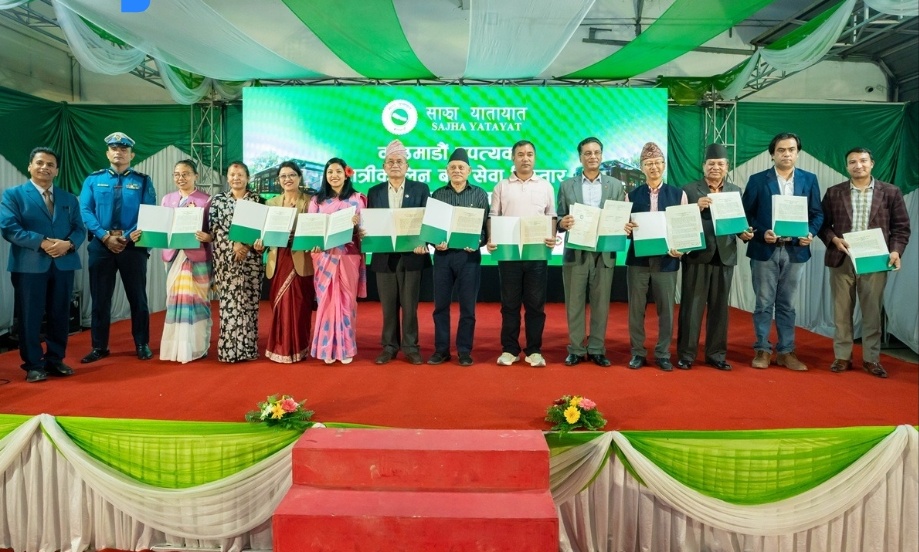
Kathmandu, Sept. 20: Nine local governments in the Kathmandu Valley have joined a joint programme to operate and expand night-time bus services in the Valley.
The local governments have signed an agreement with Sajha Yatayat to expand the night bus service that has been operating on a trial basis since April 14 under the leadership of Kathmandu Metropolitan City. The local governments have agreed to share responsibilities and financial obligations as required to ensure the service continues and expands.
The service aims to provide convenient, safe and reliable transportation at night for the general public, businesspeople, entrepreneurs, workers, patients travelling to hospitals, and domestic and foreign tourists. The mayors and representatives of the participating local governments signed a memorandum of understanding with Sajha Yatayat on Constitution Day.
The participating local governments are Kathmandu Metropolitan City, Lalitpur Metropolitan City, Budhanilkantha Municipality, Godawari Municipality, Chandragiri Municipality, Kirtipur Municipality, Bhaktapur Municipality, Suryabinayak Municipality and Madhyapur Thimi Municipality. Sajha Yatayat Chairperson Sushil Raj Pyakurel signed the agreement on behalf of the transport company at a ceremony held at its office.
Following the agreement, 30 buses have begun operating on six routes.
Kathmandu Metropolitan City Deputy Mayor Sunita Dangol said the night bus service was being further developed and expanded as part of efforts to increase access to basic services guaranteed to citizens by the Constitution.
“We have added four routes to the two routes operated during the trial period. We have increased the number of buses from seven to 30. With the cooperation of four municipalities, the number of participating local governments has now reached nine. We have begun this cooperation with a commitment to further expand the service and share financial responsibilities as required. This service will not stop. It will operate continuously and sustainably,” she said.
Lalitpur Metropolitan City Mayor Chiribabu Maharjan said the federal government should have introduced plans to operate a metro system to ease transportation in the Valley, but no such initiative had materialised.
“If there is no metro, there should have been a Bus Rapid Transit (BRT) system. There is no indication of that either. We cannot simply remain silent because nothing has come from the federal government. Therefore, we have started cooperation on a system that can be operated at the local level,” he said, adding that efforts to develop and expand the service would continue.
Maharjan described the night bus service as a major achievement for citizens, saying it would provide a reliable means of safe travel at night.
Sajha Yatayat Chairperson Pyakurel said it was a significant milestone in the organisation’s history to have local governments take responsibility as its institutional partners.
Under the expanded service, six buses will operate between Jagati-Suryabinayak and Thamel; six between the existing Lagankhel-Budhanilkantha route and Godawari; eight on the Ring Road in both clockwise and anticlockwise directions; four between Kirtipur and Jamal; two between Takhel and Thamel; and four on the existing Nagdhunga-Airport route.
Previously, seven buses operated on a trial basis from 8 pm to 11 pm on the Lagankhel-Budhanilkantha and Nagdhunga-Airport routes. An assessment of the service and a cost-benefit analysis concluded that public service was more important than profit or loss in operating the night buses.
Under the agreement, if ticket revenue is insufficient to cover the operating costs, 50 percent of the shortfall will be shared equally by the seven concerned municipalities. The remaining 50 percent will be covered according to the population of the participating municipalities, with Kathmandu Metropolitan City contributing 18.55 percent, Lalitpur Metropolitan City 18.55 percent and the other seven municipalities contributing 9 percent each.
Sajha Yatayat will submit quarterly requests for the funds required to cover any operating shortfall.
The concerned municipalities will determine the locations where passengers will board and get off the buses. Sajha Yatayat has been assigned responsibility for installing digital signage boards and developing and operating digital bus stops at those locations during fiscal year 2083/84. The respective municipalities will provide the necessary coordination and facilitation.
The concerned municipalities will provide land required for constructing bus charging stations at the terminal points of the designated routes, while Sajha Yatayat will install the charging infrastructure. The municipalities will also be responsible for the security of the charging stations.
The agreement also opens the possibility of expanding night bus services to other areas as passenger demand and transportation needs increase.
With bus services now available along the Ring Road, passengers will be able to reach different parts of the Valley by changing buses at designated points. The maximum fare for such a journey will be Rs. 80.
To reduce financial leakage from ticket sales, Sajha Yatayat introduced a digital ticketing system on September 17. Passengers can purchase tickets either through QR payments or by paying cash. The company expects the system to reduce revenue leakage and consequently lower its operating deficit.
The Government of Nepal holds shares worth Rs. 3 billion in Sajha Yatayat, while Kathmandu Metropolitan City has invested Rs. 150 million. Sajha Yatayat currently operates 111 buses.