Amrit Kharel

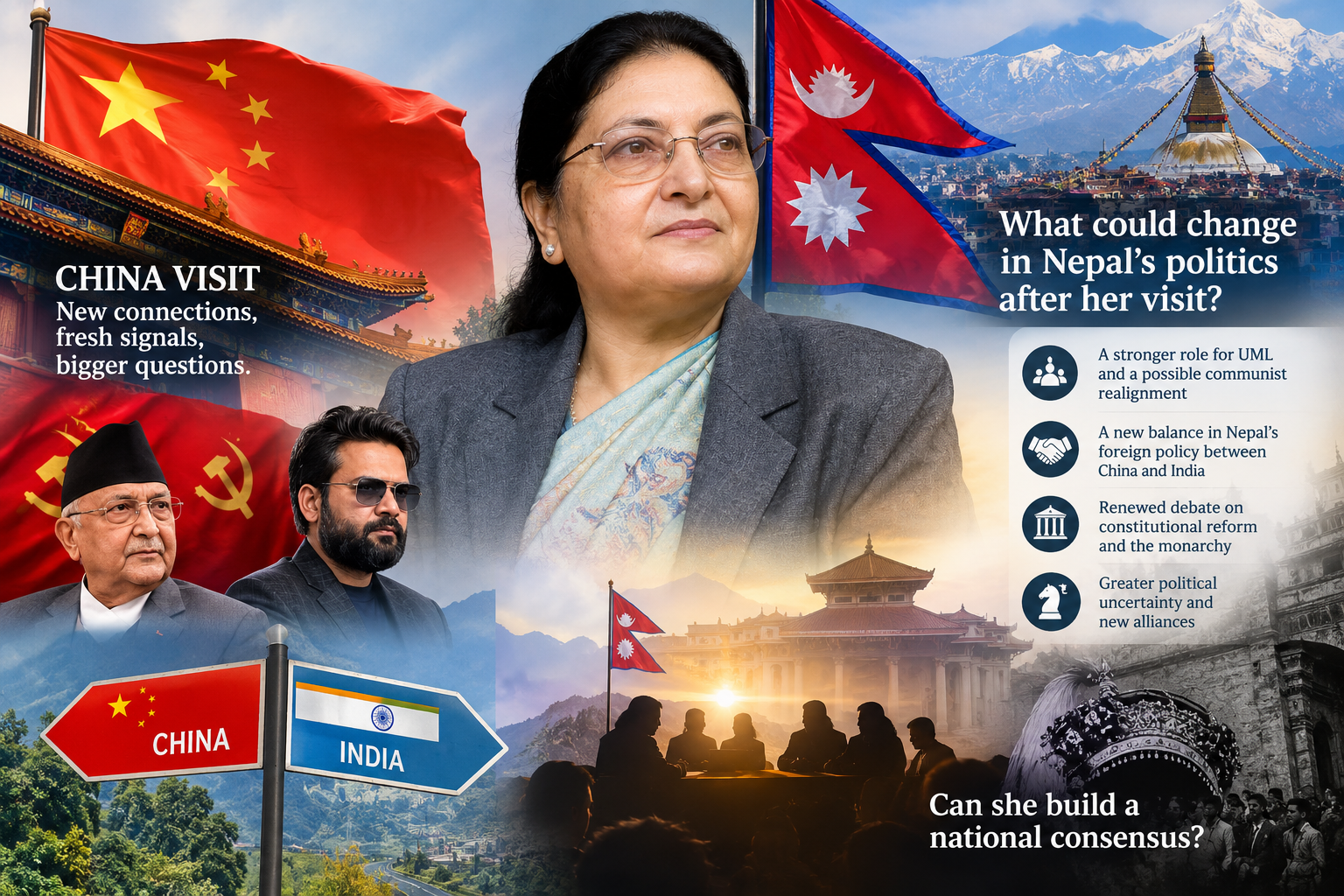
As the former president returns to active UML politics, her appearance at a high-level Chinese forum raises questions about Beijing’s interests, communist party realignment and the strategic calculations surrounding Prime Minister Balendra Shah’s proposed visit to India.
Kathmandu, October 22
Former President Bidya Devi Bhandari’s departure for China to attend the Global Governance Forum comes at a politically sensitive moment in Nepal. Her visit might appear to be a routine engagement with an international conference, but its timing gives it significance beyond the forum’s stated agenda.
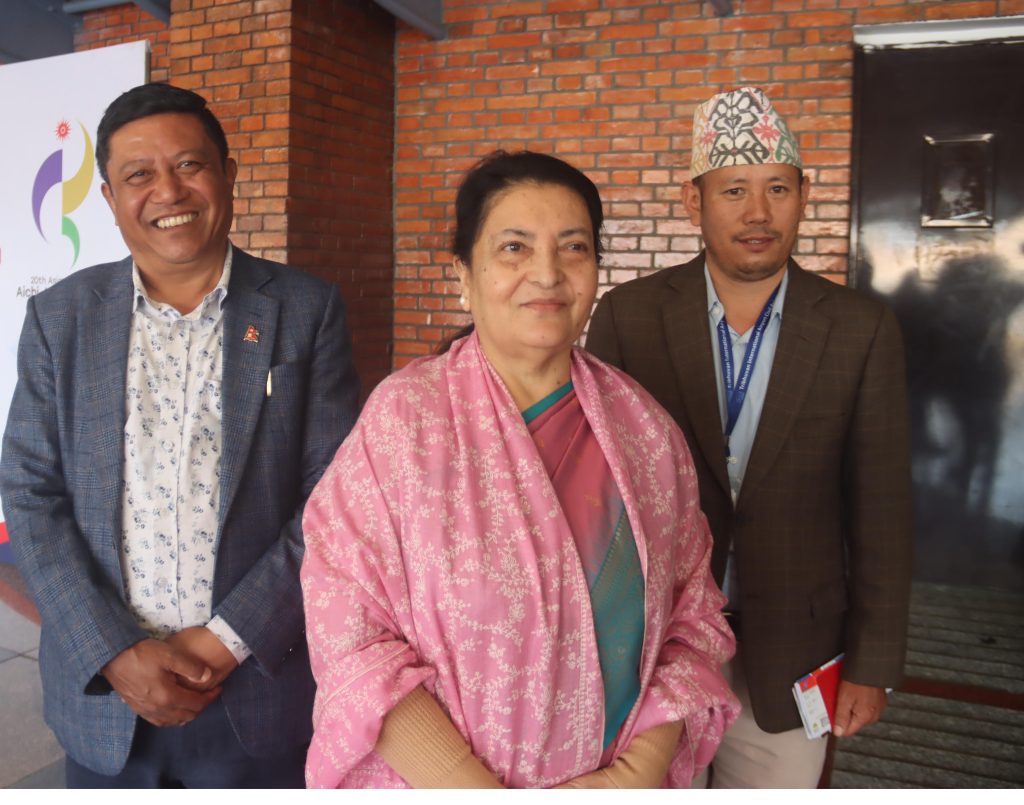
Bhandari has only recently returned to active party politics after taking an oath as a senior leader of the Communist Party of Nepal (Unified Marxist-Leninist), or CPN-UML, on October 8.
Her appointment has reopened questions about the party’s future leadership, the balance of power within Nepal’s communist movement, and the possible role of external relationships in shaping the country’s political landscape.
Now, less than two weeks after formally resuming her political career, Bhandari is travelling to China at the invitation of the Chinese government to attend a forum where she is expected to address international dignitaries as a special guest.
The central question is whether the timing, the level of Chinese engagement, and her newly restored political position offer clues to a broader realignment that could affect Nepal’s domestic politics and its relations with its two powerful neighbours.
There is, at present, no publicly established evidence that Beijing has engineered Bhandari’s political comeback or is directing efforts to unite Nepal’s communist parties under her leadership. But the circumstances are sufficient to make the political implications worth examining.
Why Beijing may have chosen this moment
China’s invitation deserves attention for three reasons: Bhandari’s renewed political relevance, the strategic importance Beijing attaches to Nepal’s political stability, and the timing of Nepal’s developing diplomatic engagement with India.
The first is Bhandari’s political standing. Her return to the UML has created a new variable in a party historically shaped by KP Sharma Oli and other senior leaders. Her position as senior leader gives her a formal platform within the organisation, although it does not automatically make her the party’s future leader. She also carries the legacy of being the wife of late Madan Bhandari, who was deemed as a charismatic leader of that party in his time.
The second is the character of the invitation. This is not simply a visit by a former head of state attending an ordinary cultural programme. Bhandari is travelling at the invitation of the Chinese government to participate in a forum where she is expected to address an international gathering as a distinguished guest.
Such invitations can serve several purposes simultaneously. They recognise an individual’s international standing, maintain relationships with influential political figures, and provide diplomatic opportunities to exchange views beyond formal government-to-government channels.
China has a clear interest in maintaining relationships across Nepal’s political spectrum. But maintaining access to a prominent politician is not the same as sponsoring her political ambitions. The invitation alone cannot establish that Beijing is backing Bhandari to lead Nepal’s communist movement.
However, the political significance lies in the opportunity the visit creates.
Is China looking for a new centre of gravity in Nepal’s communist politics?
Bhandari’s return to the UML has prompted a larger question. Could she eventually emerge as a figure capable of bringing different communist factions closer together?
The question is understandable. Nepal’s communist parties have repeatedly experienced splits, rival leadership claims and disagreements over electoral strategy, relations with China and India, and the distribution of power. A leader with a national profile and experience as head of state could, in principle, offer an alternative centre of political gravity.
Bhandari also occupies a distinctive position. She has held the presidency for two terms, has a long association with the UML and family legacy of late Madan Bhandari. And now she has formally resumed party responsibilities. That combination gives her a profile different from that of an ordinary party functionary. Her persona may work better while there is rifts and tussles between personality clash among other top brass communist leaders i.e. K.P. Sharma Oli, Puspa Kamal Dahal, Madhav Nepal and so on.
However, these questions remain unanswered yet:-
First, does Bhandari herself intend to become a unifying leader across the communist movement, or is she primarily seeking a greater role within the UML?
Second, would established leaders and rival factions accept her leadership, particularly when their own political influence could be diminished?
Beijing has a diplomatic interest in political stability and in maintaining constructive relations with governments in Kathmandu. Yet it would be premature to conclude that Bhandari’s visit represents a Chinese plan to reorganise Nepal’s communist parties.
It can be seen from the political scenario that the visit offers Beijing an opportunity to engage a politician whose influence may grow further in the coming months.
If she does become a more consequential political figure, the relationship established now could prove useful. That is a plausible strategic consideration, not proof of a coordinated political project.
Being legitimately in power is one thing, but holding authority is another matter. Though the Rastriya Swatantra Party and Balendra Shah Government is officially in power, they seem to be in a fragile position to hold authority and trust from all walks of life. Neither the investors, nor top businessmen, nor consumers, nor the devastating flood victims, nor the squatters taken forcefully to the holding centers, have much faith and trust in the government and the largest political party.
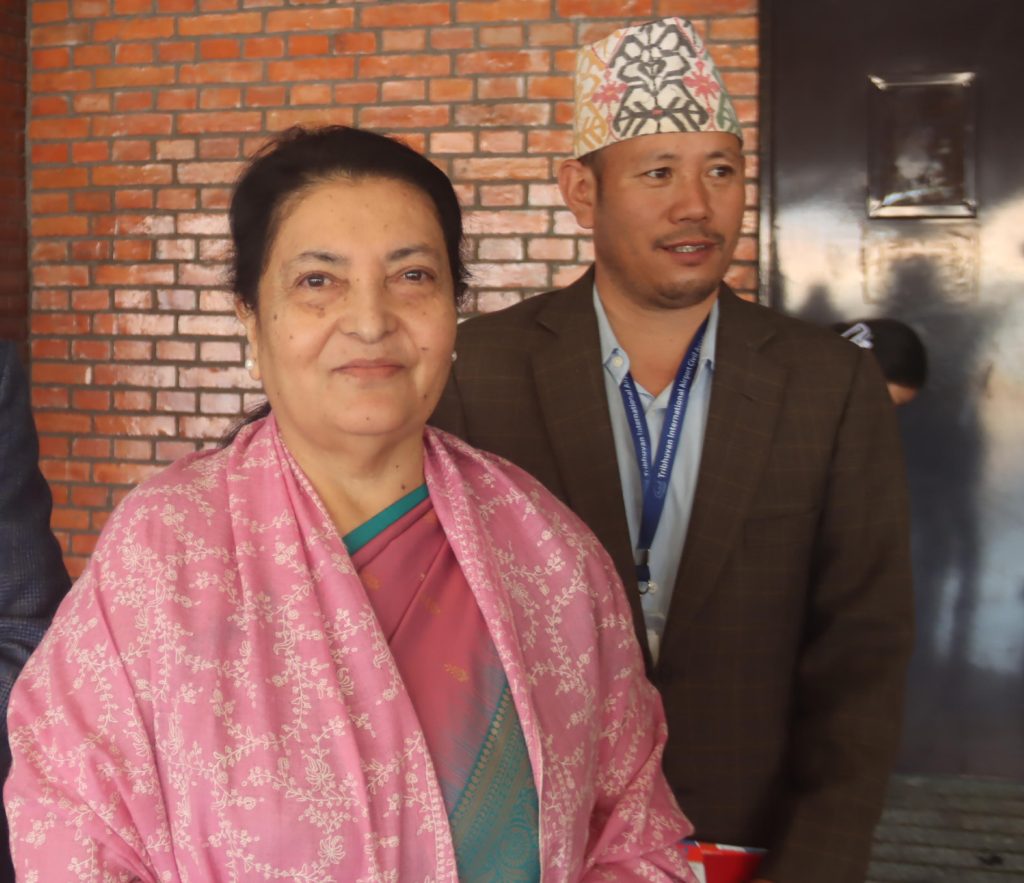
The Oli factor: cooperation or an emerging leadership contest?
Bhandari’s political return also has implications for the internal balance of the UML.
Her appointment as senior leader places her near the top of the party hierarchy, while Oli remains chairman. This creates a potentially delicate relationship between the party’s established leadership and a former president with her own political standing.
The arrangement could initially benefit both sides. Bhandari brings national recognition and the potential to attract supporters, while Oli retains the organisational machinery and formal leadership of the party.
But the relationship could become more complicated if Bhandari’s influence expands.
Would she reinforce Oli’s leadership, help the party rebuild its political strength, or eventually become an alternative around which dissatisfied leaders and supporters could organise?
There is no basis to assume that a confrontation is inevitable, but before the Gen Z movement and even after the Gen Z movement, Oli has opposed her return in party politics. However, two weeks earlier, Oli backtracked on his position and let Bhandari enter into party politics as a senior leader. So that any external pressure or such circumstances cannot be ignored, which compel Oli to shift from his position regarding the reentry of Bhandari in party politics. But there is no evidence that the China visit is intended to advance an internal leadership challenge.
Nevertheless, Bhandari’s first foreign visit since her return to active politics gives the relationship an international dimension. If Chinese officials engage her prominently, political observers in Nepal will naturally examine whether that recognition strengthens her standing within the UML.
The most consequential signal may not be anything announced during the forum. It may be how Bhandari is received by her own party after she returns.
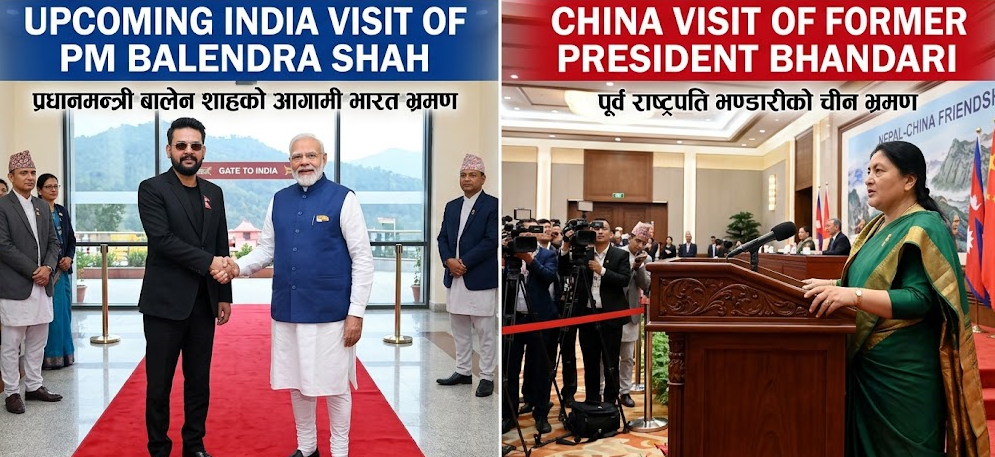
The India visit: a diplomatic balancing act for Balen Shah
Bhandari’s China visit comes as Prime Minister Balendra Shah’s government prepares for its first official bilateral visit to India.
The Ministry of Foreign Affairs has been working on the proposed visit, with late November discussed as a possible timeframe, although the dates have not been formally finalised. The agenda is expected to include major infrastructure projects and outstanding bilateral issues.
This timing creates an interesting diplomatic contrast.
While a former president and newly reinstated UML leader is attending a high-level forum in China, Nepal’s sitting prime minister is preparing for engagement with India, the country’s closest major neighbour in terms of geography, trade, transit and people-to-people ties.
The two visits should not automatically be treated as competing diplomatic initiatives as Bhandari is not travelling as Nepal’s sitting head of state or as the government’s official representative. Her participation cannot substitute for a formal bilateral engagement led by the prime minister.
Nevertheless, the political optics matter.
China may view the visit as an opportunity to sustain contact with an influential figure at a time when Nepal’s political arrangements are changing.
India, meanwhile, will be watching how the new government defines its foreign policy and whether Kathmandu maintains a stable, predictable relationship with both neighbours.
For Balendra Shah, the challenge is to ensure that Nepal’s engagement with India is guided by national interests rather than domestic political calculations about who has closer ties with Beijing.
A successful India visit could demonstrate that the government is prepared to pursue pragmatic cooperation with New Delhi while maintaining constructive relations with China. Conversely, any suggestion that the government is being drawn into a regional contest for influence could complicate its diplomatic position.
The question, therefore, is not whether Bhandari’s visit will derail the prime minister’s plans. It is whether the emerging political and diplomatic signals will influence how Nepal’s neighbours assess the country’s future direction.
The Cholendra Shumsher Rana episode and the politics of power
Another development adds to the atmosphere of uncertainty surrounding Nepal’s political transition: the September episode involving former Chief Justice Cholendra Shumsher Rana.
Police took Rana from his residence in the early hours of September 27 and held him at the Kathmandu Valley Crime Investigation Office before releasing him to his family later that day. Authorities said the action was prompted by a security threat. The government subsequently insisted that he had not been arrested but moved to a safe location for his protection.
The circumstances raised legitimate questions. Police did not publicly identify the source of the alleged threat, and the manner in which Rana was taken from his home attracted scrutiny from legal circles and the National Human Rights Commission.
It is important, however, to distinguish those documented events from speculation about a possible political coup or an attempt to alter the balance of power. There are not any publicly available evidence that establish that Rana was involved in a coup plot, nor does it establish that his removal from his home was part of a government operation against such a plot.
But It illustrates the uncertainty surrounding political authority, the role of former power holders and the relationship between the executive, judiciary and political parties during a period of transition.
It also demonstrates how quickly a security operation can become a wider political controversy when the government fails to explain its legal basis and the evidence behind it.
Being legitimately in power is one thing, but holding authority is another matter. Though the Rastriya Swatantra Party and Balendra Shah Government is officially in power, they seem to be in a fragile position to hold authority and trust from all walks of life. Neither the investors, nor top businessmen, nor consumers, nor the devastating flood victims, nor the squatters taken forcefully to the holding centers, have much faith and trust in the government and the largest political party.
Bhandari’s China visit is a separate event, and there is no established evidence connecting the two developments. They should not be presented as parts of one coordinated political operation.
Yet both developments contribute to a broader question facing Nepal. How will the country’s political institutions and established power centres respond to a changing political order?
What will count as evidence of a larger Chinese strategy?
If Bhandari’s visit is to be assessed seriously, observers should look beyond the fact that she has travelled to China.
Several developments would provide more meaningful evidence of a political shift.
The nature of her official engagements and meetings with senior Chinese political leaders beyond the forum’s ordinary programme would be relevant, although such meetings would not, by themselves, prove political sponsorship.
The substance of her public remarks and statements about Nepal’s political future, regional cooperation or relations with China could indicate the direction in which she wants to take her international role.
Her position within the UML after returning and any expansion of her organisational responsibilities, public leadership role or influence over party strategy would offer a clearer measure of her domestic political standing.
Developments across communist parties and concrete negotiations, public agreements or organisational initiatives aimed at bringing rival communist factions together would be more persuasive evidence of political realignment than rumours about private intentions.
The government’s diplomatic response will also be meaningful. How Balendra Shah’s government manages relations with China and India will help determine whether the episode remains an ordinary diplomatic engagement or acquires a wider political dimension.
These indicators would allow the issue to be assessed on evidence rather than assumption.
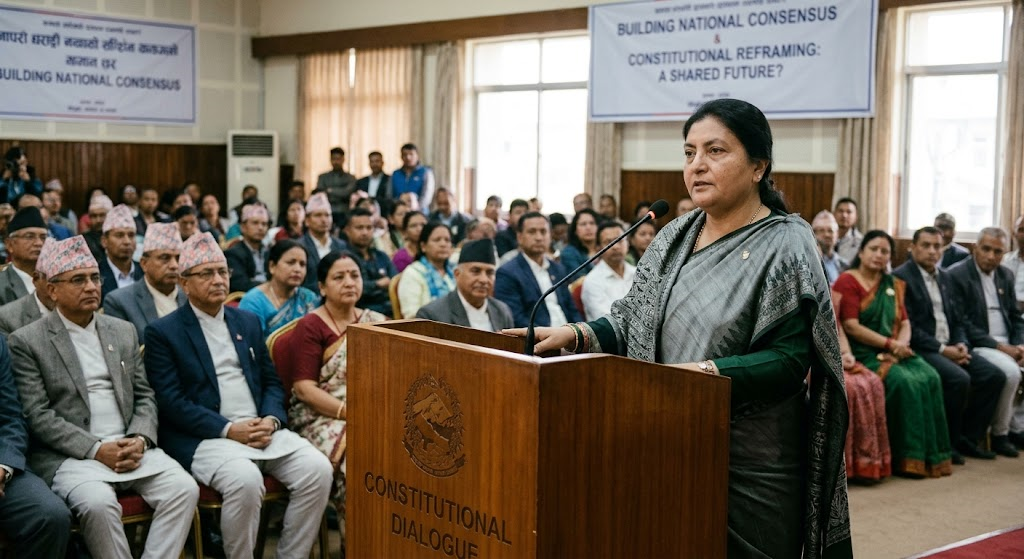
Will Bhandari be able to build national consensus on constitutional reframing?
Another crucial question is what position Bhandari will take on constitutional reform and the future of Nepal’s political system.
During and after her presidency, her perceived sympathy towards certain traditional institutions and her reported openness to debate over the monarchy have fuelled speculation about whether she could appeal beyond the UML’s traditional constituency.
If she chooses to champion constitutional reform, her real test will be whether she can build a national consensus that accommodates republican forces, constitutional monarchists, advocates of a Hindu state, and other political and social groups without undermining the constitutional rights of those who disagree.
Her experience as former president could give her a platform to encourage dialogue, but it does not automatically confer a mandate to speak for all these forces. Nor is there established evidence that China is supporting her to bring the monarchy and communist parties together.
Could Bhandari emerge as a consensus-builder capable of bringing historically opposed forces around a shared national development agenda?
That would require a clear constitutional vision, respect for democratic procedures and an honest assessment of the differences between restoring the monarchy and reforming the existing republic.
Her China visit may increase interest in her political ambitions, but whether she can turn that attention into a genuinely inclusive national project will depend on her own choices and the confidence she can earn across Nepal’s divided political spectrum.
Who will shape Nepal’s next political settlement?
Bhandari’s visit is significant because it coincides with her return to active politics, the continuing importance of the UML’s internal leadership arrangements and the new government’s efforts to establish its diplomatic priorities.
China’s invitation gives her an international platform at a moment when her domestic political role is being redefined. That is noteworthy in itself.
The prime minister’s proposed India visit should be understood as a separate but strategically important development. Nepal’s foreign policy will ultimately be judged by the agreements it secures, the interests it protects and its ability to maintain productive relations with both neighbours.
The most important outcome of Bhandari’s China visit may therefore be political rather than diplomatic. It could strengthen her visibility, provide opportunities to develop international contacts and raise expectations about her future role within the UML.
Whether those opportunities translate into a larger leadership project will depend on what happens after she returns: the decisions she makes, the support she commands within her party and whether other communist leaders see her as a partner, a rival or a possible unifying figure.
For now, the visit is a meaningful political signal, not proof of a hidden geopolitical arrangement. Nepal’s political future will be shaped less by speculation about who stands behind which leader than by the alliances, decisions and institutional changes that can actually be demonstrated.
And that is precisely why Bhandari’s return from China deserves close scrutiny.