इजिप्टको प्राचीन मन्दिर
Abu Simbel (Egypt), October 23:
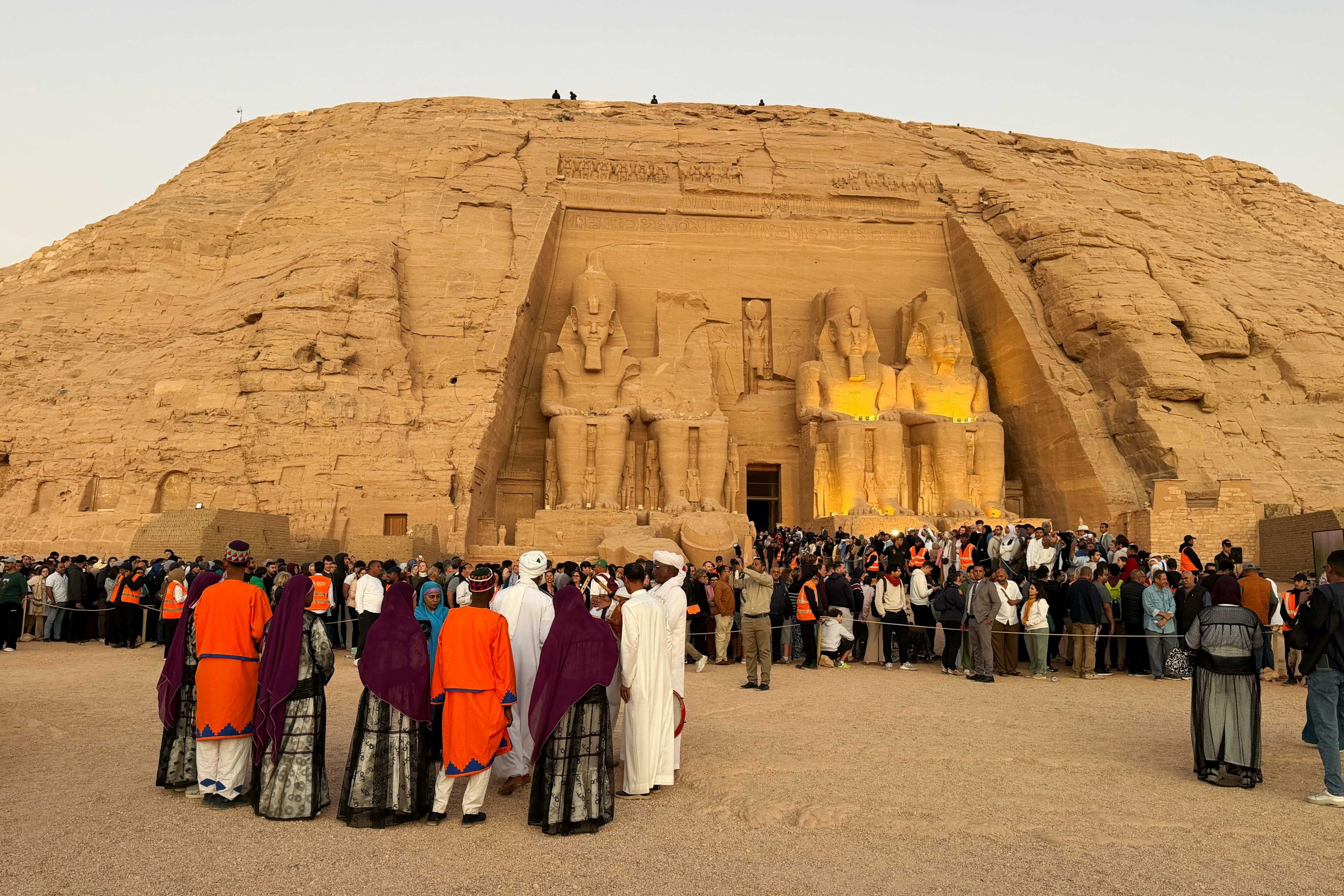
Hundreds of tourists and locals gathered early Thursday morning to witness a rare astronomical phenomenon in Egypt’s southern region, where the golden rays of the sun penetrate the inner sanctum of a 3,000-year-old temple to illuminate its statues twice a year.
The sun’s rays enter the Great Temple of Pharaoh Ramesses II annually on October 22 and February 22. These dates are believed to coincide with the birthday and coronation of the ancient Egyptian king, Ramesses II. Due to the temple’s architectural design and its precise alignment with the sun, the illuminating light remains inside the inner chamber for about 20 minutes. Hisham Khella, a local tour guide for Italian tourists, noted that this day is a special occasion of festive and historical significance. Tourists had queued up since early morning to catch a glimpse of the rare sunrise, with some even spending the night outdoors. The temple premises were crowded with visitors capturing photos and selfies using mobile phones and cameras, making them appear dwarfed in front of the massive statues. The temple faces the Nile River.
During the celebration, artists dressed in traditional attire performed dances to the accompaniment of bells, tabla rhythms, and the mizmar—an ancient Egyptian wind instrument resembling a trumpet—entertaining the visitors. The temple’s inner chamber houses statues of Ramesses II, Amun-Ra, and Ra-Horakhty. Normally shrouded in darkness, the sun’s rays travel about 60 meters deep into this chamber to illuminate the statues. According to the National Research Institute of Astronomy and Geophysics, this visual phenomenon is made possible by the unique relationship between the temple’s structural design and the sun’s position.
Janis Soudy, a visitor from Atlanta, USA, expressed her admiration for the giant statues and their preservation. She mentioned that she was even more captivated by the intricate carvings, hieroglyphs, and colors adorning the temple walls.
In the 1960s, following the construction of the Aswan High Dam, archaeologists and engineers undertook a massive project to relocate the temple to a safe location to protect it from rising waters. Special care was taken during the relocation to maintain the temple’s alignment with the sun. As a result, even after more than 3,000 years, the ancient tradition of the sun’s rays reaching the inner chamber twice a year continues uninterrupted.
RSS/Unified Nepal