भैरव नाच
Arghakhanchi, November 8:
The Bhairav dance, deeply intertwined with the religious faith, cultural identity, and generational traditions of the Newar community, stands established as a quintessential cultural heritage of Arghakhanchi district.
Presented with the resonance of traditional musical instruments, attractive attire, the distinctive rhythm of seven beats (sata taal), and ritualistic procedures, this dance highlights not only the cultural legacy of the Newar community but also the social harmony and cultural diversity of the district.
Preserved across generations, the Bhairav dance serves as a shared cultural identity for the Newar communities residing in various parts of Arghakhanchi. The Newar communities living in Patuwathum of Sandhikharka Municipality-1, Dibhrana in Ward No. 12, and Nuwakot and Lattebanj of Bhumikasthan Municipality-8 maintain a tradition of organizing this dance in alternating years. This year, the Nuwakot Bhairav Society of Bhumikasthan-8 performed the dance, while the Newa Society of Arghakhanchi-Rupandehi staged performances in Butwal. Both societies have showcased the Bhairav dance across various locations, including Sandhikharka.
The Bhairav dance follows strict religious procedures and time limits. In Arghakhanchi, the tradition dictates that the dance, which begins on Shree Krishna Janmashtami, must be performed up until the no-moon day (Kaushik Aunshi) of Kartik. According to Rajkumar Shrestha, Coordinator of the Arghakhanchi Bhairav Dance Conservation Committee, local belief requires that the Bhairav dance must conclude before the madal drums for Deusi-Bhailo begin playing. This elevates the dance from mere entertainment to a sacred tradition bound by religious faith and traditional discipline.
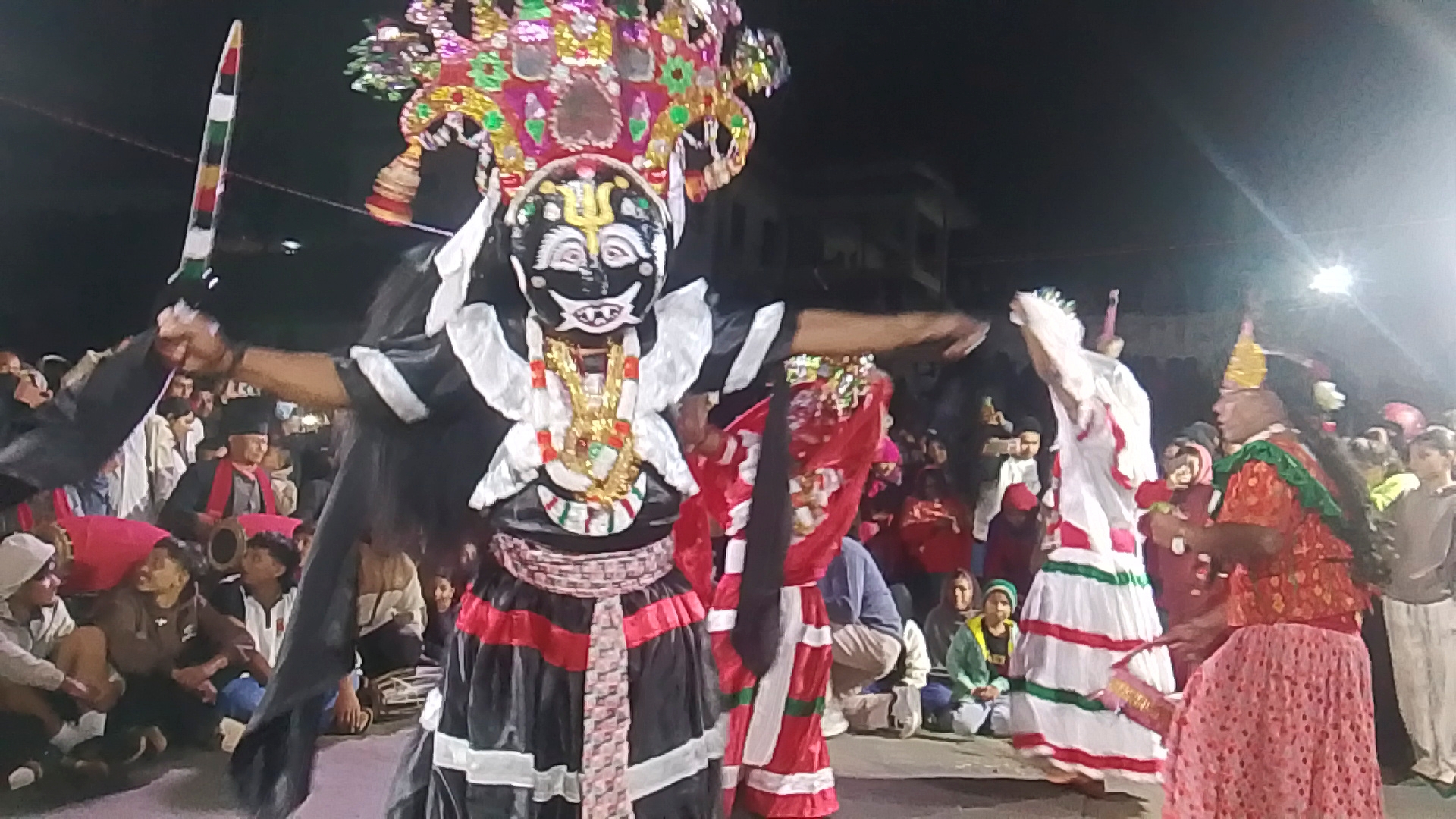
In the Bhairav dance, Kal Bhairav is presented as the primary character, while Shwet Bhairav and Rakta Bhairav serve as supporting figures. Alongside them, the role of Dankini (the dancer) is equally significant. Distinct colors, makeup, and costumes are assigned to each character. The artists portraying Bhairav are traditionally adorned with a khwapa (mask/skullcap), special garments, garlands, and a chamar (yak-tail flywhisk). The use of the tail of a mountain yak (chauri gai) as the chamar is part of the long-standing tradition.
While some changes in makeup materials and the use of modern items have occurred over time, the community remains deeply conscious of preserving its original form and religious sanctity. Coordinator Shrestha notes that artists dressed as Bhairav are worshipped as symbols of the deity. Rituals according to tantric methods are performed before the dance commences, after which the performance proceeds according to prescribed rhythms and traditions.
Another distinctive aspect of this dance is the rhythm of the seven beats (sata taal). Generally performed across seven beats, each beat in the Bhairav dance features a distinct tempo and presentation style. According to Kazi Shrestha, Vice-President of the Arghakhanchi Chamber of Commerce and Industry, a single beat cycle lasts approximately 10 minutes, followed by a brief rest before the next beat begins. The synergy between the dancers and musicians enhances the appeal of all seven beats, each carrying its own unique characteristics.
According to Sandhikharka Municipality Mayor Krishna Prasad Shrestha, the khing baja (mirdung)—a type of traditional drum—is used as the principal instrument in the Bhairav dance. Additional instruments include jhurma (jingles), sahnai (wind instrument), and dhankuri. When the dancers’ movements align with the distinct melodies of these instruments, the true originality of the dance shines. While the primary musicians traditionally belong to the Newar community, individuals from other communities also participate as supporting instrumentalists, reflecting profound cultural cooperation among communities, Mayor Shrestha remarked.
Religious and tantric rituals are given utmost importance in the Bhairav dance. According to local belief, during the fifth and sixth beats, Bhairav descends into individuals adept in tantric arts, causing not only the dancers but even spectators to tremble. Because any error in rituals or worship is believed to invite misfortune, extreme caution is observed from the preparation phase through to the conclusion. This discipline sets the dance apart from ordinary forms of entertainment.
Alongside religious performances, recreational segments are also incorporated into the Bhairav dance program. Presentations such as stick dances (Takundoli), horse dances, bird dances, and Lahure-Lahureni dances add vibrancy to the event. This provides local artists with an opportunity to showcase their talents while supporting the preservation of various traditional dances and skills.
Madhav Shrestha from Sandhikharka Municipality-1 points out that although the Bhairav dance is historically a Newar tradition, its popularity has transcended community boundaries. Thousands of spectators gather at Sandhikharka’s Tundikhel to witness the Bhairav dance, with notable participation from non-Newar communities as well.
The Bhairav dance is practiced in various districts of western Nepal. Beyond Arghakhanchi, traditional performances related to it are staged in Palpa, Baglung, and Dailekh, varying in style and presentation by region. Often recognized as Kalika Nach or Lakhe Nach in certain areas, these traditions highlight the cultural diversity of western Nepal. Coordinator Shrestha mentions that Arghakhanchi’s Bhairav dance is also popular in Gulmi, Pyuthan, Palpa, Kapilvastu, and Rupandehi.
Efforts made by communities displaced from their homelands due to employment, business, or education to preserve their indigenous culture are commendable. The Bhairav dance performance organized by the Newa Society Arghakhanchi-Rupandehi in Butwal this year serves as a prime example. Such programs familiarize the younger generation with their cultural history and foster warmth and connection among communities residing elsewhere.
Nevertheless, changing lifestyles, modern entertainment media, and shifting interests among the youth pose continuous challenges to the survival of traditional culture. Keeping the Bhairav dance alive requires more than a once-a-year public exhibition; it necessitates teaching the younger generation about its associated religious rituals, the knowledge of the seven beats, instrument-playing skills, costume-making arts, and historical background, as Shrestha argues.
Documenting the knowledge held by community elders and experienced artists through written, audiovisual, and digital media can facilitate the intergenerational transfer of this tradition. Strengthening cooperation among local governments, cultural organizations, Newar community leaders, and youth can create opportunities for school-level awareness and regular practice and performance.
Arghakhanchi is a district rich in natural beauty, historical heritage, religious sites, and indigenous culture. Proper promotion and conservation of the Bhairav dance can significantly bolster cultural tourism in the region. However, it is emphasized that the dance should be respected not merely as a tourist attraction, but as a living heritage carrying immense religious faith and historical value.
The distinct forms of Kal Bhairav, Shwet Bhairav, and Rakta Bhairav, the rhythm of the seven beats, the resonance of traditional instruments, and tantric worship rituals form the distinct identity of the Bhairav dance. Preserved across generations by the Newar community and now receiving broader support and participation from other communities, this tradition continues to march forward. Its safeguarding ensures not merely the continuity of a single dance, but the protection of Arghakhanchi’s historical identity, social harmony, and cultural diversity.
— RSS