प्रतीकात्मक तस्वीर
Ram Kumar Rai
Kathmandu, November 3 (Kartik 17):
In the year 1857 Vikram Samvat (V.S.), King Rana Bahadur Shah relinquished his royal duties and left for Banaras (Kashi), but returned to Nepal toward the end of V.S. 1860.
Immediately upon his return, he assumed absolute control over the state administration as “Swami Maharaj.”
His return had already generated intense distrust and suspicion between the old nobility and those seeking a new balance of power within the palace.
Upon returning from Banaras, Swami Maharaj brought along a formidable faction of nobles, including Bhimsen Thapa and Ranganath Pandit.
On the other hand, Kazi Damodar Pande and his supporting nobles, who were governing from within Nepal, were deeply apprehensive of Swami Maharaj’s return and his volatile temperament. This clash of powers ultimately became the primary seed for the impending series of massacres.
Immediately upon entering Nepal, Swami Maharaj Rana Bahadur Shah and his newly formed faction of nobles launched a ruthless crackdown on Kazi Damodar Pande, who was considered a pillar of the old regime.
To prevent Swami Maharaj from advancing toward Kathmandu from Nuwakot, Damodar Pande, Prabal Rana, and other nobles had gone to Thankot with a military force. However, in the face of Swami Maharaj’s royal and spiritual influence, the government troops abandoned their commanders.
After the Tilanga (soldiers) obeyed Swami Maharaj’s commands, Damodar Pande and Prabal Rana were arrested right at Thankot. Damodar Pande was imprisoned, and while some of his followers were detained, others were subjected to severe punishments.
Ultimately, a total of eight individuals—including Kazi Damodar Pande, Kazi Bhim Khawas, Sardar Indraman Khatri, and Damodar Pande’s sons (Rakeshar Pande and Gajkeshar Pande)—were beheaded near Bhadrakali and sentenced to death. Through this complete suppression of the powerful Pande faction, Swami Maharaj solidified his control over the administration.
Even after the demise of Damodar Pande, internal strife within the court did not subside. As Swami Maharaj Rana Bahadur Shah completed three years of rule, internal discontent within the palace escalated.
Swami Maharaj began strict interrogations, accusing Kazi Tribhuvan Pradhan (Khawas) of embezzling the state treasury and causing him distress during his stay in Banaras.
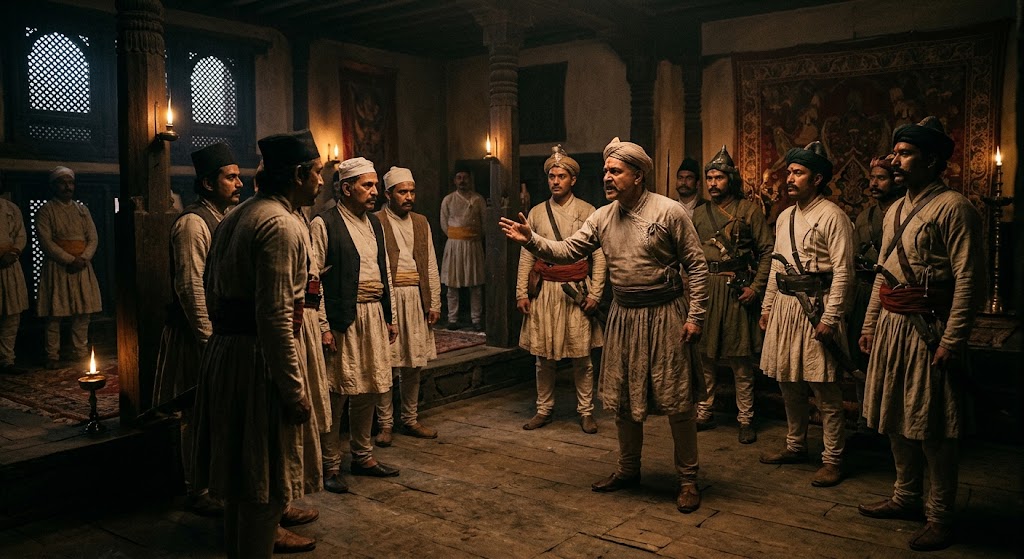
On the night of Vaishakh 15, V.S. 1863, an emergency Kachhari (assembly) of all nobles was summoned in the large meeting room of Bhandarkhal. Prominent nobles, including Kazi Tribhuvan Pradhan, Kazi Kirtiman Singh Basnyat’s brother Upper Chautariya, and Lower Chiruwdar, were present at the assembly.
Looking toward Tribhuvan Pradhan during the meeting, the Maharaj questioned, “Why did you chase me to Kashi, break open the state treasury, and spend the money? Which enemy did you defeat with this money? Which country did you conquer? Why was the state’s wealth spent to banish me toward Kashi?”
Tribhuvan Pradhan replied, “I was not alone; the money from the treasury was withdrawn based on everyone’s advice and decision.”
Enraged by this response, Swami Maharaj looked toward Sher Bahadur Shah (Rana Bahadur’s stepbrother) and signaled him to arrest and punish the other nobles as well.
While the assembly was underway, General Bhimsen Thapa excused himself by saying he was going to have his meal and left the venue. At that very moment, orders were given to arrest both Kazi Tribhuvan Pradhan and Kazi Narasingh and take them away for punishment.
Amidst this, the atmosphere grew extremely tense. The lights in the meeting place suddenly went out, plunging the room into darkness. Seizing this opportunity, Sher Bahadur Shah launched a fatal attack on Swami Maharaj Rana Bahadur Shah. Swami Maharaj fell, grievously injured.
Immediately, Swami Maharaj’s bodyguard, Balnarsingh Kunwar, retaliated with a counter-attack against Sher Bahadur Shah. A fierce conflict broke out in Bhandarkhal. Bam Shah took Sher Bahadur’s associates into custody. Swami Maharaj was immediately brought out to the courtyard, where he breathed his last.