भाइटीका
Kathmandu, November 11:
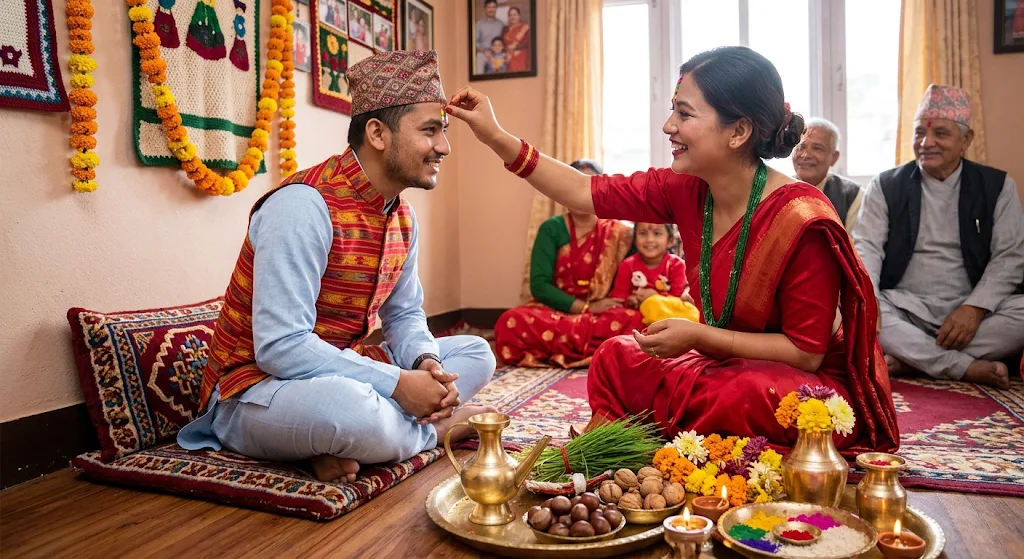
Bhaitika, the final day of Yamapanchak (Tihar), is being observed today as brothers receive the auspicious tika from their sisters.
Celebrated every year on Kartik Shukla Dwitiya, Bhaitika is the main festival of Tihar, the second-greatest festival for Nepalese. On this day, sisters traditionally apply a seven-colored or five-colored tika (Saptarangi or Pancharangi) to their brothers, praying for their long life, good health, and prosperity. This festival is also known as Yamadwitiya.
Following the application of tika by sisters, brothers reciprocate by applying tika to their sisters. According to religious belief, worshiping sisters brings continuous fortune and prosperity.
Although Bhaitika can be observed throughout the day today, the Nepal Calendar Determination (Panchang) Development Committee has stated that 11:07 AM is the most auspicious time (sait) for those seeking a specific moment.
Committee Chairman and Professor Dr. Purushottam Bhattarai informed RSS that there are no restrictions on performing the rituals throughout the day. However, state leaders are required to follow the precise auspicious time, the committee noted.
The committee also stated that this year, sisters applying the tika should face East, while brothers receiving it should face West. This arrangement will place the Moon—currently residing in Scorpio—on the right side. The Moon enters Scorpio this morning; prior to that, it remains in Libra.
Dharmashastra expert Prof. Dr. Ramchandra Gautam noted that the tika can also be applied according to this directional alignment while the Moon is in Libra. Classical traditions dictate that auspicious tasks should be performed with the Moon positioned either directly in front or to the right.
On the day of Bhaitika, sisters worship the oil lamp (diya), water vessel (kalash), and Lord Ganesha established on Laxmi Puja. Afterward, they worship the Ashta Chiranjeevi (eight immortals)—Markandeya, Ashwatthama, Bali, Vyasa, Hanuman, Vibhishana, Kripacharya, and Parashurama—alongside Chitragupta, Yamaraj, Yamuna, Dharmaraj, and various botanical deities inscribed within the Ashtadal on the main ritual plate.
Sisters traditionally enclose their brothers with a stream of oil before applying the Pancharangi or Saptarangi tika, followed by garlanding them with flowers including velvet (makhamali), globe amaranth (sayapatri), and globe amaranth/globe flowers.
While applying a seven-colored tika is widely practiced during Tihar, Dharmashastra expert Gautam mentioned that classical texts prescribe a five-colored tika consisting of red, white, yellow, green, and blue.
Following the rituals, sisters present their brothers with walnuts, chestnuts, spices, and selroti (traditional rice bread). In return, brothers express their respect and gratitude by presenting their sisters with clothing and monetary gifts (dakshina) symbolizing good fortune, according to their means.
Balagopaleshwar Temple Open for Those Without Siblings
For individuals who do not have sisters or brothers, there is a tradition of opening the Balagopaleshwar Temple located in the middle of Ranipokhari in Kathmandu. Opening only once a year on the day of Bhaitika, this temple welcomes those without siblings to offer prayers, pay homage, and receive tika.
Kathmandu Metropolitan City Spokesperson Nabin Manandhar informed RSS that all necessary preparations have been completed to keep the Balagopaleshwar Temple open for devotees starting early Wednesday morning.
Similarly, cultural expert and Guthis Sansthan Chairman Dr. Govinda Tandan noted that devotees without siblings also gather to worship and receive tika at the Khansjनेश्वर Mahadev Temple located in Jayabageshwari.
According to him, prior to 1935 (2035 BS), the Ranipokhari temple used to be closed due to safety issues involving individuals jumping into the pond to access it. During those times, brothers and sisters without siblings would gather at the Khansjनेश्वर Mahadev Temple in Jayabageshwari—a tradition that still draws large crowds of devotees on Bhaitika.
The Balagopaleshwar Temple inside Ranipokhari resumed regular openings after 1935. Following structural damage sustained during the April 25, 2015 (2072 BS) Gorkha earthquake, devotees without siblings visited the Khansjनेश्वर Mahadev Temple until 2020 (2077 BS). Following its reconstruction, the Balagopaleshwar Temple reopened to devotees in 2020.
The Newar community celebrates the day of Bhaitika as Kija Puja. Depending on ancestral traditions, members of the Newar community observe Kija Puja either today or the previous day. Most Newar communities in Bhaktapur observed Kija Puja yesterday, following decisions made by the priests and astrologers of the local Taleju Temple.
— RSS