आजदेखि छठ पर्व सुरु
Mahottari, November 13.
With the conclusion of the Deepawali festival, the Chhath festival has begun today, on Kartik Shukla Chaturthi, bringing a surge of enthusiasm and bustling activity to villages and markets across the Mithila region, including Mahottari. Local residents are actively engaged in preparations for the four-day festival.
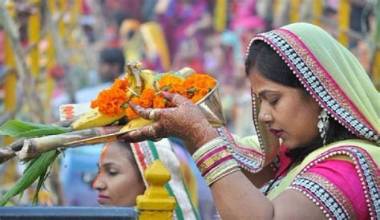
Regarded as a festival of faith, devotion, and purity, preparations for Chhath have filled homes across the Mithila region with traditional Chhath songs. Devotional songs glorifying the Sun God and Goddess Shashti (Chhithi Mata) have immersed the atmosphere of Mithila in a festive spirit.
To prepare for the festival, locals have been busy constructing and cleaning Chhath ghats along riverbanks, ponds, and religiously significant water bodies. Youths, in particular, have shown active participation in constructing and decorating the ghats. Walls of houses built using bamboo splits and twigs are also being plastered and painted for decoration. Electric lights have been installed along streets, houses, and public places. People from all walks of life, rich and poor alike, are preparing to celebrate the festival with reverence and devotion according to their capacity.
The daily lives of locals have centered around the festival as preparations gain momentum. Haridev Mahato, headmaster of Janata Secondary School located at Bardibas-13, Bijalpura, stated that everything from social visits and conversations to household chores has become focused on Chhath.
Markets in the Mithila region are witnessing a heavy rush of people purchasing Chhath worship materials. Sales of necessary items, including banana bunches, have increased. Local farmers are making preparations to bring items used in Chhath worship—such as sugarcane stalks, ginger plants, turmeric bundles, leafy bundles, jammir (local citrus), and items with roots intact—to the market. Shivachandra Chaudhary, president of the Jaleshwar Chamber of Commerce and Industry, stated that the main sales of such items will take place on Saturday.
Similarly, sales of items made from bamboo strips and splits—such as dhaki, daliya, koniyan, nanglo, chalno, and fans, used for holding Chhath worship items and other purposes—have increased in weekly haat markets. The market for earthen pots—such as diyo (oil lamps) for lighting, chhyanchi for setting curd, toula for worship materials, and ankhra and gagri for storing water—has also expanded. The demand for bamboo items and earthen pots has surged due to the tradition of placing worship materials in new vessels during Chhath.
The rush to prepare Chhath prasad at home has also intensified. Homemakers are busy making offerings including thekuva and bhusuva. The tradition of pounding and grinding rice and wheat flour at home using traditional dhiki and janto is still maintained. In this festival, where purity and sanctity are given special importance, prasad is prepared with the help of family members. Mithilani, the women of Mithila, are busy preparing rice and wheat flour for Chhath. Shanti Devi Sah, 55, of Bhangasha-4, Ramnagar, remarked that devotion is the most important aspect of Chhath preparations.
In Mithila, the Chhath festival is observed for four days from Kartik Shukla Chaturthi to Saptami. Beginning with the ‘Nahay-Khay’ ritual on the first day, the festival proceeds with ‘Kharna’ on the second day. On the third day, worshippers offer argha (oblations) to the setting sun, and the festival concludes after offering argha to the rising sun on the morning of the fourth day.
During Chhath, people set aside past grievances, gather in one place, and worship the Sun God. A longstanding tradition at Chhath ghats is for everyone to sit in a single row and celebrate the festival without caste or communal discrimination. Locals believe that participating in festival preparations makes people humble and cooperative through religious faith. There is a enduring belief that this festival, dedicated to the worship of the Sun God and Goddess Shashti, brings well-being and prosperity.