Representative Image AI
Amrit Kharel
Kathmandu, November 3: It is talk of the town these days about whether the Supreme Court has “opened up” marijuana in Nepal. After a recent verdict of the Supreme Court in one case, many people are confused about whether marijuana is now legal.
However, the text of the verdict does not say that.
In the writ case filed by Advocate Saroj Adhikari and others against the Office of the Prime Minister and Council of Ministers and others (079-WO-0994), a joint bench of Justices Dr. Nahakul Subedi and Til Prasad Shrestha made a narrower ruling.
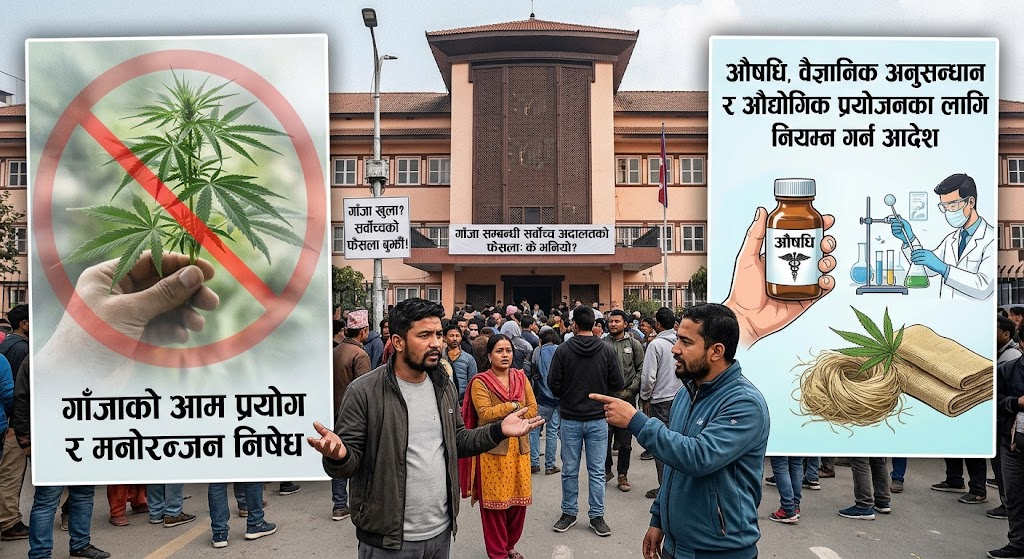
It directs the government to regulate cannabis for medicinal, scientific and industrial purposes. It rejects the demand for general decriminalisation and for recreational use.
What the Court refused
The petitioners asked the Court to lift the prohibition under the Drugs (Control) Act, 2033 and to settle what criminalisation and decriminalisation mean.
The bench held that deciding what is an offence belongs to the legislature. Where the legislature has made cultivation, production, sale, distribution and consumption of cannabis offences, the Court said, declaring them non-offences is outside its jurisdiction. It added that doing so would breach the separation of powers under the Constitution. This part of the petition was dismissed.
On recreational use, the Court noted that cannabis is still listed as a restricted drug under the international drug control regime. It also pointed to health problems for individuals, the economic and social costs, and the erosion of cultural and moral values.
It held that the state should decide this policy after consulting experts and stakeholders, and found it inappropriate to issue the order sought. In its closing paragraphs it said the Act nowhere expressly grants a right to recreational use. The Court only drew the government’s attention to the need for broad consultation and possible legal reform.
What the Court ordered
The Court found that the Act already allows cultivation and preparation of cannabis under state permits and conditions for medicinal, scientific research and industrial purposes.
It said the 1961 Single Convention on Narcotic Drugs does not bar Nepal from drawing maximum benefit from plants growing naturally in its soil and climate. But Section 4 of the Act says the government “may” make rules, and in more than five decades none have been framed.
The Court held that this left the provision meaningless and that the government cannot ignore its duty to make rules. Citing earlier precedents, it read “may” as obliging the government to act.
It therefore issued a mandamus directing the respondents, within three months of receiving the order, to:
- frame the necessary rules, criteria and procedures for controlled cultivation and production of cannabis, consistent with the 1961 Convention, including Articles 23 and 28;
- provide permits for cultivation, production, storage, use, research, distribution, sale and export for medicinal, scientific, agricultural and industrial purposes; and
- create a strict regulation and monitoring mechanism so that illegal cultivation, production, preparation, sale and distribution remain prohibited.
What the Court did not say
It did not legalise cannabis, strike down the 2033 Act, or permit public use, possession or carrying.
It also did not allow anyone to start farming now, since permits and rules are still to come. Until the rules are made, existing prohibitions stand.
Read the full text of the judgement here: