
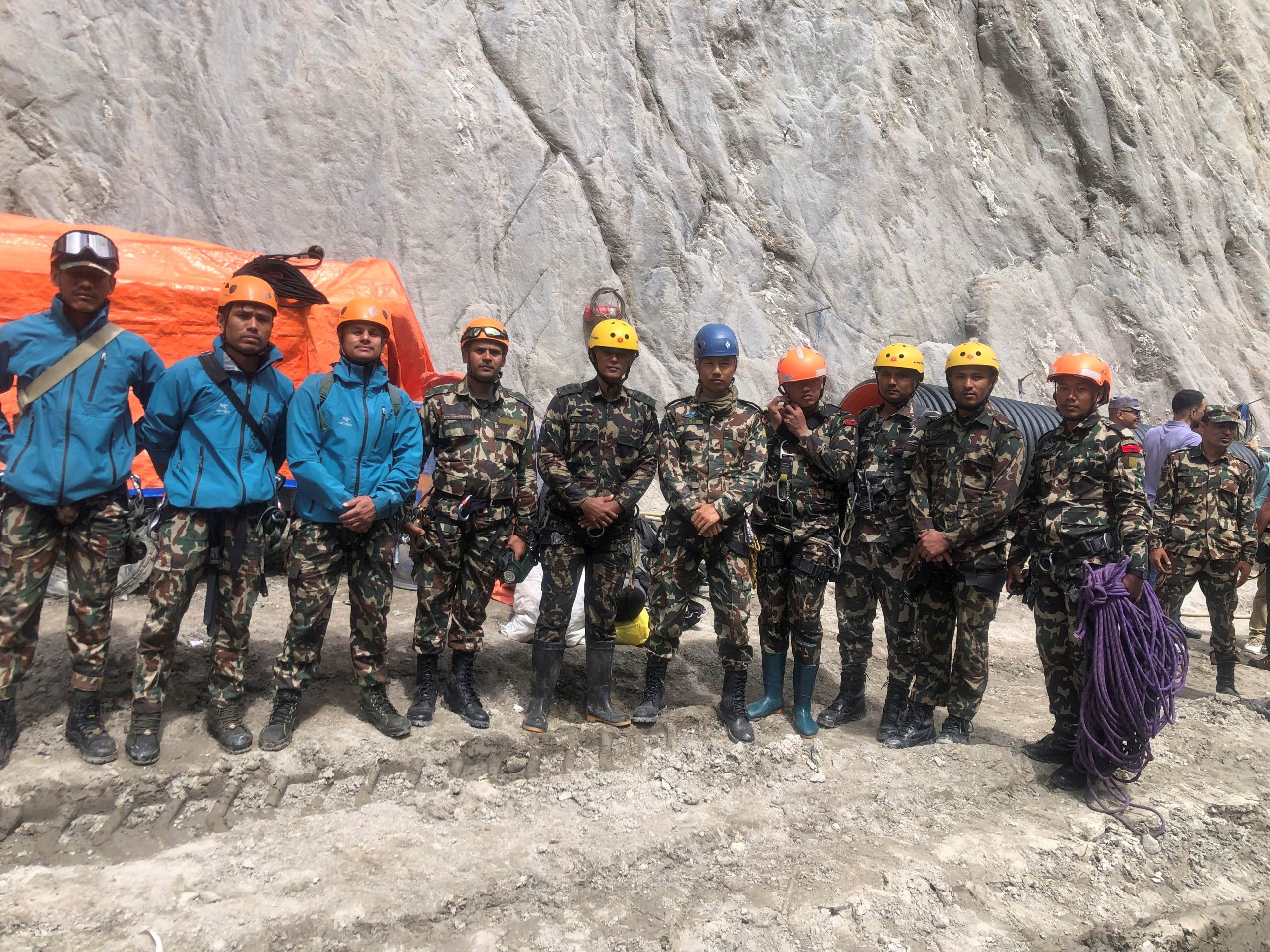
‘बाँचे देशकै सेवा गर्छु, मरे देशकै लागि मर्छु ।’
Kathmandu, October 2
“If I live, I will serve the country; if I die, I will die for the country.”
Abhishek Shahi had not forgotten this solemn oath taken upon joining the Nepal Army, even when he had to plunge into the torrents of the Bhote Koshi flood in Rasuwa to engage in search and rescue operations.
On August 26 (Bhadra 10), a devastating flood wrought havoc along the Bhote Koshi and subsequently the Trishuli River. Since that day, personnel from the Nepal Army, Nepal Police, Armed Police Force, and other rescue teams have been continuously deployed in the flood-affected areas. More than a month has passed. The hope of finding survivors—who were swept away by the raging waters, trapped inside hydropower tunnels, or lost among cliffs while fleeing for safety—has almost faded.
Even if living souls are no longer found, Abhishek remains active among the Nepal Army personnel searching to retrieve bodies. Remembering the horrific moment when the overflowing river breached settlements and turned beautiful villages into barren riverbeds within minutes still weighs heavily on his heart. More than that, the loss of numerous lives breaks the hearts of everyone. The beauty of the settlements may return, but those lost lives will never come back.
On the day of the Bhote Koshi flood, the area was submerged under water, mud, and debris. Desperate pleas like “My relative is missing, please search for them quickly” created immense pressure. Cries of grief echoed everywhere, while the ongoing risk remained high. Predicting the scale of subsequent hazards was difficult, yet Abhishek and his team did not hesitate. Rather than worrying about their own safety, they were preoccupied with how to save the lives of others.
“We did not have the luxury to sit back and worry about our own lives. Every second was critical. A matter of seconds could save someone’s life, while a delay of a few seconds could cost one. Our only concern was how to save others,” Abhishek recalls. Driven by this courage, his team immediately deployed to the affected area for search and rescue. The river level was rising, and thick mud and debris made movement extremely difficult, often trapping their feet.
The Flood Forecasting Division under the Department of Hydrology and Meteorology issued warnings that another lake had formed at the source of the flood and could burst at any moment. Abhishek and his team were aware of the alerts, but their oath to serve the nation at any cost did not allow them to pull back. “We didn’t know when another flash flood might hit, but we felt no fear. A mindset prepared for death gives courage,” says Abhishek. “When mobile networks failed in the area, we received risk updates via handheld radio sets.”
Even as safety warnings urged people to move to safer ground, Abhishek and his team had to head directly toward the dangerous zones. Risking his own life, his objective was clear: reach anywhere there was a chance of finding life. Remembering the first day remains painful. “We had to act quickly to check if people were trapped in the hydropower projects, but the mud inside the tunnels was so thick we could barely move. The water level inside had not dropped, and debris obscured the path,” he explains. “We had to gauge the risk first. It took three days of pumping out water and clearing debris before we could enter certain sections.”
Inside the tunnels, walkie-talkies served as their most reliable link to monitor risks and coordinate efforts. Abhishek was not alone in demonstrating this courage; every member of the rescue team prioritized the lives of others above their own. For another soldier, Deepak Rai, searching in the aftermath of the flood was equally challenging. Hunger, thirst, fatigue, and fear were luxuries the team could not afford. Navigating pitch-black tunnels filled with debris using only flashlights to search for survivors and retrieve bodies tested their limits.
Some bodies had already decomposed severely. Deepak shares that grabbing a limb would sometimes cause it to detach. The stench of decomposition caused nausea and vomiting, making it impossible to eat or drink inside the tunnels. Despite these harsh conditions, the team faced criticism from distraught relatives accusing them of delays. The team viewed these reactions with empathy, understanding that families clinging to hope were naturally emotional.
Courage Forged by Training and Practice
Deepak attributes their courage to formal disaster response training and drills. “Training and drills prepare you to handle duties under extreme conditions. Having undergone disaster management training made it manageable,” he says. “The training provided skills, and adequate equipment supported us.” Above all, a strong sense of duty provided motivation. “Motivation drives us,” Deepak adds. “At that moment, the only thought in our minds was that any delay on our part could cost a survivor their life.”
Inspired by this sense of duty, the team persevered through floodwaters, mud, and debris. Pramod KC shared a similar resolve to face any situation. “The first four days after the flood were the most challenging. In some tunnel sections, mud was settled up to seven feet deep. Roads and bridges were swept away. We had to search for missing persons and rescue the injured while navigating terrain that was difficult even on foot. Despite the risks to our own safety, protecting those in danger was our duty,” he says.
For soldiers deployed in various national disasters, such risks were not new. Family members often expressed concern for their safety, but rescuing missing persons and bringing closure to families was considered the ultimate success. Members of the rescue team including Sujit Joshi, Gyanendra Dangi, Mahesh Karki, Surendra Kumar Rokaya, Indra Bahadur Gurung, Dinesh Tamang, and Narayan Sharma continue their efforts, keeping their enlistment oath at heart.
Searching for Life Inside the Tunnels
Following the Bhote Koshi flood, search operations inside the tunnels of various hydropower projects commenced. Entering these tunnels presented severe hazards for the rescue teams. Brigadier General Subash Jung Thapa of the Nepal Army highlighted the team’s bravery. “Some rescue members suffered from fever, skin irritation, and vomiting. Despite these health issues and risks, they remained dedicated to search and rescue,” he stated. “Protecting others at personal risk is our responsibility.”
On August 26 (Bhadra 10), the day of the flood, the Nepal Army conducted aerial reconnaissance of the Langtang Hydropower Project via helicopter. Search and rescue inside the project’s tunnel began on August 29 (Bhadra 13) in coordination with an Indian expert team, according to Thapa. Aerial reconnaissance of the Chilime Hydropower Project was also conducted on August 26, with search operations starting on August 30 (Bhadra 14) alongside Indian experts.
“Aerial reconnaissance for the Upper Trishuli-1 Hydropower Project was similarly carried out on August 26. Operations with a Chinese expert team began on August 30. After 11 days of continuous effort, a Chinese national was rescued alive,” said Brigadier General Thapa. “At the Trishuli-3 ‘A’ Hydropower Project, two employees were rescued alive on the 10th day. Successfully bringing them out after prolonged efforts brought immense joy to the rescue team.”
According to Thapa, the Nepal Army continued search and rescue efforts via foot patrols across affected areas in Rasuwa and Nuwakot, establishing bases in areas across the Trishuli River such as Colony, Tupche, Dansing, Samari Bhanjyang, Kalikasthan, and Manche. Where road connections were severed, drones were deployed to deliver essential food and relief supplies to remote settlements.
The Nepal Army reported that 4,242 individuals—including 3,959 Nepali citizens and 283 foreign nationals—have been rescued via army aviation assets across various affected regions. With the impact of the Bhote Koshi flood extending from Rasuwa through Nuwakot, Dhading, Chitwan, to Nawalparasi East and West, more than 8,200 Nepal Army personnel have been directly deployed on the ground.