लुम्बिनी
RUPANDEHI, Nov 5 :
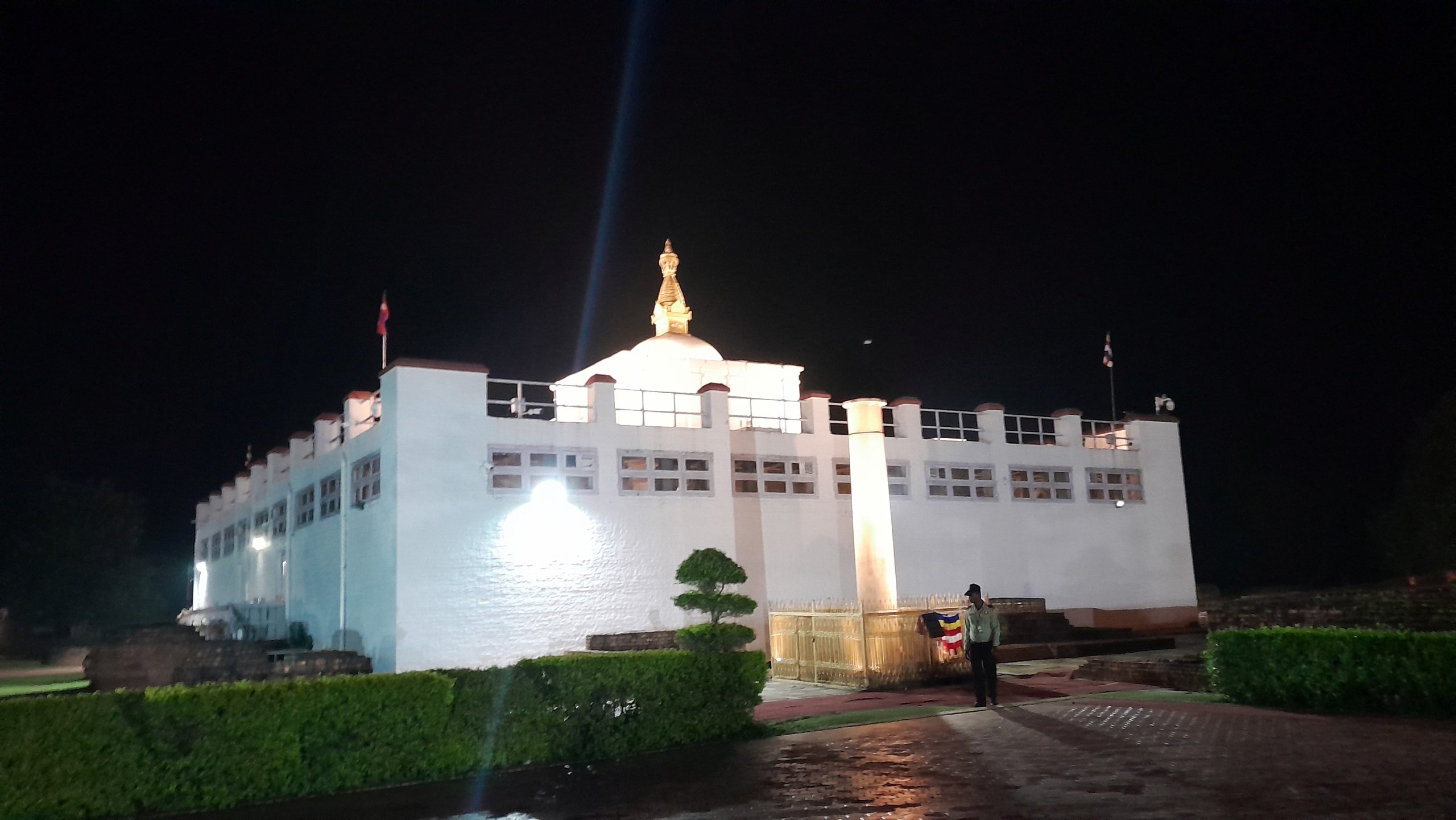
With the assumption of office by new leadership at the Lumbini Development Trust, a debate has begun regarding the future direction of development at the birthplace of Lord Buddha.
Following the appointment of Ani Choying Dolma as the Vice-Chairperson and Engineer Santosh Pandey as the Member Secretary of the Lumbini Development Trust, new responsibilities and expectations have been added to the institution.
The new leadership faces the challenges of completing the decades-old unfinished master plan, advancing stalled projects, and preserving archaeological heritage. However, the pressing need of the hour is to move beyond limiting Lumbini’s development merely to physical infrastructure and instead connect it with Buddha’s teachings, philosophy, and message of peace.
Nearly 48 years have passed since the implementation of the Lumbini Master Plan, designed by Japanese architect Kenzo Tange in 1978, yet it remains uncompleted. The development work, which was originally targeted for completion within 17 years, has lingered unfinished for a long time.
Although various physical structures have been built in Lumbini in the meantime, efforts to develop Lumbini as a spiritual, peaceful, and blissful destination in accordance with the core spirit of the master plan have failed to gain the expected momentum. Stakeholders hold the view that the prevailing tendency to prioritize only the construction of buildings, roads, parks, convention centers, and other physical infrastructure must change. Experts emphasize the need to end the current trend where tourists visit for a short while, take pictures, and return, and instead create an environment where they can stay for a few days, understand Buddhist philosophy, meditate, and experience spiritual bliss.
Suraj Ghimire, a lecturer at Lumbini Buddhist University, notes that since Lumbini is an important spiritual center that has drawn the world’s attention, the new leadership must understand its uniqueness and work accordingly. He states that Lumbini should not be restricted merely to physical infrastructure development; rather, the teachings of Buddha—peace, compassion, loving-kindness, and messages of human welfare—must form the foundation of its development. Ghimire asserts that because Lumbini is a globally significant spiritual area, it continues to attract people worldwide with its message of peace. He suggests that Lumbini should be developed not only as a pilgrimage site for Buddhists, but as an international destination where people from all over the globe can attain peace, meditation, and spiritual joy.
Umesh Chandra Rijal, a sociologist and associate professor at Tribhuvan University, mentions that Lumbini should be developed as an important national identity and “brand” on the international stage. According to him, Lumbini should be nurtured as a shared sanctuary where people worldwide can experience peace and spiritual awakening. Noting that Lumbini’s significance goes beyond religious faith, Rijal opines that its global identity, spiritual importance, and cultural heritage must be promoted in an integrated manner. He emphasizes that the development of Lumbini is a shared responsibility of the government, the development trust, local communities, universities, religious institutions, and the international community.
Another vital aspect of Lumbini is the preservation of its archaeological heritage. Shashi Panthi, a student of archaeology, points out that Lumbini is recognized not only as a religious and spiritual site, but also as one of the world’s most significant archaeological areas. Therefore, she believes that priority must be given to preserving archaeological significance, historical evidence, and original structures during its development.
The development of Lumbini should not be confined solely to completing the unfinished tasks of the master plan. Stakeholders have also highlighted the need to review the master plan by taking into account changes in time, technology, the nature of tourism, and global requirements. There is a strong emphasis on formulating a new concept for the holistic development of Lumbini that suits contemporary times while safeguarding the core spirit and historical significance of the original master plan.
Connecting Lumbini’s development with Buddha-era civilization is equally crucial. Areas such as the ancient Rohini civilization, the Rohini River, Shakya-Koliya relations, Devdaha, Tilaurakot, Kudan, Niglihawa, Sagarhawa, Gotihawa, and the Ramgram Stupa can be developed as an integrated Buddhist cultural and archaeological tourism circuit. In particular, it is essential to highlight, preserve, and promote the historical importance of the Buddha-era civilization linked to the Rohini River.
The significance of this region can be further expanded if Buddha’s lifetime messages of peace, coexistence, compassion, and dialogue are integrated into Lumbini’s tourism. Programs that connect visitors with meditation, Vipassana, Buddhist studies, cultural interactions, peace walks, and the local lifestyle can help extend the duration of tourists’ stays in Lumbini. This can also enhance the economic and social participation of the local community.
The responsibility of the Lumbini Development Trust extends far beyond building physical infrastructure. The trust’s mandate includes the conservation and development of Buddhist heritage sites such as the birthplace of Lord Buddha in Lumbini, alongside Tilaurakot, Kudan, Niglihawa, Sagarhawa, and Gotihawa in Kapilvastu, Devdaha in Rupandehi, and the Ramgram Stupa in West Nawalparasi. If these sites are connected and developed through their shared historical relationship within a single Buddhist cultural civilization, tourists visiting Lumbini can be encouraged to stay in the region for a longer period.
Questions have also been raised regarding the quality and utility of some structures built during the implementation of the master plan. Public reports revealed that despite massive expenditures on the international conference and meditation center, leakage issues appeared even before the handover. Furthermore, controversies concerning land use and conservation in the heritage zones have cast doubt on the trust’s administrative approach.
The financial condition of the trust also presents a challenge for the new leadership. According to public disclosures, the trust generates an annual revenue of approximately NPR 170 to 180 million, but staff salaries alone consume about NPR 120 to 130 million. When other administrative and operational costs are added, the revenue is routinely insufficient to cover regular expenses, as stated by the Lumbini Development Trust. Under such circumstances, securing long-term financial resources is essential for running major development projects.
Engineer Pandey, a resident of Tilaurakot, Rupendehi, brings valuable experience in structural engineering and urban infrastructure development to the trust. He has previously worked as a structural engineer for Kathmandu Metropolitan City, Butwal Sub-Metropolitan City, and Tilaurakot Municipality. Experts believe that successful leadership in the Lumbini Development Trust requires a holistic understanding of its religious, cultural, spiritual, and international significance alongside technical expertise.
The core question now facing the new leadership is whether to transform Lumbini into a tourist destination packed with concrete structures, or to develop it as a global spiritual center where visitors can truly experience Buddha’s teachings and peace. Completing the remaining tasks of the master plan, scientifically preserving archaeological heritage, promoting Buddha-era sites including the Rohini civilization, and making the local community a partner in development must be the top priorities of the new leadership.
Since Lumbini is the birthplace of Lord Buddha, its significance is not confined to any single religion or community. It is a universal land carrying a message of humanity, peace, compassion, and coexistence. Therefore, an environment must be created where every visitor leaving Lumbini takes away peace, joy, and positive energy. Fulfilling the responsibilities of the new leadership will only be meaningful if they successfully execute the long-term vision of completing the unfinished master plan while establishing Lumbini as a global center of peace and spiritual bliss.
RSS